




US-Iran clashes escalate as tankers and warships come under fire; Tehran captures advanced American underwater drone
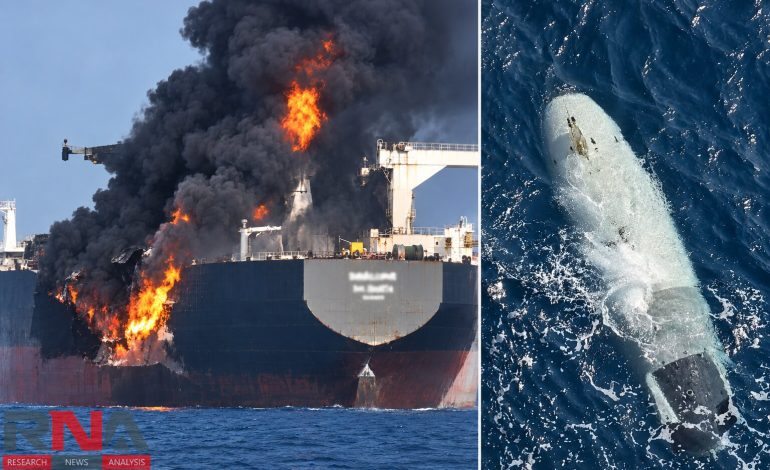
This digitally enhanced combination photo shows an Iranian oil tanker on fire after being hit by US forces (L) and a US underwater drone captured by Iran.

New Delhi: The United States and Iran have exchanged a fresh round of attacks across the Gulf and Jordan, striking oil tankers, threatening warships and targeting a military base as a monthlong period of relative calm rapidly unravelled. In a separate but closely related development, Iran said it had captured an advanced American autonomous underwater drone near the entrance to the strategically vital Strait of Hormuz.
US Central Command (Centcom) said its forces destroyed five Iranian crude-oil tankers on Tuesday, after Iran’s Islamic Revolutionary Guard Corps (IRGC) twice attempted to strike a US Navy warship with ballistic missiles over the preceding two days. The American vessel evaded both attacks and continued its patrol without suffering damage or casualties, according to the command.
Centcom identified four of the tankers – Kivik, Charminar, Horizon 1 and Riesco – as having been struck in the Gulf of Oman, while the fifth vessel, Derya, was attacked near Kharg Island, the principal hub for Iranian oil exports. It said the crews had been instructed to abandon their ships before the attacks, and Iranian state television also reported that the personnel had been evacuated.
Washington described the vessels as part of a shadow fleet that generated revenue for the IRGC and Iran-aligned armed groups across the region. The action extended a campaign against Tehran’s energy lifeline after US forces struck three other Iranian tankers on September 5 following reported ballistic-missile attacks against an American aircraft carrier and destroyer.
The US secretary of state, Marco Rubio, said Washington would not allow attempted attacks against its naval vessels to go unanswered. He warned that Iran would lose more tankers each time it tried to target an American warship, signalling that the US response was intended both as military retaliation and economic punishment.
Iran retaliated by firing ballistic missiles towards a military base near Al Azraq in Jordan that is used by American forces. Tehran claimed that the attack caused extensive damage, but Jordan said its air defences intercepted 18 of the 20 incoming missiles and that the remaining two fell in unpopulated areas without causing casualties.
A US official said the Iranian strike had been ineffective and that all American personnel at the base were accounted for. Jordan, a close US security partner that hosts American troops, has faced several Iranian attacks during the conflict, including a July strike that killed at least two US military personnel.
The IRGC subsequently claimed that it had attacked 10 vessels – two American ships and eight oil tankers – attempting to cross what Tehran described as a prohibited and unsafe section of the Strait of Hormuz. There was no immediate independent confirmation that the ships had been hit or that any casualties or serious damage had resulted.
Iran also warned crews aboard tankers near ports in Kuwait and Bahrain to leave their vessels, accusing both Gulf states of facilitating American military operations. A maritime security source separately reported damage to a liquefied-natural-gas tanker at the Emirati port of Khor Fakkan, although responsibility for that incident remained unclear.
The confrontation widened further when Yemen’s Iran-aligned Houthi movement launched missiles and drones against southern Saudi Arabia, targeting an airbase at Khamis Mushait and oil-related facilities in Abha, Najran and Jazan. Saudi authorities said 73 people, including women and children, were injured and fires broke out at several locations.
The renewed hostilities have intensified pressure on energy markets, with Brent crude approaching $100 a barrel as traders assessed the threat to Gulf exports. Roughly one-fifth of the world’s oil shipments passed through the Strait of Hormuz before the war began on February 28, making any prolonged disruption there a concern far beyond the immediate conflict.
Washington is attempting to restrict Iranian oil exports through its blockade of Iranian ports, while escorting a limited number of ships through a route off Oman. Tehran, for its part, is seeking to enforce its own navigation arrangements in the strait, turning the narrow waterway into the principal arena of an economic and military contest between the two countries.
Iran releases images captured US underwater drone
Against this backdrop, the IRGC Navy announced on Tuesday that it had recovered an American uncrewed underwater vehicle near the entrance to the Strait of Hormuz and subsequently released a footage. Iranian state media identified the vessel as a Dive-LD, a large autonomous underwater drone manufactured by the California-based defence technology company Anduril.
The IRGC described the recovery as a complex intelligence and naval operation and released images showing the submersible being lifted from the water. The precise circumstances remain disputed, however, and there has been no independent verification that Iranian forces actively intercepted the drone rather than recovering it after a technical failure.
The Pentagon acknowledged that an American underwater drone had malfunctioned more than a day earlier while surveying regional waters in support of continuing operations. A spokesperson described it as an older model that was not collecting sensitive information and carried no classified sonar or radar systems.
Anduril confirmed the loss of a Dive-LD but said the platform was designed to undertake high-risk missions in contested waters where losing an individual vehicle was considered an operational possibility. The company said the drone had already accumulated thousands of hours of work during extended operations within Centcom’s area of responsibility.
Measuring about 5.8 metres in length and 1.2 metres in diameter, the nearly three-tonne Dive-LD can reportedly descend to a depth of 6,000 metres and remain at sea for up to 10 days. Its modular payload section allows it to perform seabed mapping, intelligence, surveillance and reconnaissance, mine-countermeasure operations and inspections of underwater infrastructure, including cables and pipelines.
Such vehicles can search for naval mines and survey dangerous stretches of water without exposing divers, crewed ships or submarines to direct risk. That capability is especially relevant in and around the Strait of Hormuz, where mines, missiles, drones and small attack craft have complicated American efforts to protect commercial navigation.
Iran’s possession of an intact Dive-LD could allow its specialists to examine the vehicle’s construction, propulsion, navigation architecture and available sensors, even if the Pentagon’s assertion that it carried no classified equipment is correct. The episode is therefore both a propaganda success for Tehran and a reminder that autonomous systems designed to reduce risks to personnel may still expose hardware to capture in heavily contested waters.
The tanker attacks, Iranian missile launches and loss of the underwater drone underline how the struggle over Hormuz is evolving across several domains at once – surface warfare, ballistic missiles, energy infrastructure and autonomous undersea operations. With both sides using military force to reinforce competing economic blockades, each retaliatory move is increasing the danger of a broader regional escalation.

1 Comment
[…] Trending September 9, 2026 […]