




Oil nears $100 a barrel as US-Iran strikes and Houthi attacks compound global supply fears
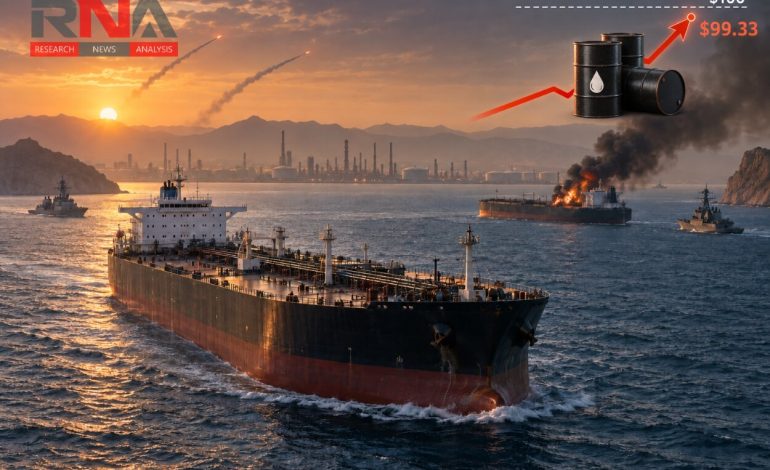
RNA Media illustration for representation.

New Delhi: Global oil prices rose for a fourth consecutive session on Wednesday taking Brent crude close to the psychologically important $100-a-barrel threshold as renewed attacks across the Middle East revived fears of prolonged supply disruption. The latest escalation included Iranian missile strikes against a base used by US forces in Jordan, American attacks on Iranian tankers and Houthi strikes on Saudi Arabian cities and energy installations.
Brent crude futures climbed 1.4 per cent to $99.33 a barrel by 7.42am IST, while US West Texas Intermediate crude advanced by the same margin to $94.34. The international benchmark has gained about 25 per cent since early August as hopes of a durable settlement to the six-month US-Iran war have receded.
The immediate trigger for the latest price increase was an intensification of the military confrontation between Washington and Tehran after nearly a month of relative calm. The US military said it destroyed five Iranian crude carriers on September 8 after Iran’s Islamic Revolutionary Guard Corps twice attempted to hit a US Navy warship with ballistic missiles.
US Central Command identified the tankers as Kivik, Charminar, Horizon 1, Riesco and Derya, saying their crews were warned to abandon the vessels before they were struck. Washington described the ships as part of a network used to finance the Revolutionary Guards and Iran-backed armed groups, although Tehran condemned the attacks as another assault on its commercial and strategic assets.
Iran responded by firing 20 ballistic missiles towards a military installation near Al Azraq in Jordan that is used by US forces. Jordan said its air defences intercepted 18 missiles and the remaining two landed in unpopulated areas, causing no casualties, while a US official described the attack as ineffective.
The Revolutionary Guards separately claimed to have attacked 10 vessels – two American ships and eight oil tankers – attempting to enter what Tehran calls a prohibited and unsafe area of the Strait of Hormuz. The claims could not immediately be independently verified, but the threat to commercial shipping reinforced concerns over the security of one of the world’s most important energy corridors.
The situation was further aggravated by attacks from Yemen’s Iran-aligned Houthis on several Saudi cities, which injured 73 people and started fires at oil facilities. The group said drones and missiles were used against a Saudi airbase at Khamis Mushait and Saudi Aramco assets in Abha, Najran and Jazan.
The attacks have placed Saudi Arabia’s attempts to maintain exports under greater strain at a time when tanker movement through the Strait of Hormuz is already heavily restricted. Riyadh has redirected some crude through pipelines to Red Sea terminals and other alternative routes, but Houthi pressure on western Saudi Arabia could weaken this important bypass.
Middle Eastern crude shipments have fallen from approximately 18 million barrels per day before the conflict to about 11 million barrels per day, according to commodity-pricing agency Argus. Shipments through Hormuz briefly recovered during the interim US-Iran arrangement in July but declined again after fighting resumed, with no very large crude carrier seen leaving the strait after September 2 in vessel-tracking data cited by Reuters.
Oil has so far remained close to, rather than decisively above, $100 because Gulf producers are using pipelines, alternative ports and ship-to-ship transfers to keep some supplies moving. Higher output from non-Opec producers, including the US, Canada and Guyana, along with subdued Chinese demand, has also partially cushioned the loss of Middle Eastern barrels.
However, the physical market is considerably tighter than headline futures prices suggest, with some Gulf crude grades and diesel already trading at steep premiums. Goldman Sachs has warned that Brent could climb as high as $120 a barrel if attacks on commercial shipping become more frequent, while Morgan Stanley expects the benchmark to average $100 during the fourth quarter.
The rise carries particular consequences for India, which imports almost nine-tenths of the crude oil it consumes and remains highly sensitive to price movements and disruption along Gulf shipping routes. Sustained crude prices near or above $100 could increase the country’s import bill, put pressure on the rupee and raise costs across transport, aviation, manufacturing and other fuel-intensive sectors.
For the wider market, the principal risk is no longer confined to the loss of Iranian exports but extends to Saudi infrastructure, commercial tankers and two critical maritime corridors – Hormuz and the Red Sea. Unless military activity subsides or credible negotiations resume, traders are likely to retain a substantial geopolitical premium in oil prices.