India, Japan reaffirm defence cooperation for a free and open Indo-Pacific
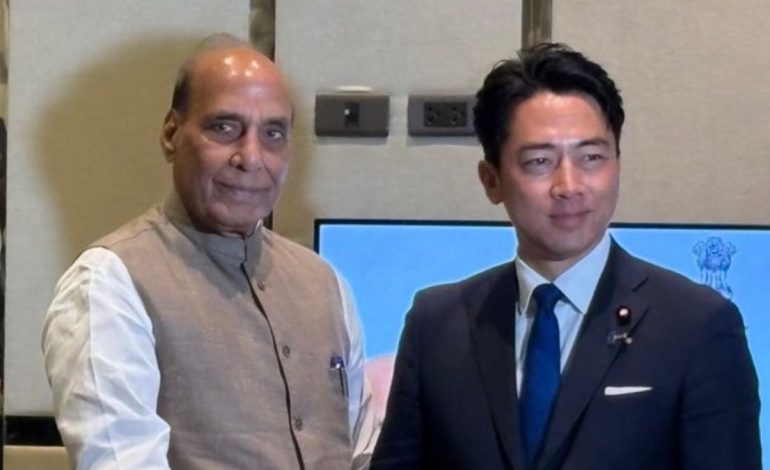
Rajnath Singh meets his Japanese counterpart Shinjiro Koizumi on the sidelines of ADMM-Plus 2026 in Cebu, Philippines. (Image courtesy: X/@rajnathsingh)

New Delhi: The defence minister, Rajnath Singh, and his Japanese counterpart, Shinjiro Koizumi, reviewed bilateral defence cooperation during talks in Cebu, Philippines, on Wednesday, reaffirming their commitment to a free, open and peaceful Indo-Pacific. The meeting, held on the sidelines of the 13th Asean Defence Ministers’ Meeting-Plus (ADMM-Plus), focused on strengthening their existing strategic partnership and exploring new areas of cooperation.
Following the meeting, Singh described his discussions with Koizumi as productive and reaffirmed the importance of bilateral defence cooperation in maintaining regional peace and stability.
“Happy to meet with the minister of defense of Japan, Mr. Koizumi Shinjiro, on the sidelines of the 13th ADMM-Plus in Cebu, Philippines. Had productive discussions on reviewing our ongoing bilateral defense cooperation and exploring new avenues to further strengthen the India-Japan Special Strategic and Global Partnership. Our shared commitment remains vital for a free, open, and peaceful Indo-Pacific region.” he said on X.
According to ANI, Singh welcomed Koizumi in Japanese and expressed satisfaction with progress since their previous meeting in New Delhi in August. Koizumi reaffirmed Japan’s commitment to expanding cooperation and expressed his intention to translate discussions into concrete outcomes.
No new defence agreement or procurement arrangement was announced following Wednesday’s meeting.
Maritime security and defence technology cooperation
The talks follow an agreement signed on 20 August to strengthen maritime security cooperation between the Indian Navy and Japan Maritime Self-Defense Force.
The arrangement covers maritime information-sharing, search-and-rescue operations and humanitarian assistance during disasters, providing a framework for closer operational coordination.
Both countries conduct regular military exercises, including the naval exercise Jaimex and army exercise Dharma Guardian.
Their August joint statement also outlined plans to expand cooperation in ship repairs, mine countermeasures, defence technology and potential joint naval shipbuilding under India’s Make in India initiative.
Another significant project involves Japan’s shipborne Unicorn integrated communications antenna system, which the two governments have identified as an important step in bilateral defence equipment cooperation.
The ministers also agreed in August to establish a senior-level working group covering operational cooperation, intelligence, technology and defence industry engagement.
India expands defence diplomacy through ADMM-Plus
The two-day ADMM-Plus meeting, hosted by the Philippines, brings together Asean’s 11 member states and eight dialogue partners, including India, Japan, the United States, China, Russia, Australia, South Korea and New Zealand. The forum provides a platform for defence consultations and practical cooperation on regional security challenges.
India currently co-chairs the ADMM-Plus experts’ working group on counterterrorism with Malaysia for the 2024–2027 cycle, reflecting its engagement with Southeast Asia under the Act East Policy.
In September, Indian naval ships INS Sahyadri and INS Kulish participated in an ADMM-Plus maritime security activity at Subic Bay, hosted by the Philippine Navy and co-chaired by Japan.
Earlier, as RNA Media reported, Singh met US secretary of war, Pete Hegseth, in Cebu to review the 10-year India-US defence framework, focusing on military technology, information-sharing and co-production.
He also held separate discussions with Australian deputy prime minister, and defence minister, Richard Marles, on defence cooperation and regional security. Singh is scheduled to address ADMM-Plus on Thursday, focusing on regional and international security challenges.
For India and Japan, the immediate priority remains translating existing commitments into practical maritime, technological and industrial cooperation. Both countries are also working towards their fourth foreign and defence ministers’ 2+2 Dialogue in Tokyo later this year, although a date has not been announced.