

Exercise Austrahind – 2026: Canberra’s envoy commends India-Australia joint army drills in Keralam
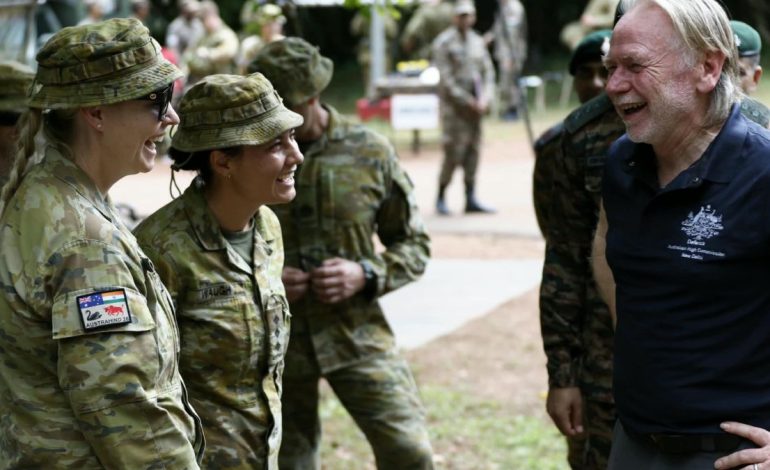
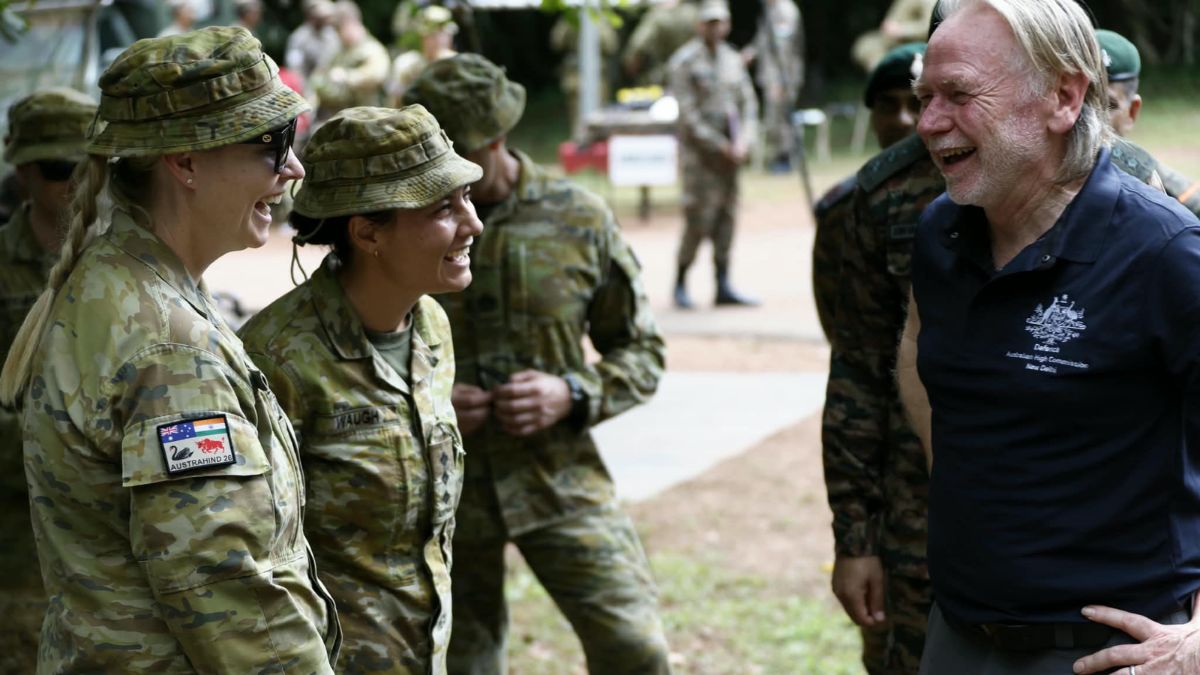
Australian high commissioner,Philip Green, praises Exercise Austrahind 2026 in Kerala.(Image courtesy: X/@AusHCIndia)

New Delhi: Australian high commissioner, Philip Green, has praised Exercise Austrahind – 2026 in Kerala for strengthening cooperation between the Indian and Australian armies. His visit comes as the two forces train to operate together in coastal and island terrain under an expanding bilateral defence partnership.
Green met Australian soldiers at the exercise in Thiruvananthapuram and described ties between the two armies as increasingly consequential. In an X post on Saturday, he said the links mattered more as the strategic partnership deepened, ending with the message: “Train to fight – train to win.”
According to a defence public relations statement, cited by ANI on Wednesday, Green highlighted India’s growing importance as a security partner and the strategic significance of the eastern Indian Ocean in connecting the two countries. He emphasized closer defence cooperation to address emerging multi-domain security challenges and commended Austrahind for strengthening strategic trust, operational interoperability and military-to-military engagement.
Coastal training with an operational purpose
The fifth edition began at the foreign training node in Thiruvananthapuram on 19 October and is scheduled to end on 1 November. Around 120 personnel from each army are participating, with the Indian contingent drawn from the Garhwal Rifles and other arms and services, and Australia’s from 13 Brigade.
The defence ministry describes the theme as “Joint Sub-Conventional Operations in Island and Coastal Environment under Chapter VII of the UN Mandate”. It is a training scenario, not a deployment on an active United Nations mission.
The training combines joint operational planning, surveillance and reconnaissance, protection of vital installations and responses to HADR emergencies. Troops are also undertaking combat swimming, static slithering, ambush drills, physical conditioning and drone manoeuvring across jungle, island and coastal terrain.
The participating soldiers are exchanging professional experiences and operational best practices to develop a common understanding of military tactics, techniques and procedures. These activities are designed to improve tactical proficiency, combat readiness and interoperability, enabling both armies to coordinate more effectively during complex operations.
Coastal approaches can involve ports, transport routes and other critical infrastructure. Training for such conditions places a premium on communication between units and rapid responses to changing situations, rather than simply bringing two contingents together for demonstrations.
New Zealand observers and wider partnership
For the first time, New Zealand is attending through an observer delegation, not as a third training contingent. The fourth edition took place at Irwin Barracks in Perth from 13 to 26 October 2025, focusing on different terrain and operational scenarios.
The training follows the July summit between the prime ministers, Narendra Modi, and Anthony Albanese, when India and Australia announced a joint defence and security declaration and maritime security roadmap. Those commitments envisage more complex exercises, information-sharing and closer operational coordination.
As RNA Media reported when Austrahind began, this year’s training prioritizes coordinated action in coastal and island environments, building on the established bilateral military relationship.
The exercise is scheduled to conclude on 1 November. Its immediate objective remains improved joint planning and coordination, with no new operational commitment announced during Green’s visit.