Miniratna HSL chairman proposes ‘digital birth certificate’ for every Indian-built ship
HSL C&MD Rear Admiral C. Raghuram

New Delhi: Every ship built in India should leave the yard with two things: her steel and a “digital birth certificate”, the chairman and managing director of Hindustan Shipyard Limited (HSL), Rear Admiral C Raghuram, VSM (Retd), said on Tuesday.
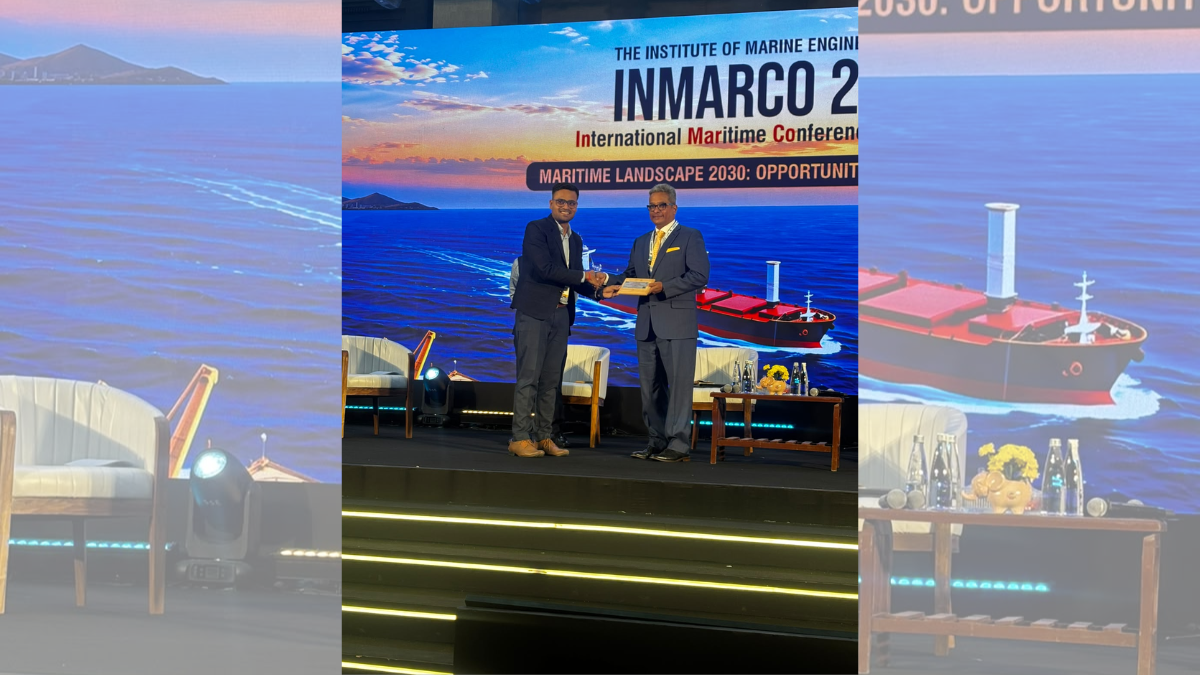
Raghuram made the proposal at INMARCO 2026, organized by the Institute of Marine Engineers (India) at The Westin Mumbai Powai Lake. He was speaking on the panel “Shipyards and Newbuilds: Maritime Landscape 2030”. HSL is a partner of the conference.
“Every ship should leave an Indian yard with two things: her steel, and her digital birth certificate,” he said.
One record for a ship’s life
The certificate, as Raghuram described it, would be a single record that includes the hazardous materials inventory required under the Hong Kong Convention. It would serve the surveyor, owner, repair yard and recycler for 30 years, replacing the need for each party to rely on separate documents.
He proposed that the India Ship Technology Centre help small and medium enterprises, design firms and yards build the shared digital record, and said HSL is ready to take part.
The idea was the third of three shifts Raghuram said Indian shipbuilding must make. The first is moving from building ships to running a production system, and the second is moving from following the rule book to helping write it.
Rules written together
On the second shift, Raghuram said India should have a say in how first-of-kind ships are designed, approved and built. “India should want a seat at that table,” he said. He suggested beginning with green tugs, developed jointly by the port, the yard, the classification society, the Directorate and battery makers.
He also asked for a stronger voice for Indian designers in rule-making, along with clearer delivery timetables shared with yards, and long-term finance and local service support from equipment makers and financiers.
Series production
On the first shift, Raghuram said repeat orders are what separate a prototype from a product. “A first ship is a prototype. The fifth ship is a product,” he said.
The Shipyards Association of India estimates the cost gap between Indian and East Asian yards at about 24%. “Incentives can narrow it. Only series can close it,” Raghuram said.
He welcomed government support for the sector, including a demand outlook of about 437 vessels over 10 years, infrastructure status for Indian-built ships, a ₹69,725 crore package, a ₹25,000 crore Maritime Development Fund, and a target of 4.5 million gross tonnage of annual capacity.
HSL’s recent work
On October 6, HSL launched Surya, the first of five fleet support ships for the Indian Navy, at its Visakhapatnam yard. The 43,500-tonne ship is classed by the Indian Register of Shipping and is targeted to have more than 80% indigenous content. The yard laid the keel of the fifth ship the same day and opened an extended Slipway-4 with a 300-tonne Goliath crane, built for ships of up to 45,000 deadweight tonnes. In August, it delivered INS Nipun, the second indigenous diving support vessel.
The session was moderated by Ankur Anal of the Directorate General of Maritime Administration. Other panellists were from GRSE, Lloyd’s Register, Swan Defence and Heavy Industries, and First Marine International (Royal HaskoningDHV).
HSL is a Miniratna Category-I public sector undertaking under the Ministry of Defence.