



BepiColombo set to enter Mercury orbit after eight-year journey to uncover planet’s mysteries. What we expect to learn?
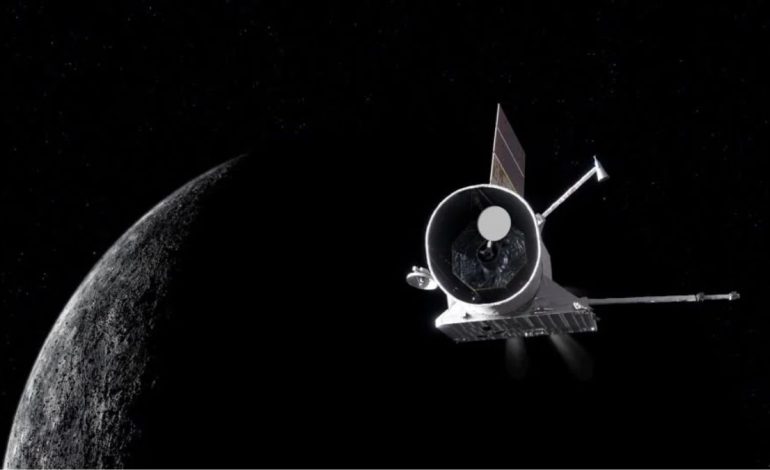
BepiColombo set to enter Mercury orbit. (Image courtesy: X/@esaoperations)

New Delhi: After an eight-year journey spanning nearly 10 billion kilometres, a spacecraft carrying two scientific orbiters is preparing to reach Mercury, the smallest planet in the solar system. The European Space Agency (ESA) and Japan Aerospace Exploration Agency (JAXA) mission, known as BepiColombo, is scheduled to enter orbit around the planet on Saturday, marking a major milestone in one of the most challenging planetary exploration missions ever attempted.
The mission is expected to provide scientists with a closer look at a world that continues to raise fundamental questions about planetary formation and evolution. Mercury is the closest planet to the Sun, where surface temperatures can rise to around 430-degrees celsius during the day before falling to nearly minus 180-degrees celsius at night. It is also exposed to intense solar radiation and a challenging gravitational environment that makes reaching and maintaining orbit around it particularly difficult.
Despite its proximity to the Sun, Mercury holds water ice in permanently shadowed craters near its poles. Its surface is also marked by unusual shallow depressions known as hollows, while its interior contains a disproportionately large metal core. BepiColombo is designed to investigate these features and help scientists understand how the planet formed and evolved.
Professor, Emma Bunce, of the University of Leicester, a principal investigator on the mission, believes Mercury has not received the scientific attention it deserves.
“I think it’s a little bit of an under-loved planet in the inner solar system, but I think that’s one of the reasons why it is so compelling,” Bunce said.
“There are lots of reasons, scientifically, why we really want to understand Mercury, how it formed, how it evolved, what it looks like today, but also how it interacts with the Sun and the extreme space weather that it experiences.”
Why reaching Mercury is so difficult
BepiColombo was launched on October 20, 2018, aboard an Ariane 5 rocket from the European spaceport in French Guiana. The journey was never going to be a straightforward flight towards the Sun.
As a spacecraft moves closer to the Sun, its gravitational pull accelerates it. Reaching Mercury is therefore not simply a matter of travelling towards the planet. A spacecraft must also lose enough speed to be captured by Mercury’s relatively weak gravity instead of flying past it.
To achieve this, BepiColombo followed a carefully calculated route involving nine planetary flybys. It passed Earth once, Venus twice and Mercury six times, using the gravitational influence of these planets to gradually adjust its speed and trajectory.
The spacecraft was initially expected to reach Mercury earlier. However, a problem with its solar-electric propulsion system reduced the power available to its thrusters in 2024. Engineers developed a revised trajectory that allowed the mission to continue, although the arrival schedule had to be extended.
The propulsion system uses solar energy to accelerate electrically charged xenon gas, providing continuous but relatively gentle thrust over long periods. The mission’s transfer module completed its role and separated from the spacecraft stack on September 3, this year. The remaining spacecraft are now approaching Mercury using their own propulsion systems for the final stages of the journey.
The upcoming orbit-insertion manoeuvre is a particularly critical stage. The spacecraft must reduce its speed at precisely the right moment so that Mercury’s gravity can capture it. A failure to execute the manoeuvre correctly could prevent the spacecraft from entering its planned orbit.
A two-spacecraft mission to study one planet
One of BepiColombo’s most distinctive features is that it carries two scientific orbiters designed to study Mercury from different perspectives.
The first is ESA’s Mercury planetary orbiter (MPO), which will focus on the planet’s surface, composition, internal structure and geological history. The second is JAXA’s Mercury magnetospheric orbiter, also known as Mio, which will investigate Mercury’s magnetic field, magnetosphere and interaction with the solar wind.
The two orbiters are travelling together and will be captured into orbit around Mercury before separating in December. ESA’s MPO and JAXA’s Mio are scheduled to separate on December 9 and 10, this year. They will then move towards their respective scientific orbits.
The mission’s full science operations are expected to begin in April 2027, after the spacecraft complete their deployment and commissioning procedures. This arrangement will allow researchers to study the planet and its surrounding space environment simultaneously, providing a more comprehensive picture than a single spacecraft could offer.
Mystery of ice on a planet close to Sun
One of the most intriguing questions BepiColombo will investigate is how water ice can exist on a planet exposed to such intense sunlight.
Mercury has almost no atmosphere capable of retaining heat. While its sunlit surface becomes extremely hot, some deep craters near its poles remain permanently in shadow. These regions can stay cold enough to preserve water ice over long periods.
Previous observations by Nasa’s Messenger (MErcury Surface, Space ENvironment, GEochemistry, and Ranging) spacecraft provided strong evidence of water ice in these polar regions. However, scientists still want to understand its distribution, composition and how it came to be preserved there.
Studying these deposits could offer clues about the delivery and storage of water in the inner solar system. It may also help researchers understand how volatile materials survive on airless worlds exposed to extreme temperature differences.
Strange hollows that scientists cannot fully explain
Another major target for the mission is Mercury’s mysterious surface hollows. Thousands of these shallow depressions have been identified in images taken by earlier spacecraft.
Unlike ordinary impact craters, which are formed when asteroids or other space rocks collide with a planetary surface, hollows have distinctive shapes. They are often irregular, have steep sides and appear in clusters. Many also have unusually bright interiors, making them stand out against the surrounding terrain.
Researchers believe these features are relatively young in geological terms, with some estimates placing their average age at around 100,000 years. However, their precise formation process remains uncertain.
One explanation involves the loss of volatile materials from rocks near the surface. As these substances escape into space, the ground may collapse or erode, gradually producing depressions. Data from Messenger offered clues supporting this possibility but did not settle the question.
BepiColombo’s instruments will map the surface in greater detail and examine its chemical and mineral composition. This could help establish what materials are responsible for the hollows and why they continue to attract scientific interest.
Why does Mercury have such a large metal core?
Mercury’s internal structure presents another puzzle. Although it is only slightly larger than Earth’s Moon, the planet has an unusually large iron-rich core compared with its overall size.
Professor, Bunce, said Mercury could once have been considerably larger before losing much of its outer rocky material in an early collision.
“One of the explanations is that the mantle was stripped away in a large collision,” she explained.
“Or it’s a combination of collisions over a longer period of time that then strips away its outer regions, its mantle and its crust, and leads to the planet that we see today.”
She also said Mercury could have formed naturally in a metal-rich region of the early Solar System.
Another possibility is that a series of impacts gradually stripped away parts of its mantle and crust. Scientists have also considered whether Mercury formed in a region of the early solar system that was naturally richer in metals.
BepiColombo will investigate the planet’s interior, gravity field and magnetic properties to help distinguish between these explanations. Understanding Mercury’s composition could also provide clues about how rocky planets, including Earth, developed billions of years ago.
What previous missions revealed about Mercury
Before BepiColombo, only two Nasa missions had visited Mercury. Mariner 10 flew past the planet three times between 1974 and 1975, returning the first close-up images of its surface. Decades later, Nasa’s Messenger spacecraft entered Mercury’s orbit in 2011 and operated there for more than four years before its mission ended in 2015.
Messenger transformed scientific understanding of the planet. It mapped much of Mercury’s surface, identified evidence of polar water ice, examined its magnetic field and revealed details about its geological history.
While Mariner 10 conducted three flybys, Messenger became the first spacecraft to orbit Mercury. BepiColombo will be the second mission to enter the planet’s orbit and the first to deploy two scientific orbiters there.
However, important questions remain unanswered. BepiColombo is expected to build on those findings with two orbiters equipped with a wider range of scientific instruments and different observation capabilities.
A closer look at the solar system’s innermost planet
Mercury’s unusual relationship with the Sun extends beyond its extreme temperatures. A year on Mercury lasts just 88 Earth days, making it the fastest-orbiting planet around the Sun. However, the planet rotates slowly on its axis, taking approximately 59 Earth days to complete one rotation. A complete day-night cycle, measured from one sunrise to the next, lasts around 176 Earth days.
The planet also has a weak magnetic field, which is surprising given its relatively small size. Studying how this field interacts with the solar wind could help researchers understand the processes operating inside Mercury and the space environment around it.
For scientists, BepiColombo’s arrival is about much more than reaching another planetary destination. Its observations could help explain why Mercury looks the way it does, how it retained some volatile materials despite its harsh environment and what its unusual internal structure reveals about the early Solar System.
The spacecraft’s arrival on Saturday will mark the beginning of the final orbital-insertion phase, not the start of its full scientific investigation. The two orbiters must still separate, reach their designated orbits and complete commissioning before routine science operations begin in April 2027.
After an eight-year journey through one of the most demanding regions of space, BepiColombo is approaching the world it was designed to explore. The answers it brings back could reshape scientific understanding of the planet closest to our Sun.