


Pahalgam terror attack: China silent as GoPro camera trail exposes missing link in Lashkar supply chain
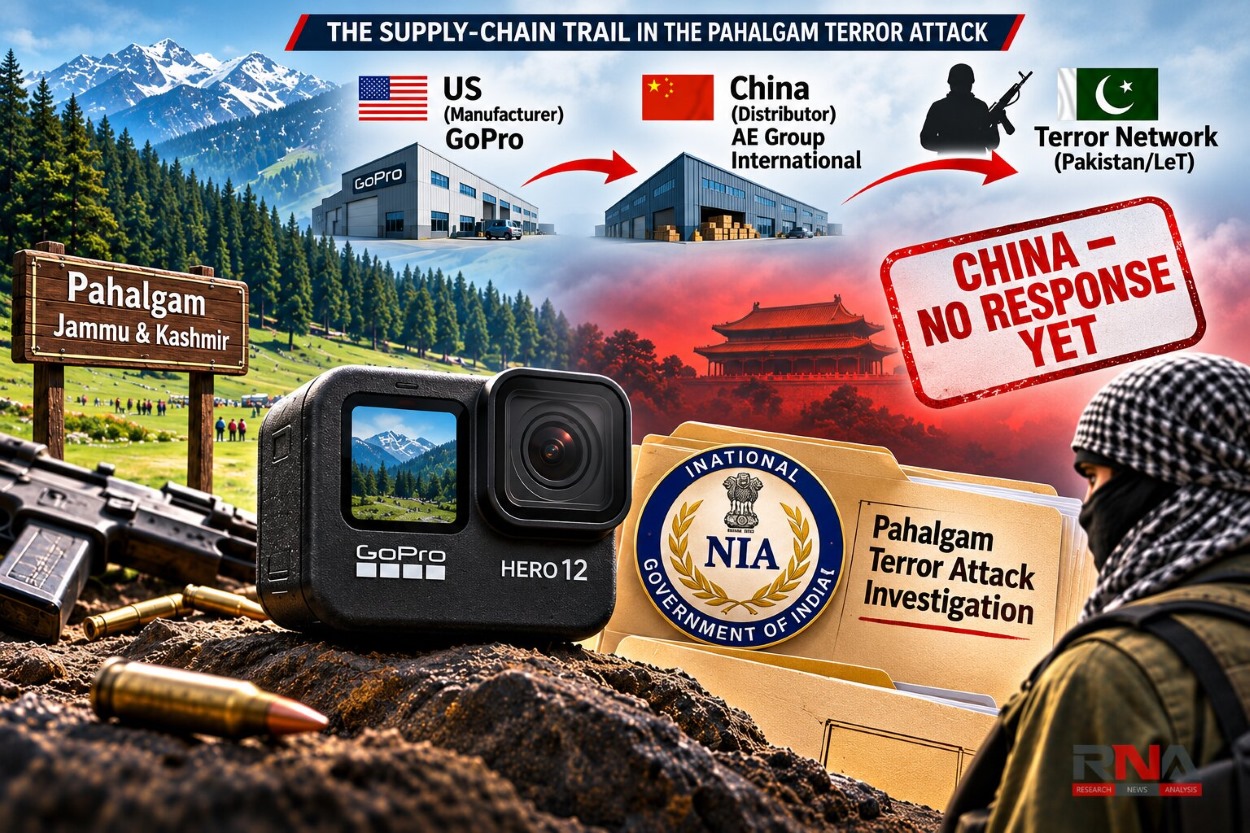
RNA Media illustration for representation.

New Delhi: China has yet to respond to an Indian request for information about a US-manufactured GoPro camera recovered from terrorists involved in the April 2025 Pahalgam massacre, leaving a crucial gap in the investigation into the attackers’ international supply network. The National Investigation Agency disclosed on Friday that although Beijing had provided no assistance so far, forensic examination of evidence recovered from the terrorists had produced additional leads.
The agency’s director general, Rakesh Aggarwal, confirmed the lack of a Chinese response on Friday when questioned by reporters about the progress of the investigation. His remarks brought renewed attention to an unusual trail of evidence linking a commercially available American camera, a distributor in China and Pakistan-based Lashkar-e-Taiba (LeT) terrorists responsible for killing 26 civilians in Jammu & Kashmir.
The investigation is particularly significant because it seeks to establish not merely where the camera originated, but how it passed through international commercial channels before reaching the terrorist operatives. Identifying its purchaser, subsequent users and possible intermediaries could help investigators reconstruct the logistical arrangements supporting the Pahalgam operation and determine whether an organized procurement network was involved.
Camera first activated in China in January 2024
The camera, identified as a GoPro Hero 12 Black bearing serial number C3501325471706, was traced to AE Group International Limited, a commercial distributor operating in China. According to court proceedings reported in March this year, records supplied by GoPro showed that the device was activated on January 30, 2024, in Dongguan, an industrial city in Guangdong province.
The activation date is significant because it predates the Pahalgam massacre by nearly 15 months, potentially allowing investigators to establish a longer history of possession, movement and use. However, the American camera manufacturer informed the NIA that it did not possess records identifying subsequent buyers or the final user, making assistance from Chinese authorities necessary to establish the device’s complete commercial history.
In March, a special NIA court in Jammu authorized a formal judicial request, known as a Letter Rogatory, to China under Section 112 of the Bharatiya Nagarik Suraksha Sanhita. The request sought information about the camera’s distribution, purchaser, end-user and associated technical records, which investigators believe could help establish whether the device was used for reconnaissance before the attack.
Although India and China do not have a bilateral mutual legal assistance treaty covering the matter, both countries are parties to the United Nations Convention against Transnational Organized Crime. The court identified this convention as a potential legal basis for seeking cooperation, with the Ministry of Home Affairs having approved the request.
Chinese weapons and Pakistan connection
Investigators are also examining the origins of assault rifles linked to the Pahalgam attackers, with reports indicating that three recovered AK-pattern weapons were of Chinese origin. Two were reportedly recovered from the attack site, while another was found during the subsequent counterterrorism operation near Dachigam, raising further questions about the equipment supplied to the terrorist group.
Security officials are reportedly examining whether Pakistan’s military procurement channels could have played a role in transferring some equipment to LeT operatives. However, neither the Chinese origin of the weapons nor the camera’s commercial history establishes Chinese government involvement, and the alleged Pakistani military connection to this particular equipment remains unproven.
The wider investigation has already identified Pakistan-based handlers and local facilitators allegedly involved in planning and supporting the massacre. In its December 15, 2025, chargesheet, the NIA accused LeT and its affiliate, The Resistance Front (TRF), of participating in the conspiracy, alongside six individuals including three Pakistani attackers subsequently killed by Indian security forces.
As RNA Media reported in its detailed account of the chargesheet, the agency identified Sajid Jatt as a Pakistan-based handler and named Faisal Jatt alias Suleman Shah, Habeeb Tahir alias Jibran and Hamza Afghani as the three attackers. The 1,597-page chargesheet also detailed the alleged involvement of two local residents, Parvaiz Ahmad Jothar and Bashir Ahmad Jothar, in sheltering and supplying provisions to the terrorist group.
China condemned massacre but mum on camera query
Beijing had publicly condemned the Pahalgam killings shortly after the attack, with the Chinese foreign ministry spokesman, Guo Jiakun, expressing opposition to terrorism on April 23, 2025. China’s foreign minister, Wang Yi, subsequently reiterated that position during a May 2025 conversation with India’s national security adviser, Ajit Doval, demonstrating that Beijing had acknowledged the seriousness of the incident at the diplomatic level.
However, no new public response from China specifically addressing the NIA’s request about the GoPro camera could be verified as of November 20, 2026. The distinction is important because China’s condemnation of the massacre and its willingness to provide evidence in a criminal investigation are separate matters, and the absence of a reply does not, by itself, establish deliberate obstruction.
A critical piece in larger investigation
The massacre at Baisaran on April 22, 2025, triggered a major deterioration in India-Pakistan relations, culminating in India’s launch of Operation Sindoor on May 7 against terrorist infrastructure in Pakistan and POK. The three suspected gunmen were subsequently killed during Operation Mahadev on July 28, allowing investigators to examine weapons, electronic devices and other material associated with their movements.
The camera investigation now represents an effort to move beyond identifying the perpetrators and establish the wider arrangements that enabled them to operate. For the NIA, the unanswered question is whether the device reached the terrorists through ordinary commercial resale, intermediaries linked to militant networks or a more organized procurement system – a distinction that could prove important in tracing the infrastructure supporting cross-border terrorism.