Indian Army orders 225 FPV drones after high-altitude trials at 17,500 feet
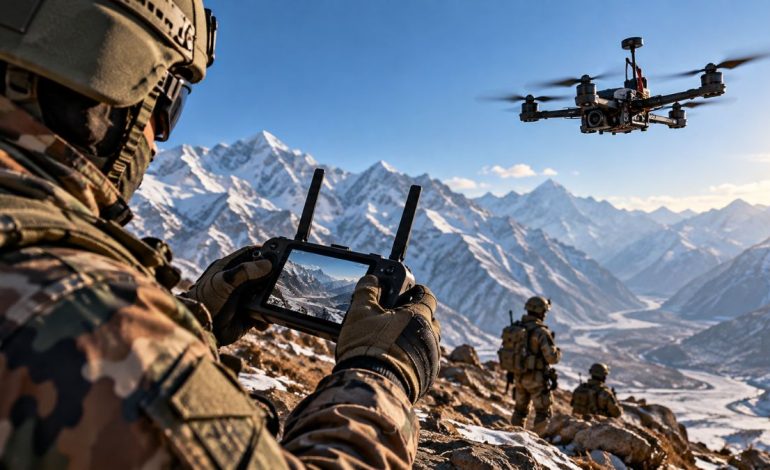
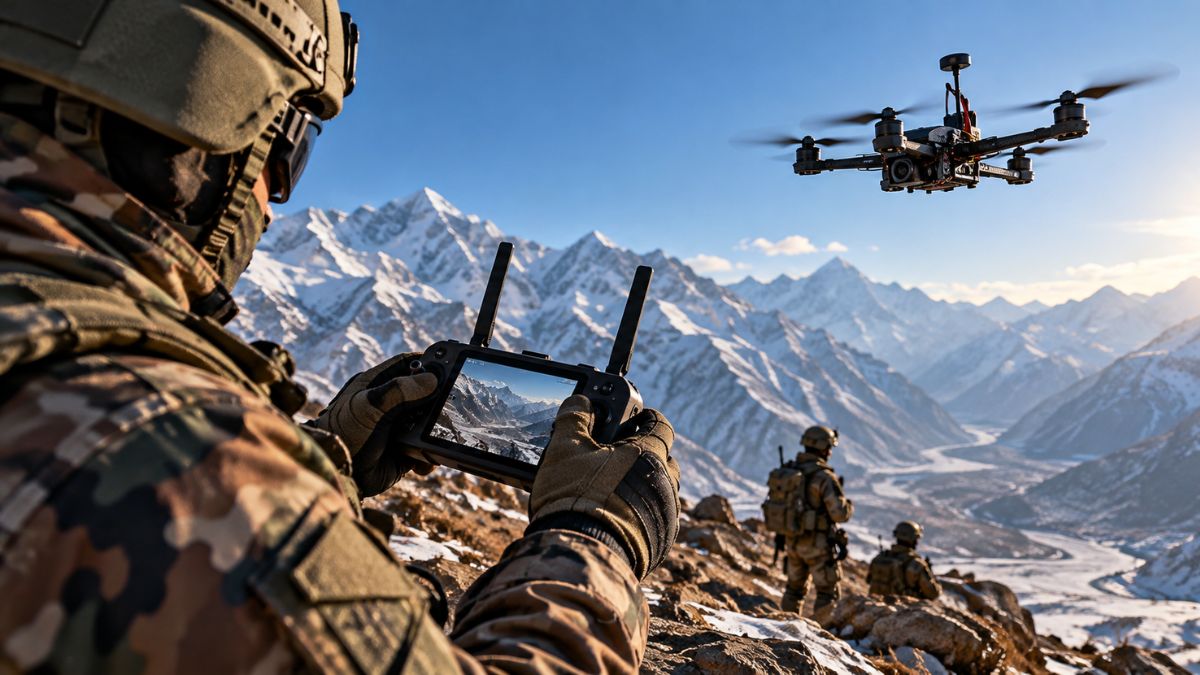
(Image courtesy: AI generated picture via Dall-e)

New Delhi: The Indian Army has ordered 225 first-person view (FPV) drones following competitive assessments that included flight trials at altitudes reaching 17,500 feet. The acquisition reflects the Army’s growing emphasis on small unmanned systems tested under demanding Himalayan conditions rather than relying solely on performance demonstrated at lower elevations.
The drones were assessed for endurance, accuracy, speed and other operational requirements before their selection. The procurement comes amid a broader Army effort to evaluate indigenous unmanned systems in high-altitude areas, including Ladakh and Spiti in Himachal Pradesh, where difficult terrain and extreme weather place considerable demands on equipment.
Operating small drones at elevations approaching 18,000 feet presents engineering challenges markedly different from those encountered at lower altitudes. Reduced air density affects the thrust generated by propellers, while freezing temperatures can diminish battery performance and shorten flight endurance. Strong winds, additional payloads and the demands placed on propulsion systems further complicate operations.
The mountainous terrain presents another major challenge. Sharp ridgelines and deep valleys can obstruct radio control signals and video transmissions, potentially interrupting communication between a drone and its operator. Such limitations make reliable flight performance and communications critical considerations when assessing systems intended for Himalayan deployments.
These conditions are particularly relevant to Indian Army formations operating along the line of actual control (LAC) with China and the line of control (LoC) with Pakistan. Troops deployed across high-altitude sectors, including the Siachen Glacier region, routinely operate in severe cold and difficult terrain, where conventional equipment can face significant performance limitations.
The reported trials at 17,500 feet are therefore significant, although that altitude should not be interpreted as the drones’ certified operational ceiling. Detailed specifications establishing their maximum operating altitude, range and endurance under different payload conditions have not been publicly disclosed.
An FPV drone transmits a live video feed from its onboard camera, allowing an operator to fly it from the aircraft’s visual perspective. Depending on its configuration, such a platform can support close range surveillance, reconnaissance, target observation and battlefield assessment. FPV technology can also be employed in attack drones, although the publicly available procurement information does not establish that all 225 systems are configured for one-way strike missions.
Indigenous firm wins competitive bid
Gurugram-based Aerodrone Robotics Private Limited has been selected to supply the drones after competitive evaluation and high-altitude field trials. A procurement result listing for Government e-Marketplace (GeM) bid, issued under the Ministry of Defence’s department of military affairs, identifies the requirement as 225 seven-inch FPV drones. The listing names Aerodrone Robotics as the lowest bidder, with a quoted value of approximately ₹1.97 crore.
Four companies appear in the final financial ranking, with Aerodrone placed ahead of Abhyuday Bharat Projects, IG Strategic Systems and Droneyards Aerial Solutions. The reported bid value does not, by itself, independently establish the final signed contract amount.
The company’s selection follows competitive trials and demonstrations, including assessments at altitudes reaching 17,500 feet. Aerodrone has described its systems as developed for demanding operational environments and says its broader military unmanned aerial systems portfolio covers surveillance, combat and logistics applications.
The company also provides operator training, maintenance and technical support, while stating that its military drone platforms incorporate software developed in-house. However, these broader company capabilities should not be treated as confirmed technical specifications for the particular 225-drone order.
The procurement forms part of the Army’s wider effort to integrate unmanned systems into battlefield operations, alongside larger surveillance drones, logistics platforms and loitering munitions. The increasing use of small drones in recent conflicts has demonstrated their value in reconnaissance, battlefield observation and precision engagement, prompting militaries to adapt the technology to different operational environments.