





Bangladesh political violence spirals as Awami League homes torched after killing of two BNP leaders
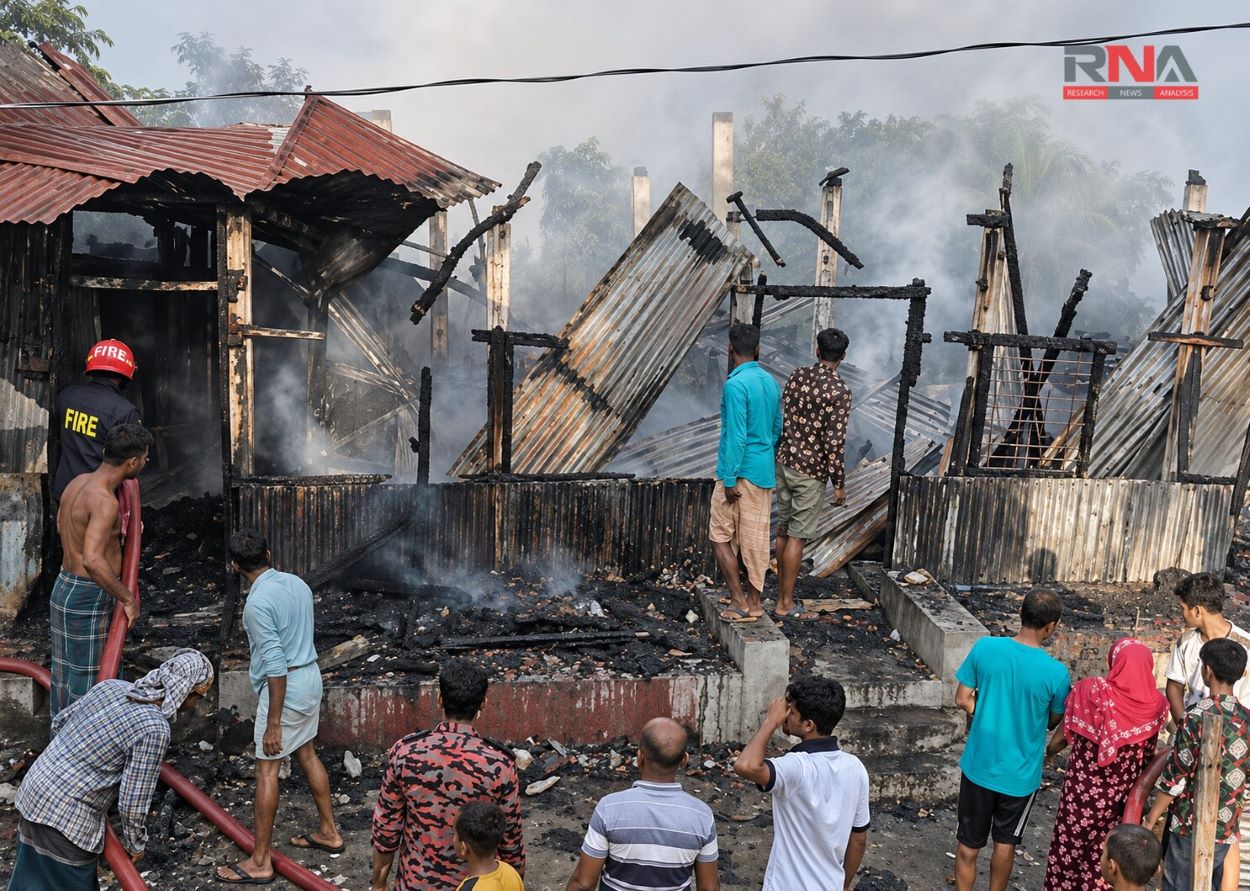
This digitally enhanced screenshot of a widely circulated video on social media shows people near gutted houses after an arson attack in Bangladesh’s Narail.

New Delhi: Dozens of houses and shops belonging to leaders and supporters of Bangladesh’s Awami League have been vandalized, looted and set ablaze in the southwestern district of Narail, following the killing of two activists associated with the ruling Bangladesh Nationalist Party (BNP). The retaliatory attacks, allegedly carried out by BNP supporters, have heightened political tensions in the country as renewed confrontation between the two rival parties threatens to undermine the stability of the government led by the prime minister, Tarique Rahman.
The violence erupted in Bendar Char village and neighbouring areas of Kalia upazila on Friday, two days after an attack on a BNP motorcycle procession left two local party functionaries dead. According to Dhaka Tribune, the attackers targeted properties associated with the Awami League, whose political activities remain prohibited, including residences belonging to former lawmakers and local party office-bearers.
Among the prominent properties attacked were the ancestral home of former Narail-1 member of parliament BM Kabirul Haque Mukti and the residence of former Kalia municipality mayor Fakir Mushfiqur Rahman Liton. The house of Krishnapada Ghosh, a local Awami League leader, was also reportedly targeted as groups of attackers moved through residential neighbourhoods, destroying property and forcing several families to flee.
The scale of the destruction remains disputed, with residents reporting attacks on as many as 50 to 60 houses and commercial establishments, although local officials have provided considerably lower estimates. The fire service said more than 50 residential structures spread across approximately 20 to 25 homesteads had been damaged, indicating that the number of individual buildings destroyed could be substantially higher than the official count of affected households.
Firefighters reportedly struggled to reach the affected areas after felled trees were used to obstruct access roads, delaying emergency operations for several hours. By the time fire crews reached the village, numerous structures had already been destroyed, with residents alleging that valuables, livestock and household belongings had been stolen before the buildings were burned.
Two killings trigger retaliatory attacks
The immediate trigger was the killing of two BNP-affiliated leaders on November 18, when a motorcycle procession came under attack near the Bendar Char sluice gate in Kalia. The victims were identified as Shaheen Sheikh, 45, a local Krishak Dal leader, and Sohel Molla, 40, a functionary of the BNP-affiliated cultural organization Jatiyatabadi Samajik Sangskritik Sangstha.
Police alleged that Awami League activists were involved in the attack, although responsibility has not been established through a judicial process. According to bdnews24.com, two suspects, Disha Biswas and Rakib Biswas, were arrested in connection with the killings, as investigators sought to establish the circumstances surrounding the confrontation.
The Narail superintendent of police, Mohammad Al Mamun Sikder, said relatives of the slain BNP functionaries and other individuals subsequently gathered in Bendar Char and attacked properties belonging to people allegedly associated with the earlier violence. However, local BNP representatives rejected accusations that their party had organized the retaliatory arson, describing the allegations as an attempt to damage its reputation.
The violence has also generated conflicting claims about attacks on religious minorities, with social media posts alleging that Hindu-owned properties were among those destroyed. Police rejected claims of communal targeting in the affected village and warned that misleading footage, including allegedly AI-generated videos, was being circulated, although the Daily Star separately reported an allegation concerning an attack on a Hindu Awami League leader’s house in another locality.
Bangladesh confronts widening political unrest
The Narail attacks come against a broader deterioration in Bangladesh’s political environment, with violence reported in several districts following renewed mobilization by supporters of the former prime minister, Sheikh Hasina. The Awami League has intensified protests against restrictions imposed on its political activities, creating fresh confrontations with supporters of the BNP and placing additional pressure on law-enforcement agencies.
According to Reuters, Awami League supporters attempted to enforce a nationwide shutdown on November 19, disrupting transport and commercial activity in several areas. The unrest coincided with attacks on political residences, public infrastructure and vehicles, including the ancestral home of Muhammad Yunus, who headed Bangladesh’s interim administration following Hasina’s removal from power in August 2024.
Hasina, who has remained in India since her government collapsed during the 2024 uprising, has announced plans to return to Bangladesh in December, further sharpening the confrontation with the BNP administration. Her political future remains deeply contested after a Bangladeshi tribunal sentenced her to death in absentia in November 2025 over crimes against humanity linked to the crackdown on anti-government protesters.
The present turmoil also poses a challenge for Rahman, whose party returned to power following Bangladesh’s February 2026 general election after years in opposition. Although the BNP government has accused Awami League elements of orchestrating destabilizing activities, allegations of retaliatory violence involving ruling-party supporters raise questions about its ability to prevent political disputes from developing into collective punishment.
The unrest carries diplomatic implications for India, where Hasina’s continued presence remains a sensitive issue in relations with Dhaka. As RNA Media reported on November 19, the latest disturbances have coincided with renewed uncertainty surrounding Hasina’s proposed return and increasing concerns about Bangladesh’s internal stability.
New Delhi and Dhaka have attempted to rebuild bilateral engagement since Rahman assumed office, but disagreements over Hasina’s status continue to complicate that process. For Bangladesh, the immediate challenge is to prevent political revenge attacks from spreading further and ensure that criminal investigations, rather than partisan retaliation, determine responsibility for the killings and destruction of property.


