US proposes penalizing India with fresh tariffs over ‘forced labour’
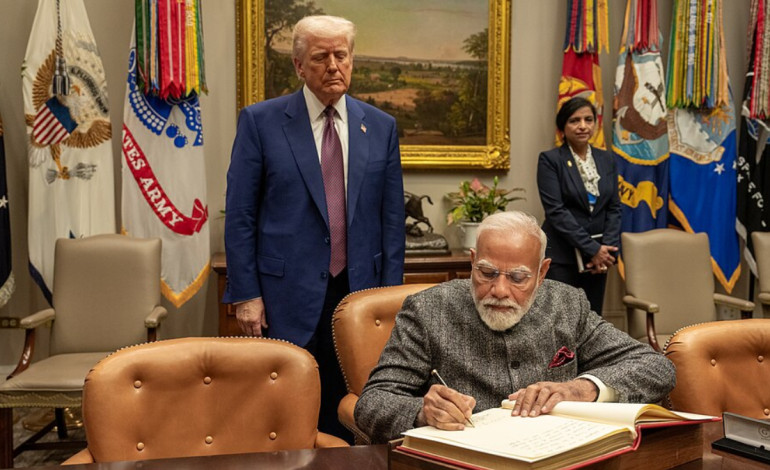
India-US Bilateral Ties. (Image courtesy: Wikimedia)

New Delhi: The Trump administration has proposed fresh tariffs of 12.5% on imports from India by listing it among 60 nations that failed to curb imports made with forced labour. The recommendation from the US trade representative’s office on Tuesday threatened to derail the bilateral trade agreement talks presently underway in New Delhi.
As the three-day US-India trade agreement negotiations progressed for the second day on Tuesday, the Trump administration’s proposals hit the news wire, threatening to complicate the two-day discussions between Indian commerce ministry officials and a US delegation led by assistant trade representative Brendan Lynch.
The USTR office’s 92-page report claimed India “has failed to impose and effectively enforce a forced labour import prohibition,” naming New Delhi’s policies unreasonable and a burden on US commerce, Reuters reported.
“The failure of our most important trading partners to address the importation of goods made with forced labour is unacceptable,” US trade representative Jamieson Greer said. “This creates a dynamic where American workers are forced to compete globally on an unlevel playing field.”
The Trump administration report and its recommendations are part of a Section 301 unfair trade practices probe that sought to rebuild emergency tariffs struck down by the US supreme court in February.
India is listed among 54 economies that lack a law banning imports made with forced labour and hence were recommended to face a higher tariff rate.
Pakistan, among the six nations that include the European Union, Canada, Ecuador, Indonesia, and Mexico, has a prohibitive law on forced-labour imports, but has failed to enforce the ban effectively. Thus, these six nations faced lower tariffs at 10%.
India might challenge USTR report
India could challenge the USTR probe’s findings, as this was not about forced labour in Indian exports, but if India stopped importing goods that were linked to forced labour elsewhere around the world, Reuters quoted Global Trade Research Initiative founder Ajay Srivastava as saying.
“The proposed tariffs are viewed as part of broader US pressure tactics, and India should treat Section 301 actions and the India-US bilateral trade agreement negotiations separately,” Srivastava said.
India was planning to raise the Section 301 investigation by the USTR and its latest report with the Brendan Lynch-led American delegation to seek relief as part of the larger trade deal, Reuters quoted an unnamed Modi government source as saying.
The USTR, which also named India as an intermediary in cotton supply chains linked to Chinese forced-labour inputs, said it was planning a textile mechanism to allow a certain volume of apparel and textile imports to enter the US at a reduced tariff rate, but didn’t mention the volumes or the duty rates.
The announcement comes ahead of the July 24 expiration of a 10% temporary tariff imposed by the Trump administration on February 20, the day the US supreme court struck down the US president’s previous tariffs under the International Emergency Economic Powers Act.
India and the US had agreed to an interim trade deal in February, but talks on the trade deal had slowed down after the top American court struck down Trump’s previous tariff measures against a slew of nations, including allies.
The US investigations under Section 301 of the American Trade Act, 1974, were launched after the country’s top court ruling to establish unfair trade practices of American trading partner nations, including India, apart from levying a blanket 10% tariff.
“India has to discuss the tariff rate, 301 probe impact, and aim for a competitive tariff rate versus direct competition,” Reuters reported, quoting an unnamed source. The final trade deal could be agreed on if “we get the terms fair, equitable, and balanced,” the source said.
During the talks, India would seek tariff arrangements that provide it an advantage over other Asian manufacturing hubs, aiming to strengthen its position in the global supply chain, the report said.
New Delhi expected preferential tariff rates compared to other South Asian and Southeast Asian nations, including Pakistan, Bangladesh, and Sri Lanka, it added.
Greer could visit India once the final draft of the trade agreement was finalized. The talks in New Delhi come at a time India sought greater access to the American market, even as it negotiates the tariffs that led to trade-related and regulatory tensions in the latter half of 2025.
Only last week, the US ambassador to India, Sergio Gor, noted that the India trade deal could be finalized “over the next few weeks and months,” but did not set a specific deadline for the agreement to be signed.