




US unveils global visa curbs on cyberscam and sextortion networks
RNA illustration for representation.

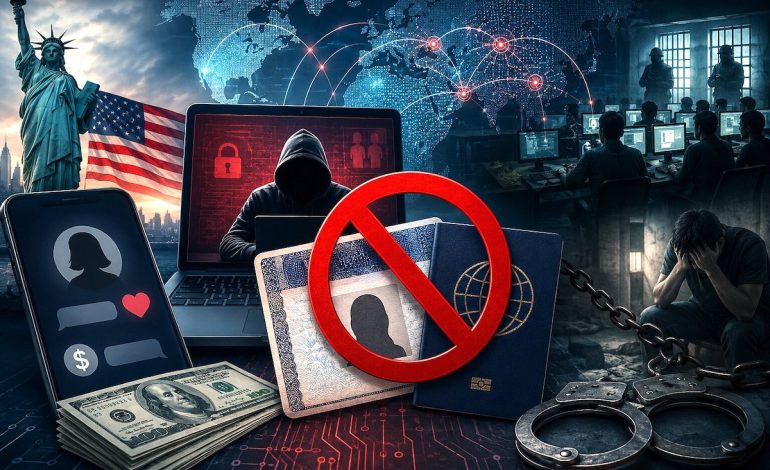
New Delhi: The United States has announced a sweeping new visa restriction policy aimed at foreign nationals who organize, or knowingly assist, cyberscam and sextortion operations, extending Washington’s crackdown on the criminal networks that have industrialized online fraud across Southeast Asia and beyond. The policy, unveiled on Thursday, by the US secretary of state, Marco Rubio, covers anyone responsible for, or complicit in, cybercrime and cyber-enabled crime, such as those involved in cyberscams and sextortion.
This has been issued under Section 212(a)(3)(C) of the US Immigration and Nationality Act, which is a provision generally reserved for cases Washington deems to carry serious foreign-policy or security implications rather than routine immigration breaches.
Officials made clear the restrictions would not stop at the individuals directly involved. Certain immediate family members of people covered by the policy may also be subject to the new visa restrictions, widening the net considerably beyond named operators.
Rubio cast the move as deterrence rather than mere punishment. He said the new measure was meant to send a clear message that the US will go after those who prey on our citizens.
Background of the policy
The measure flows from an executive order the US president, Donald Trump, signed earlier this year, titled “Combatting Cybercrime, Fraud, and Predatory Schemes Against American Citizens”, which directed federal agencies to develop countermeasures against foreign scam centres, transnational criminal organizations and cyber-enabled financial fraud. Washington has pinned much of the blame on Chinese transnational criminal organizations.
Scammers, often orchestrated by such groups, are said to have defrauded US citizens of at least $10 billion in 2024 alone, while fuelling corruption, money laundering and human trafficking. Separately, the state department says American children have been targeted from abroad through sextortion schemes that have devastated families.
Stranglehold on scam networks
Thursday’s order builds on a run of financial actions against the scam-compound economy of Cambodia, Myanmar and Laos. The US treasury department designated the Prince Group Transnational Criminal Organization in October 2025 over its role running a criminal network built on scam compounds, fraud and money laundering, and has since sanctioned individuals and entities linked to it, including scam-compound investors and front companies.
The US treasury’s financial intelligence unit, FinCEN, separately cut off the Cambodia-based Huione Group – described by the US treasury secretary, Scott Bessent, as the “marketplace of choice for malicious cyber actors” – from the US financial system. The justice department has since moved to seize technology infrastructure that, according to prosecutors, allowed billions of dollars in fraud proceeds to be shifted and hidden, much of it traced back to Southeast Asian scam compounds.
A UN Office on Drugs and Crime report released this week found that the syndicates behind these operations have grown steadily more sophisticated and interconnected, folding drug production, cyber-enabled fraud, human trafficking, underground banking and real estate investment into shared operational and financial networks. The cybercrime visa measure is also the latest in a run of restrictions the state department has imposed through this year against people accused of backing political violence, destabilizing entire regions, aiding adversaries in the Western Hemisphere, or maintaining cartel links.
Where India stands
For Indians, the announcement lands against a backdrop that is uncomfortably familiar. India sits at both ends of this economy – one of the largest source countries for the trafficked workforce inside these very compounds, and independently, one of the world’s most targeted victim pools for the investment frauds they run.
On the workforce side, the Ministry of External Affairs told the Rajya Sabha in December 2025 that the number of Indians pulled out of cybercrime compounds in Cambodia, Laos and Myanmar had crossed 6,700, most lured by fake advertisements for well-paid IT or digital-marketing jobs before having their passports confiscated and being forced into online fraud under threat of violence. A further 520 were freed in February 2026 in a joint operation involving the ministry of external affairs, the ministry of home affairs and the Maharashtra Cyber Cell.
An earlier rescue saw 549 Indians flown home aboard Indian Air Force aircraft after their release from cybercrime centres along the Myanmar-Thailand border.
The mirror image of this crisis plays out at home. Indians lost ₹22,495 crore to cyber fraud in 2025, barely down from ₹22,845 crore the year before, with investment scams – the very “pig-butchering” model these Southeast Asian compounds specialize in – accounting for more than three-quarters of the total, according to home ministry data. At current exchange rates, that works out to roughly $2.3 billion; Washington’s $10 billion figure covers American losses alone, but the comparison suggests India’s toll, relative to the size of its economy, is not far behind.
The government’s cybercrime nodal body, I4C, says its fraud-reporting system has frozen more than ₹11,158 crore across over 32.8 lakh complaints as of June 30, while banks have flagged over 24.67 lakh suspect mule accounts to a registry launched in 2024.
Rights groups have long cautioned that the line between perpetrator and victim inside these compounds is not always clean. The UN human rights office estimated in 2023 that at least 120,000 people were being held in Cambodia and around 100,000 in Myanmar, coerced into running romance scams, cryptocurrency fraud and sextortion schemes, with the UN high commissioner for human rights, Volker Turk, arguing that such compounds amount to human trafficking rather than ordinary cybercrime.
Advocacy groups such as Freedom Collaborative have separately warned that treating scam-compound cases purely as financial crime or immigration violations, rather than trafficking, risks leaving coerced workers – many of them Indian – without protection even as enforcement tightens. Washington’s new policy speaks of people “responsible for, or complicit in” cybercrime, a formulation that will need careful, case-by-case application if trafficked labourers are not to be caught in the same net as the organizers profiting from their captivity.
Nothing in the US state department’s announcement identifies Indian nationals as targets, nor has any public list of affected individuals been issued. However, the overlap between America’s enforcement priorities and India’s own – both countries confronting the same scam-compound economy from opposite ends, one as principal victim, the other as both victim and source of trafficked labour.
This points to room for closer coordination as New Delhi continues its rescue operations and Washington tightens the financial and immigration noose around the networks profiting from both.