

Trump rolls out fresh forced-labour tariffs on 60 nations after US supreme court setback; India’s rate eased to 10%
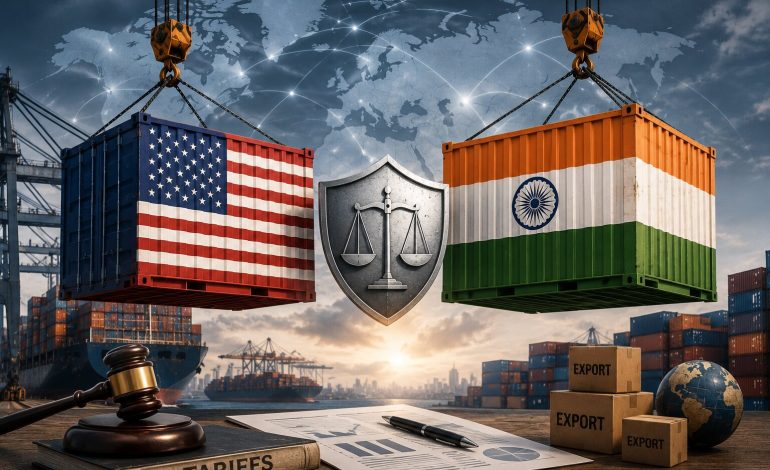
RNA Media illustration for representation.

New Delhi: The Trump administration has imposed a new round of import tariffs on 60 trading partners, accounting for nearly the whole of America’s overseas trade, in a manoeuvre that replaces the temporary levies struck down in effect by a United States supreme court (USSC) ruling earlier this year. India has been placed in the lower of the two new tariff bands, at 10%, after New Delhi amended its foreign trade policy to prohibit the import of goods produced through forced labour.
The duties, which took effect at from Friday, were unveiled on Thursday by the US trade representative, Jamieson Greer, under Section 301 of the Trade Act of 1974 – a statute that permits Washington to act against what it deems unfair trade practices, provided an investigation has first been conducted. Seventeen economies, including India, that have banned, committed to banning, or partly restricted the import of forced-labour goods will pay a 10% duty.
The remaining economies on the list, among them China, Britain and Japan, face a steeper 12.5%. Five partners – the European Union, Taiwan, Japan, South Korea and Switzerland – will have the new levy calculated net of their existing tariff rates on specific products. Goods already in transit before the deadline have been given a grace period to July 28. Oil, gas, fertilizer and products qualifying for duty-free treatment under the US-Mexico-Canada Agreement have been exempted altogether.
Tariff on legal improvisation
The move is the latest in a series of attempts by the White House to keep its tariff architecture standing after the USSC, in a 6–3 verdict on February 20, ruled that Trump had no authority under the International Emergency Economic Powers Act to impose his sweeping “Liberation Day” tariffs on most of the world. The decision, delivered in Learning Resources Inc v Trump, wiped out the president’s single broadest source of tariff power and obliged the administration to begin refunding duties already collected. Trump called the ruling “deeply disappointing” at the time and said he was “absolutely ashamed” of the justices who ruled against him.
Within hours of the verdict, the administration turned to Section 122 of the same 1974 trade law, which allows a president to raise tariffs for up to 150 days to address balance-of-payments concerns, and imposed a flat 10% levy on nearly all imports. That authority was always due to lapse on July 24, which is precisely when Thursday’s Section 301 tariffs take over. A federal trade court had in the meantime also found the Section 122 levy unlawful in May, though that ruling was stayed pending appeal and never took practical effect.
Section 301, by contrast, has so far withstood every legal challenge brought against it; the Supreme Court declined in June to hear a case testing the trade representative’s power to expand an existing Section 301 action.
Greer described Thursday’s measure as among the most far-reaching labour-rights actions ever undertaken by any government, framing it explicitly as a human rights instrument rather than a purely economic one. Testifying before Congress this week, he told lawmakers that “the specific authorities this administration is using have changed, but the trade strategy has not”, adding that the aim remained the re-industrialisation of the American economy, higher wages for domestic workers and a narrower trade deficit. Critics, including several congressional Democrats, have argued that the underlying objective is unchanged from earlier tariff rounds and that American consumers, not exporting nations, ultimately bear the cost.
The Tax Foundation has estimated that tariffs imposed through the year cost the average American household close to $700 in 2026, a figure that predates Thursday’s announcement.
Why India’s rate came down
For India, the outcome represents a modest but meaningful reprieve. When the Section 301 investigation was first flagged last month, India had been provisionally bracketed with countries facing the higher 12.5% band, as RNA Media had reported earlier. New Delhi’s decision to amend its foreign trade policy to explicitly bar the import of goods made using forced labour was enough, according to a senior US official, to move India into the 10% category alongside a smaller group of nations judged to be taking the issue seriously.
Washington has pointed to India as one of the clearer examples of a country adjusting policy in direct response to the threat of tariff action, alongside the European Union’s own forced-labour regulations due to take effect next year.
The development sits within a far bumpier trajectory in India-US trade relations over the past year. India had been staring at a combined 50% tariff as recently as August last year, which is a 25% baseline duty compounded by a further 25% penalty tied to its continued purchases of Russian crude oil. This is a level Indian officials and trade economists warned could render entire categories of exports, from textiles and leather goods to gems and jewellery, commercially unviable in the American market.
That punitive rate was subsequently eased through negotiation, with an executive order removing the additional duty and bringing the effective tariff down to 18% before February’s USSC ruling and the shift to Section 122 pushed it lower still, to a temporary 10%. Thursday’s announcement effectively locks in that 10% rate, though now on a more durable legal footing than the stopgap arrangement it replaces.
The stakes for New Delhi remain considerable. India runs a trade surplus of roughly $46 billion with the United States and is looking to a long-pending bilateral trade agreement to lift two-way commerce from about $190 billion to $500 billion by 2030. Five rounds of talks have already taken place, and Indian officials have described progress as steady, even as agriculture and dairy continue to be treated by New Delhi as non-negotiable red lines.
Whether Thursday’s tariffs complicate or coexist with those broader negotiations is likely to become clearer once both sides resume formal discussions in the coming weeks. For the moment, however, the forced-labour tariffs give the Trump administration a tool that has proved more resilient in the courts than its predecessors, even as questions persist over how durable this latest legal foundation will prove and how trading partners, India included, will calibrate their own policy responses to keep their rates from rising further.