China Slams US For Iran War, Sanctions On Oil Firms, Orders Its Companies To Defy
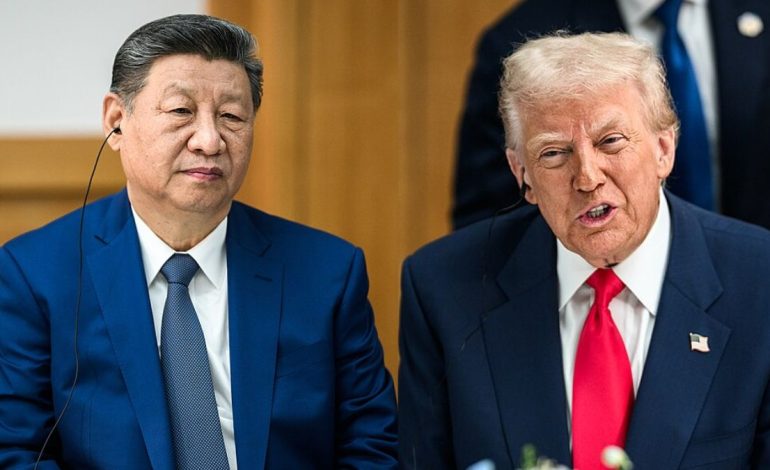
China pushes back against US sanctions over Iran oil trade, signalling a sharper confrontation between Washington and Beijing. Image courtesy: Wikimedia Commons.

China has hit out at the US over its alleged coercive behaviour, including sanctions on Chinese vessels and firms, even as it has asked its companies, particularly oil refineries, to ignore those restrictions entirely.
China’s top UN envoy also slammed the US for starting the war against Iran, along with Israel, even as Beijing took over the role of United Nations Security Council presidency for May 2026.
The Chinese verbal attack on the US came on Friday (May 1, 2026), as Washington put more pressure on Beijing by sanctioning a Chinese oil terminal operator.
The US move was the latest in a series of recent moves to restrict Chinese purchases of Iranian oil under what White House has called ‘Operation Economic Fury’.
“We don’t believe it’s fair to sanction Chinese ships or companies,” Chinese ambassador to the US Fu Cong told a media briefing.
“The Iran war is the biggest example of the rise of unilateralism, power politics, and some bullying practices by certain partners. And it is dealing heavy blows to the rule of law in international affairs,” Fu said.
Fu, who was previously the Chinese ambassador to the European Union, said Chinese Foreign Minister Wang Yi would chair a UNSC meeting on May 26.
Fu said China would do what it could in May 2026 as the UNSC president, but its influence was limited to ensuring a lasting peace in West Asia and the reopening of the Strait of Hormuz.
“We’ll try our best to work on our American friends, but how much influence we can have, I’m not sure,” Fu said. “Frankly speaking, we are very concerned about some of the remarks we have been hearing recently about this ceasefire being temporary, about the need to initiate another round of attacks,” he said.
US President Donald Trump has criticised the UN, terming it inefficient and bloated, apart from voicing its “inability” to end the growing number of global wars, as it was observing its 80th anniversary.
Meanwhile, China pushed back against the US sanctions on its oil companies, ordering them not to conform to the restrictions imposed for trading in Iranian oil.
This was Beijing’s first application of a measure it designed to block “improper” foreign actions against its energy security, which could make it difficult for the US to enforce its sanctions.
The order came in response to the US sanctions since last year on Chinese entities and individuals, charging them with involvement in Iranian oil trading.
China’s Ministry of Commerce said the five companies were Hengli Petrochemical (Dalian) Refinery, Shandong Jincheng Petrochemical Group, Hebei Xinhai Chemical Group, Shouguang Luqing Petrochemical, and Shandong Shengxing Chemical.
The US State Department had on Friday (May 1) said the sanctions on the Chinese entities were part of the “decisive action to disrupt Iran’s illicit oil trade” and that Washington would hold Iran and sanctions-evading entities accountable as long as oil revenues were used to fund “destabilising activities” in West Asia.
Beijing said on Saturday (May 2) that it had carried out an in-depth assessment of the sanctions and concluded that the US actions constituted improper extraterritorial application.
China said the sanctions were not recognised, enforced, or complied with by the five companies, effective immediately. In a separate statement, the commerce ministry explained that since 2025, the US had used executive orders to force third countries to act against Chinese interests.
“These sanctions improperly prohibit or restrict Chinese companies from conducting normal economic and trade activities with third countries (regions) and their citizens, legal persons, or other organisations,” it said. “[This] violates international law and the basic norms of international relations.”
Beijing issued the order under the 2021 Rules on Counteracting Unjustified Extraterritorial Application of Foreign Legislation and Other Measures, also known as the “Blocking Rules.”
This marked the first such invocation of the 2021 law, which the State Council revised and expanded in April 2026. The framework was aimed at identifying and blocking improper extraterritorial application of foreign laws and measures, including actions that violate China’s sovereignty, security, and development, rights of its citizens and organisations, and international law.