

Manipuri rock pioneer Chongtham Vikram Singh killed in Delhi, northeast India demands justice
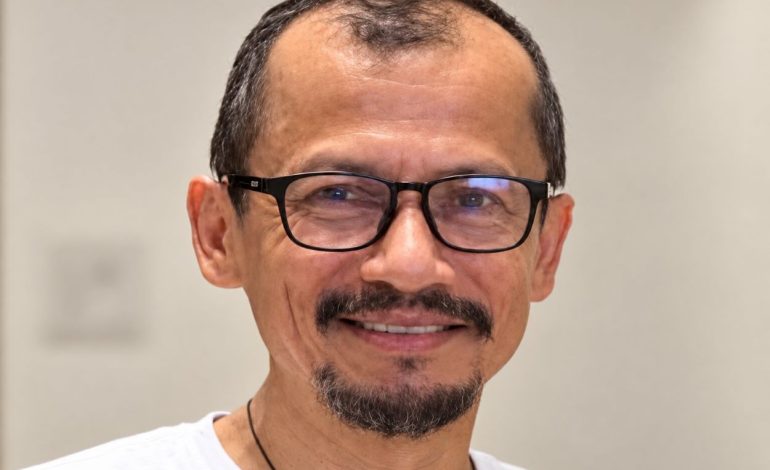
Chongtham Vikram Singh. (Viral photo via X)

New Delhi: Renowned Manipuri guitarist and music teacher Chongtham Vikram Singh died of serious injuries on Monday, after allegedly being beaten by a group of men outside his home in southeast Delhi following a dispute over late-night noise. Delhi Police arrested seven adults and apprehended a juvenile in connection with the killing, which has provoked anger across Manipur and revived concerns about the safety of people from northeast India in the national capital.
Singh, 55, was at his residence in Kilokari village, near Ashram, when he reportedly heard shouting and other disturbances outside at about 11pm on Saturday. According to the police and his family, he went downstairs and asked a group comprising food-delivery workers and employees of nearby eateries to reduce the noise.
The exchange allegedly escalated into violence, with members of the group punching and kicking Singh before pursuing him as he attempted to return to his building. CCTV footage examined by investigators reportedly showed eight people leaving the premises after the assault, although the precise role of each accused remains under investigation.
Singh’s 20-year-old son, Yaiphaba, found him semi-conscious near the family’s door and took him to Holy Family Hospital in Okhla. Doctors recorded a severe fall in his blood pressure, and he died at about 6.30am from haemorrhagic shock caused by blunt-force injuries, according to the hospital report.
The police identified the arrested adults as Bharat Kumar, 19; Pramod, 26; Ramzan Khan, 22; Deepanshu, 21; Mohan Vishwakarma, 32; Vijay, 36; and Mannu, 26. A 15-year-old boy was apprehended separately, and investigators said the suspects worked at different dhabas and food stalls in the area.
A case was registered at Sunlight Colony police station after the police received an emergency call concerning the assault. The deputy commissioner of police for southeast Delhi, Vineet Kumar, met Singh’s family and members of the community and assured them that the investigation would be conducted promptly and in accordance with the law.
Some members of the northeast Indian community have asked investigators to determine whether regional or racial hostility contributed to the attack. The police, however, said no such motive had been established and cautioned that the circumstances leading to the violence were still being examined.
Northeast reacts with grief and anger
The chief minister of Manipur, Yumnam Khemchand Singh, expressed grief over the musician’s death and said his contribution to the state’s music and cultural life would be remembered with deep respect. The chief minister’s response was accompanied by growing demands from political representatives and community bodies for a time-bound investigation and firm prosecution of those responsible.
The member of Parliament from Inner Manipur, Angomcha Bimol Akoijam, said his office had coordinated with the Delhi Police, medical authorities and community volunteers before the arrests were made. Describing Singh as a gentle person and a pioneering guitarist, Akoijam demanded exemplary punishment and said the life and dignity of every citizen must be protected, irrespective of whether the person came from northeast India or any other part of the country.
The former chief minister of Manipur, N Biren Singh, called the death a profound loss for Singh’s family, the music fraternity and the people of the state. He urged the Delhi Police to examine all available evidence, complete a thorough investigation and ensure that justice was delivered without delay.
The chief minister of Meghalaya, Conrad K Sangma, said the assault had reopened painful memories of violence and discrimination experienced by people from the northeast in the national capital. He called upon the authorities to impose the strictest consequences permitted by law on those found responsible.
The leader of opposition in Lok Sabha, Rahul Gandhi, said the killing had compelled families from the northeast living in Delhi to question whether they were safe in the city. Gandhi sought a swift investigation and asked the Union home ministry and Delhi Police to address what he described as growing lawlessness affecting northeastern residents.
The North-East Students’ Society of Delhi University condemned the assault and demanded a prompt, impartial and transparent inquiry. The North-East Media Forum and other community organizations similarly sought full accountability, with members of the Manipuri and wider northeastern communities gathering outside Sunlight Colony police station to press for action.
The demonstrations also reflected anxieties extending beyond this individual case, with participants recalling previous attacks and instances of discrimination against people from the region in Indian metropolitan centres. Police officials maintained that the question of motive must be decided through evidence and that no racial dimension had emerged from the preliminary investigation.
Who was Chongtham Vikram Singh?
Chongtham Vikram Singh, who came from Thangmeiband Lourung Purel Leikai in Imphal West, belonged to a family closely associated with Manipur’s cultural life. He was the eldest son of Chongtham Ongbi Kamala Devi, a respected Hindustani, Rabindra Sangeet and Manipuri singer who also sang in “Matamgi Manipur”, the state’s first feature film.
His musical education began at the age of eight with the accordion, Hawaiian guitar and Spanish guitar, and he performed for All India Radio during his childhood. A two-year period in Kolkata in the early 1990s exposed him more deeply to jazz and Western classical music through musicians connected with the Calcutta School of Music.
Singh became an influential figure in Manipur’s early western and rock-music movement through his association with bands including Ultra Vires, Phoenix and Eastern Dark. An archived profile of his later band, Fubar Ghetto, credited him with more than 300 concerts and session work on about 30 albums and 120 singles, indicating the breadth of a career that often unfolded outside mainstream publicity.
After moving to Delhi nearly two decades ago, Singh continued performing but increasingly devoted himself to music education. He established a music school, trained students privately and taught at the Delhi School of Music, earning affection not only as a technically accomplished guitarist but also as a patient and accessible mentor.
His work extended beyond rock music through the Rock’n’Roots project and collaborations with prominent performers, including the Rajasthani folk singer Mame Khan. Friends and fellow musicians remembered him as a versatile instrumentalist who could move comfortably between rock, jazz, western classical and Indian musical traditions.
Singh was also a cousin of Lakshmipriya Devi, the director of “Boong”, the first Indian film to win the Bafta award for best children’s and family film. He is survived by his wife, Jyotsana, and their son, Yaiphaba, while his death has deprived Manipur of a musician whose popularity rested as much on the generations he taught as on the stages and recordings that carried his guitar work.