



Japan’s MMX mission targets Mars moon Phobos in historic sample-return bid
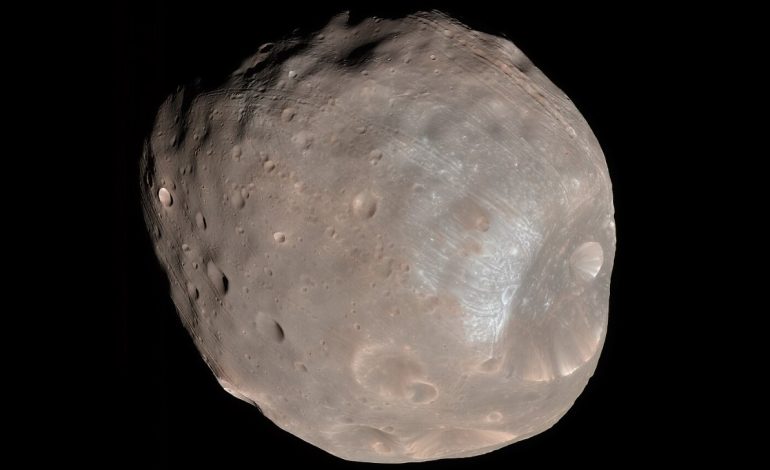
A false-colour composite image of Phobos captured by the Mars Reconnaissance Orbiter in 2008. (Public Domain/Nasa)

New Delhi: Japan is preparing to launch a spacecraft to retrieve the first samples from the Martian moon Phobos, seeking answers to how Mars acquired its two moons and how its planetary environment evolved. The five-year Martian Moons eXploration (MMX) mission aims to bring at least 10 grams of material to Earth in 2031, opening a new chapter in the investigation of the red planet and its surroundings.
Led by the Japan Aerospace Exploration Agency (Jaxa), the mission is scheduled to launch aboard an H3 rocket from the Tanegashima Space Center on Tuesday at 4.41am Japan time – 1.11am IST. It brings together Japanese expertise in retrieving extraterrestrial samples with instruments and support from American and European partners.
The central question is deceptively simple: where did Phobos and its smaller companion, Deimos, come from? Scientists are testing two leading explanations – that they were asteroids captured by Mars’s gravity, or that they formed from debris thrown into orbit after a large object struck the planet.
Determining their origin could help explain how material moved through the early solar system, including the delivery of water and organic compounds to rocky planets. Jaxa expects the combination of close observations and laboratory analysis to provide evidence that distant images alone cannot supply.
Phobos also offers an indirect route to studying Mars itself, because impacts on the planet are believed to have scattered Martian material on to the nearby moon. Those grains could preserve clues to ancient water, environmental change and potentially past biological activity, although finding them would not automatically establish that life once existed on Mars.
Under the mission timetable outlined by the European Space Agency, MMX is expected to enter Mars orbit in August 2027 and begin close operations around Phobos the following month. It will survey the moon before releasing the small Idefix rover in early 2029, with the main spacecraft’s sample collection scheduled for 2030.
Developed jointly by France and Germany, Idefix will investigate the composition and physical properties of the surface, helping engineers prepare for the spacecraft’s landing. The rover has a mass of 25 kilograms, but Phobos’s extraordinarily weak gravity means its weight there will be equivalent to that of roughly 15 grams on Earth.
That environment presents an unusual engineering problem: reaching the surface is only part of the task, because the spacecraft must also remain stable while collecting material. Jaxa identifies the unfamiliar terrain, extreme temperature changes and communication delays of up to 44 minutes for a round trip as major operational challenges.
The sampling system uses two different methods: a Japanese corer will retrieve material from about two centimetres beneath the surface, while a Nasa-supplied device will use pressurized gas to lift loose grains into a container. Jaxa plans two soft landings, allowing the mission to collect material during separate surface operations.
The spacecraft will also carry instruments to examine surface chemistry, map terrain and investigate the environment around Mars and its moons. These include a gamma-ray and neutron spectrometer developed in partnership with Nasa, alongside a radiation monitor intended to gather information relevant to the safety of future crewed exploration.
MMX comprises propulsion, exploration and return modules, with only the return module making the journey back towards Earth. The plan calls for departure from the Mars system in 2030, followed by the release of a sample capsule for recovery in Australia in 2031.
After recovery, the material will be transferred to Japan, catalogued and made available for scientific investigation, including studies by international partners. Returning physical samples allows researchers to use laboratory equipment too large or sensitive to send into space, while preserving material for analysis with future instruments.
The mission builds on Japan’s Hayabusa and Hayabusa-2 experience, which established its ability to collect material from small celestial bodies and deliver it to Earth. MMX extends those capabilities to the Martian system, combining the scientific investigation of two little-understood moons with a practical test of technologies needed for more ambitious exploration.