




India caps margins on 137 cancer drugs; prices may fall up to 70% from November 9
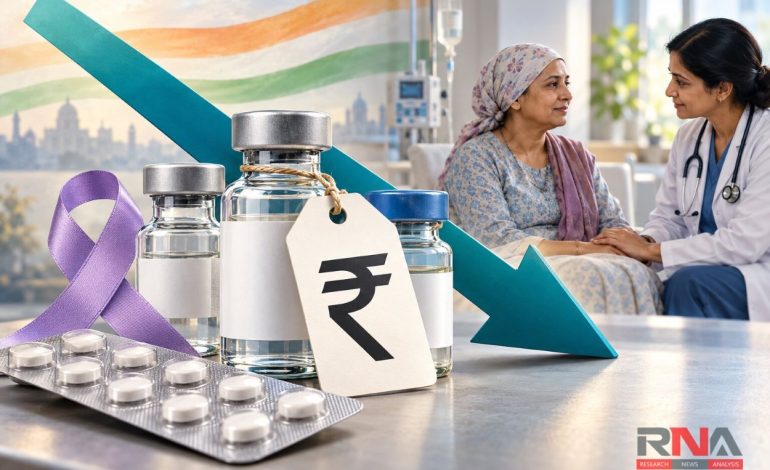
RNA Media illustration for representation.

New Delhi: India has widened price controls on 137 cancer medicines, with revised prices taking effect on November 9, 2026, in a move expected to reduce the cost of some drugs by up to 70%. The intervention targets excessive margins in the distribution chain, although the saving on each medicine will depend on its existing pricing structure.
The National Pharmaceutical Pricing Authority (NPPA) has capped trade margins at 30% of the maximum retail price (MRP), excluding goods and services tax (GST). Announced through a notification on Saturday, the measure covers selected non-scheduled anti-cancer medicines – drugs outside the system of formulation-specific ceiling prices.
According to the Department of Pharmaceuticals’ announcement, the list includes pembrolizumab, durvalumab and osimertinib, alongside medicines used in treating breast, prostate, colorectal, ovarian and cervical cancers. It also covers supportive medicines such as pegfilgrastim, which helps prevent neutropenia, a condition involving low levels of a type of white blood cell.
The pricing formula distinguishes between a trade margin and a mark-up on the distributor’s purchase price. A margin of 30% of the pre-tax MRP permits a mark-up of approximately 42.86% on the price charged to the stockist or distributor, with applicable GST added subsequently.
For example, if a manufacturer supplies a medicine to a stockist for ₹700, the resulting retail price under the formula would be ₹1,000 before GST. This does not mean every covered medicine becomes 30% or 70% cheaper; the reduction depends on how far its existing MRP exceeds the recalculated price.
The scale of existing mark-ups helps explain the intervention: an analysis considered by the pricing authority found an average of approximately 170% for non-scheduled cancer medicines, rising to 700% in some cases. The Indian Express reported that India’s cancer-drug market has annual sales of around ₹12,500 crore, of which medicines already subject to scheduled price controls account for approximately ₹2,250 crore.
The expanded controls are expected to generate annual savings of approximately ₹2,500 crore, according to Business Standard. Manufacturers must submit revised prices to the NPPA within seven days of the notification and publish and circulate their price lists to retailers and hospitals.
Companies whose existing MRPs are below the prices calculated under the new formula must retain those lower prices. Manufacturers must also maintain production, obtain prior permission before reducing average monthly output and inform the regulator if they intend to discontinue a covered formulation.
Hospitals will have a direct role in implementation because a substantial share of cancer medicines reaches patients through institutional purchases. State drug controllers will oversee compliance across manufacturers, retailers and medical institutions, while manufacturers that overcharge will be liable to repay the excess with interest.
The decision expands a programme introduced in 2019, when trade margins were capped for 42 anti-cancer drugs. The government said that exercise reduced MRPs across 526 brands by up to 90%, and that the latest list, recommended by an expert committee under the Directorate General of Health Services, would be reviewed periodically.
However, restricting distribution margins may provide less relief where the manufacturer’s own selling price accounts for most of a medicine’s cost. ETPharma reported that clinical experts and public-health groups expect the effect to vary across brands, particularly for patented treatments with limited scope for reductions in trade margins.
The secretary general of the Indian Pharmaceutical Alliance, Sudarshan Jain, told the publication that the effect on affordability and access would need evaluation as the policy takes effect. He also stressed the importance of patient awareness and continued medicine availability in ensuring that the intended savings reach those undergoing treatment.