

Modi and Putin to hold talks ahead of BRICS summit, Su-57 sale on agenda along with bolstering energy and trade ties
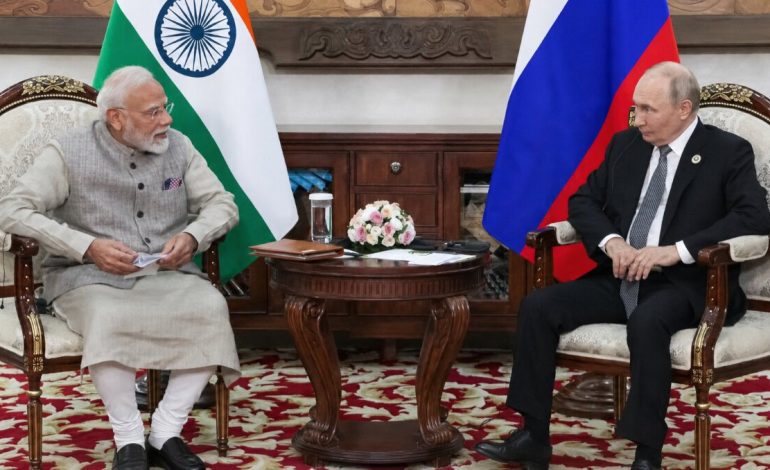
Narendra Modi (L) with Vladimir Putin at Bishkek, on August 31, 2026. (Video screengrab)

New Delhi: The prime minister, Narendra Modi, and the Russian president, Vladimir Putin, will hold bilateral talks in New Delhi on Friday, with the proposed sale and possible transfer of production technologies for Russia’s Su-57 fighter expected to feature prominently. Their meeting, scheduled shortly before the BRICS leaders’ summit, will also review cooperation in trade, energy, civil nuclear power and other areas of defence.
The Kremlin spokesman, Dmitry Peskov, confirmed the engagement during a virtual interaction with Indian journalists on Tuesday. The talks will take place as world leaders arrive in the Indian capital for the 18th BRICS Summit, scheduled for September 12–13.
Peskov said the sale of the Su-57 was on the bilateral agenda and described the aircraft as a “very, very sophisticated machine” and one of the best fighters in the world. He also acknowledged that India was seeking access to production technologies, an issue that he said required further discussions that were already underway.
The Kremlin spokesman said countries possessing newly developed and sensitive military platforms generally preferred to retain the underlying technologies. However, Russia’s advanced strategic partnership with India had encouraged Moscow to examine what technologies could be shared with its Indian partners, he added.
Peskov provided no details about the technologies being considered or the stage reached in the negotiations. He said military cooperation was important but inherently non-public, adding that such discussions should be conducted discreetly to preserve their effectiveness.
The remarks indicate that negotiations extend beyond a straightforward purchase of completed aircraft and could involve production in India, localization of components and access to selected technologies. Such conditions would be central to New Delhi’s assessment because India increasingly requires major foreign defence acquisitions to strengthen domestic manufacturing and reduce long-term dependence on imported equipment.
The Su-57 is Russia’s twin-engine, low-observable multirole combat aircraft, developed for air-superiority missions as well as strikes against land and maritime targets. Moscow has been promoting its export version, the Su-57E, as a possible near-term option for India as the Indian Air Force confronts a shortage of fighter squadrons and awaits the development of the indigenous AMCA (advanced medium combat aircraft).
Any Indian decision would nevertheless depend on a detailed assessment of the fighter’s stealth characteristics, sensors, weapons, engines, maintenance requirements and life-cycle costs. The extent of technology transfer, control over mission systems and freedom to integrate Indian weapons and avionics would also be important considerations.
Modi and Putin last met in Bishkek on August 31 on the sidelines of the Shanghai Cooperation Organisation summit, where they discussed trade, investment, energy, defence cooperation and the safety of Indian seafarers in the Black Sea. During that meeting, Modi urged Russia to move from an “endless war” towards an end to the Ukraine conflict, reaffirming India’s support for dialogue and diplomacy.
Friday’s meeting is expected to build on those discussions, with economic ties occupying a central place on the agenda. Russia-India trade reached a record $70 billion in 2024 before declining in 2025 under the impact of tighter western sanctions but recovered during the first half of 2026.
The two countries have set a target of increasing bilateral trade to $100 billion by 2030, although New Delhi remains concerned about the substantial imbalance created by its large imports of Russian oil, coal, fertilisers and defence equipment. India has consequently pressed for greater Russian purchases of pharmaceuticals, agricultural products, engineering goods, textiles and information-technology services.
Payment arrangements are also expected to receive attention because western financial restrictions have complicated transactions involving Russian entities. Peskov said Moscow was not pursuing “de-dollarization” as an objective in itself and remained open to payment methods acceptable to its partners, although Russia opposed the use of national currencies as instruments of political pressure.
Energy cooperation will remain another important component, particularly as India seeks secure supplies at competitive prices during renewed instability in West Asia. Moscow has assured New Delhi of continued supplies of crude oil and fertilisers, even as India faces diplomatic pressure from Western countries over its purchases of discounted Russian energy.
Civil nuclear cooperation is also likely to be reviewed, with Russia’s Rosatom constructing four additional VVER-1000 reactors at the Kudankulam Nuclear Power Plant in Tamil Nadu after the first two units entered service. The two countries have explored cooperation on further nuclear projects and emerging technologies, including small modular reactors.
Russia-Ukraine war and India’s position
The Ukraine war will provide an unavoidable strategic backdrop to the talks. India has neither endorsed Russia’s military campaign nor joined Western sanctions, maintaining that diplomacy remains the only viable route to a settlement and that its energy purchases are guided by national requirements and global market conditions.
As RNA Media reported on last Friday, The external affairs minister, S Jaishankar, defended New Delhi’s position by arguing that discontinuing Russian oil imports would not, by itself, end the war. India’s approach reflects its policy of strategic autonomy – preserving its longstanding partnership with Moscow without allowing that relationship to restrict engagement with the United States and Europe.
Beyond bilateral matters, Modi and Putin are expected to coordinate their positions on the BRICS agenda, including reforms of multilateral institutions, trade among emerging economies, development financing and the wider use of national currencies. Russia formally pledged support for India’s 2026 BRICS chairship during the India-Russia annual summit in December 2025.
The New Delhi meeting will therefore test whether Russia is prepared to match its Su-57 proposal with technology access substantial enough to meet India’s emphasis on domestic production and operational sovereignty. Its outcome could also indicate how both countries plan to modernize a defence relationship that remains strategically important despite India’s diversification of military suppliers.
1 Comment
[…] Latest news September 8, 2026 […]