


US repels drone swarm at Britain’s RAF Lakenheath airbase, suspicion falls on Iran
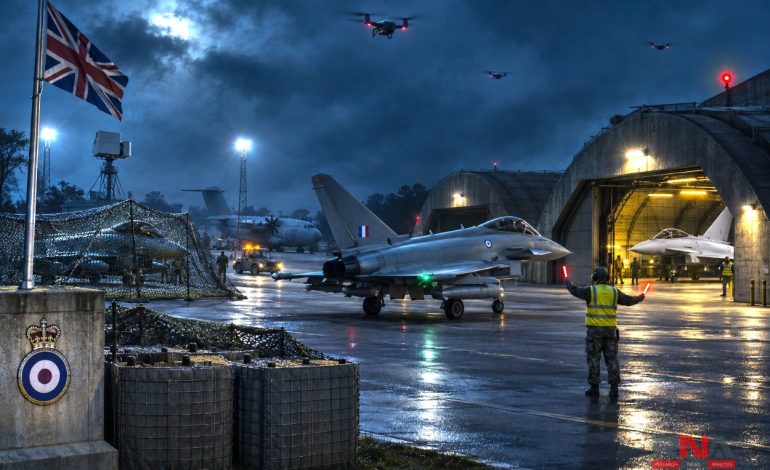
RNA Media illustration for representation.

New Delhi: The United States military used counterdrone technology to repel a swarm of unidentified drones at Britain’s Royal Air Force Lakenheath airbase earlier this month, according to a report published on Saturday. Iran is suspected of having links to the incident, which has heightened concerns over the security of American military installations in Europe and their exposure to unconventional aerial threats.
The Financial Times reported, citing people familiar with the incident, that around six unmanned aerial vehicles (UAVs) were involved in the November 13 intrusion at the strategically important airbase in Suffolk, eastern England. American forces successfully repelled the drones, although neither British nor US personnel recovered the aircraft.
A security alert had been issued instructing American military personnel to remain sheltered during the incident. The United States Air Force (USAF) subsequently confirmed that no personnel, aircraft or infrastructure had been affected by the intrusion.
Britain’s defence ministry, responding to questions from Reuters, confirmed that its military police and Suffolk Police had coordinated with USAF security personnel to respond to the unauthorized drone activity. The ministry said the situation was brought under control quickly, allowing the installation to return to its routine security arrangements.
Neither the Pentagon nor the White House immediately commented on the latest revelations. The USAF has declined to disclose details of the counter-drone systems employed, citing operational security considerations.
Suspected Iranian link raises wider security concerns
The reported drone intrusion was the latest in a series of security incidents involving British military installations hosting American forces, against the backdrop of the continuing confrontation between Washington and Tehran. However, no publicly available evidence has conclusively established Iranian involvement in the Lakenheath incident.
In September, a suspected plot targeting RAF Fairford in Gloucestershire prompted the US military to withdraw its B-1 strategic bombers from the installation. The US president, Donald Trump, subsequently attributed the threat to Iran, while British authorities brought criminal charges against several suspects.
Tehran has rejected allegations of involvement in the Fairford episode and other hostile activities on British territory. British security agencies have repeatedly accused Iran of orchestrating or supporting plots against Iranian dissidents, Israeli interests and members of Britain’s Jewish community.
Days before the Lakenheath intrusion, American forces had also relocated more than a dozen military aircraft from RAF Mildenhall following a security threat, according to an Associated Press report. The installation temporarily raised its force-protection alert to the second-highest level.
Although the three incidents have intensified concerns about the security of American military assets stationed in Britain, investigators have not publicly established whether they were connected or formed part of a coordinated campaign.
Why RAF Lakenheath matters
RAF Lakenheath is one of Washington’s most important military installations outside the continental United States. It houses the USAF’s 48th Fighter Wing, popularly known as the Liberty Wing, which operates four combat-ready squadrons equipped with F-15E Strike Eagle and fifth-generation F-35A Lightning II fighters.
The installation constitutes a significant component of American airpower in Europe and supports Washington’s military commitments to the North Atlantic Treaty Organization (Nato). Aircraft stationed there have also participated in American combat operations in West Asia.
In April 2024, F-15E aircraft from Lakenheath participated in the interception of Iranian drones and missiles launched against Israel. Personnel involved in the operation were subsequently decorated for their service.
The November 13 episode was not the first instance of unexplained drone activity around Lakenheath. In November 2024, unidentified drones were detected around several British installations used by American forces, prompting investigations and additional security measures.
Britain steps up counterdrone defences
The Lakenheath incident comes as Britain is undertaking a significant overhaul of its military infrastructure protection arrangements in response to the proliferation of inexpensive and increasingly sophisticated drones.
According to a British parliamentary report, the number of drone-related incidents recorded around defence installations rose from 126 in 2024 to 266 in 2025. The increase prompted the government to seek expanded legal powers for military personnel to counter unauthorized UAVs through provisions in the Armed Forces Bill.
In a written parliamentary response on November 24, the British government disclosed plans to invest more than £750 million in short-range counter-drone capabilities to protect domestic military installations and deployed forces. A further £470 million has been earmarked for strengthening military base security.
The government is also expanding airspace restrictions around defence installations while strengthening surveillance, policing and physical security.
The changing nature of airbase security
The Lakenheath incident illustrates how the proliferation of unmanned aircraft has complicated the protection of military installations, even in countries geographically removed from active conflict zones. Small drones can be employed for surveillance, espionage, sabotage or direct attacks, making it difficult for security personnel to determine their operators’ intentions immediately.
Counterdrone systems typically combine specialized radars, electro-optical sensors, radio-frequency detection equipment and electronic warfare capabilities. Depending on the nature of the threat, defensive measures can include electronic jamming, physical interception and other means of neutralizing unauthorized aircraft.
However, the term “swarm” does not necessarily imply that the drones involved in the Lakenheath episode possessed autonomous coordination capabilities. The precise nature of the aircraft, their payloads and their intended objectives remain unknown.
The developments also hold relevance for India, where the military has been strengthening its multilayered air defence architecture following the May 2025 hostilities with Pakistan. As RNA Media reported on Friday, India is preparing to augment its air defence capabilities through the induction of another S-400 system, alongside broader efforts to address emerging aerial threats.
Nevertheless, protecting military installations against small drones requires specialized capabilities that complement conventional air defence systems. The Lakenheath episode underscores a growing challenge confronting militaries worldwide – protecting sophisticated combat aircraft and expensive strategic assets against comparatively inexpensive unmanned platforms, even far beyond conventional battlefields.