


Falklands oil battle: Argentina suffers legal blow as UK-backed drilling project clears major hurdle
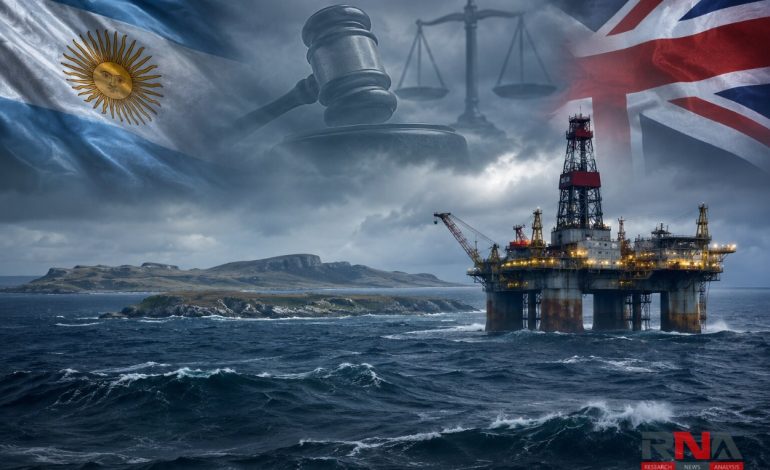
RNA Media illustration for representation.

New Delhi: Argentina has suffered a major diplomatic and legal setback after an international maritime tribunal rejected its bid to halt a British-authorized offshore oil project near the disputed Falkland Islands on Saturday. The ruling clears an immediate obstacle to the archipelago’s emergence as an oil-producing territory, opening a new economic and strategic front in a sovereignty dispute that led Britain and Argentina to war in 1982.
The Hamburg-based International Tribunal for the Law of the Sea (ITLOS) voted 18–3 against Argentina’s application for provisional measures to suspend the development of the Sea Lion oilfield in the South Atlantic. In its decision delivered on Saturday, the tribunal concluded that the jurisdictional requirements for granting the requested relief had not been met.
The ruling represents a setback for the government of the Argentine president, Javier Milei, who has made the recovery of sovereignty over the Falklands, known in Argentina as the Malvinas, a central foreign policy objective. Buenos Aires maintains that Britain’s unilateral exploitation of natural resources in the disputed maritime territory violates Argentina’s sovereign rights.
Britain welcomed the decision and called on Argentina to abandon its campaign of economic pressure against the islands. In a joint statement, the British foreign secretary, Ed Miliband, and the attorney general for England and Wales, Ellie Reeves, reaffirmed London’s position on British sovereignty and the islanders’ right to determine their political and economic future.
Why Argentina’s legal challenge failed
Argentina approached ITLOS on October 13, 2026, seeking an emergency suspension of drilling activities and the installation of oil-production infrastructure until a separate arbitration tribunal could examine the substantive dispute. It also sought restrictions on the issuance of fresh licences for hydrocarbon exploration and exploitation.
Buenos Aires invoked provisions of the United Nations Convention on the Law of the Sea (Unclos), arguing that Britain’s activities infringed its maritime rights and impeded its ability to discharge environmental obligations in the disputed waters. However, the tribunal determined that examining these claims would first require establishing which country possessed sovereignty over the islands.
Such a determination falls outside the scope of Unclos, which primarily governs maritime rights and obligations rather than competing claims to territorial sovereignty. Crucially, Saturday’s decision neither establishes British sovereignty over the Falklands nor extinguishes Argentina’s territorial claim.
The tribunal nevertheless recorded Britain’s assurances that drilling would not begin before March 21, 2027, and commercial extraction would not commence before March 2028. It also noted London’s undertaking that no fresh licences would be issued while the licensing regime remained suspended.
Sea Lion: An oilfield that could transform the Falklands
Situated around 210 kilometres north of the Falkland Islands, Sea Lion represents the territory’s most significant commercial hydrocarbon development. The project is being undertaken by Israel’s Navitas Petroleum, which holds a 65% interest, and Britain’s Rockhopper Exploration, which owns the remaining 35%.
The companies took their final investment decision in December 2025, with funding requirements of approximately $1.8 billion to reach initial production. According to a recent regulatory disclosure by Rockhopper, the first phase will use a floating production, storage and offloading vessel capable of handling approximately 55,000 barrels of oil a day.
For the Falklands, whose economy remains heavily dependent on fisheries, the emergence of a petroleum industry could fundamentally alter its financial position. The development licences provide for a 35-year exploitation period, potentially generating substantial revenue through taxation, royalties and associated commercial activities.
The project could also strengthen the territory’s economic viability and reduce its vulnerability to fluctuations in fishing revenues. However, its long-term financial returns will depend on international crude prices, production costs and the successful completion of successive development phases.
Argentina vows to continue resistance
Buenos Aires has made it clear that Saturday’s ruling will not end its campaign against petroleum development in the disputed waters. The Milei administration has maintained that the rejection of its request for interim relief does not confer legal legitimacy on the exploitation of resources claimed by Argentina.
According to the Guardian, Argentina initiated fresh sanctions proceedings against five entities on Friday over alleged violations of its domestic legislation. The government is also pursuing legislation aimed at penalizing participation in economic activities it considers unlawful in the Falklands.
The military implications of the project have also featured in Argentina’s legal arguments, with Buenos Aires contending that greater economic resources could help sustain Britain’s military presence in the South Atlantic. London, however, argues that preventing the islanders from developing their natural resources would undermine their economic rights and self-determination.
A centuries-old territorial dispute
Britain established control over the Falklands in 1833, while Argentina maintains that it inherited sovereignty over the archipelago from Spain following independence. The competing claims culminated in the 1982 Falklands War, which ended with Argentina’s defeat and the restoration of British administration.
In 1965, the United Nations General Assembly adopted Resolution 2065, recognizing the existence of a sovereignty dispute and calling for negotiations between the two countries. A subsequent UN resolution adopted on December 1, 1976, urged both sides to refrain from unilateral measures that would alter the situation while the dispute remained unresolved.
Britain bases much of its contemporary position on the principle of self-determination, citing the outcome of a referendum held in March 2013, in which 99.8% of participating voters favoured retaining the territory’s British status. Argentina rejects the referendum’s legitimacy, arguing that self-determination cannot override its territorial integrity.
The two countries previously attempted to separate their sovereignty dispute from offshore resource development through a hydrocarbons cooperation agreement concluded in 1995. However, Argentina withdrew from the arrangement in 2007, accusing Britain of pursuing unilateral exploration activities.
From territorial rivalry to energy geopolitics
The Falklands occupy a strategically significant position in the South Atlantic, near maritime approaches connecting the Atlantic and Pacific oceans and routes towards Antarctica. Commercial oil production would add another dimension to Britain’s longstanding strategic interests in the region.
Although a separate arbitration process is expected to follow, Saturday’s ruling raises serious questions over whether it will have jurisdiction to adjudicate Argentina’s claims as currently formulated. With drilling scheduled to begin next year, commercial development could advance considerably before the next stage of the legal battle concludes.
For Britain, Sea Lion offers an opportunity to strengthen the economic foundations of its overseas territory. For Argentina, the prospect of substantial petroleum revenues flowing into a British-administered archipelago represents a new complication in its decades-long campaign to recover sovereignty.
The battle over the Falklands is increasingly becoming as much about the wealth beneath the surrounding waters as it is about the territory itself.