
India could emerge as submarine export hub for Southeast Asia under German partnership
RNA Media illustration for representation.

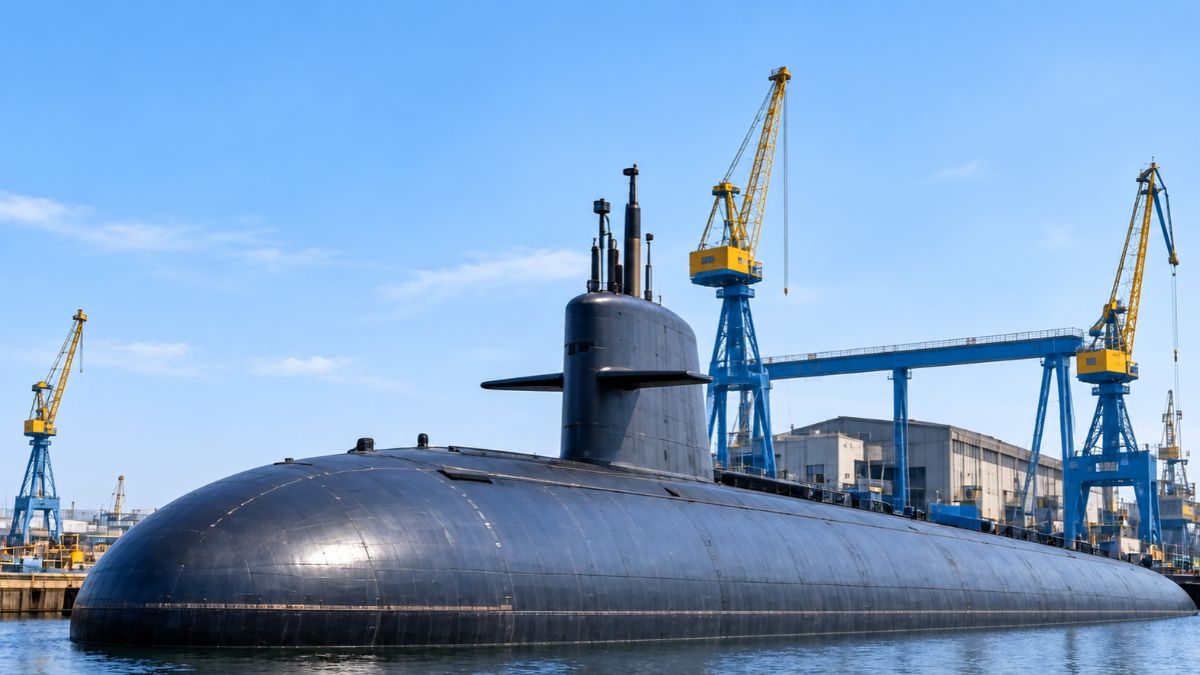
New Delhi: The German submarine manufacturer Thyssenkrupp Marine Systems (TKMS) has proposed developing India into a submarine manufacturing and export hub for Southeast Asian countries and other international partners. Its proposed collaboration with state-owned Mazagon Dock Shipbuilders Limited (MDL) under the Indian Navy’s Project-75(I) could provide the foundation for future international submarine-building programmes.
Several countries have approached TKMS for submarine programmes that could potentially combine German designs with Indian manufacturing and assembly capabilities, the company’s chief executive officer, Oliver Burkhard, told the Times of India in an interview published on Friday. He emphasized that such partnerships would have to align with the political interests of India and Germany.
“A hub built on P75(I) would serve the Indian Navy first and then partners in the region and beyond,” Burkhard said in a separate interview with ANI on November 24. He noted that German-designed submarines had been built at Mazagon Dock since the 1980s, providing an established foundation for industrial cooperation.
The proposed six-submarine programme, estimated at $8–9 billion, is awaiting final approval from the cabinet committee on security (CCS), The Times of India reported. TKMS announced in September 2025 that formal contract negotiations involving MDL and Indian procurement authorities had commenced.
The Ministry of Defence issued the tender in July 2021 for six conventional submarines equipped with air-independent propulsion (AIP), which enables them to remain submerged for longer periods. The tender also envisaged developing India into a global centre for submarine design and production through technology transfer and indigenous manufacturing.
Project-75(I), is distinct from the proposed procurement of three additional Scorpene-class submarines, for which the defence acquisition council granted Acceptance of Necessity in July 2023. Both programmes envisage a significant manufacturing role for MDL.
Extensive technology transfer in the underwater domain, extending beyond submarine construction, would form a central component of Project 75(I), German ambassador to India, Jasper Wieck, said. “Germany has committed to becoming a reliable defence-industrial partner of India. The bilateral defence industrial cooperation roadmap, which was signed in April this year, explicitly includes defence technology transfer,” he said.
Burkhard said the submarine design would belong to the Indian Navy, enabling India to undertake future modifications and sustain the vessels over an anticipated 40-year service life. While acknowledging that certain core technologies would remain protected, he said indigenous content would reach 70 per cent in the final submarine.
Existing industrial cooperation includes TKMS’s work with CFF Fluid Control Limited on sonar systems and with MDL and Medha on a submarine motor. On November 6, TKMS and CFF signed an agreement to establish a joint venture, with proposed ownership stakes of 49 and 51 per cent respectively, to strengthen indigenous underwater defence manufacturing.
Addressing concerns over TKMS’s separate submarine programme with Turkiye, Burkhard said technology, data and intellectual property would remain protected through intergovernmental agreements. “The design India will receive is a highly advanced, unique-to-India boat and that has nothing to do with Turkey anymore,” he said. Wieck maintained that sensitive technologies would be shared only with relevant Indian companies and government bodies.
Wieck described India as central to Germany’s Indo-Pacific approach, highlighting shared interests in upholding a rules-based international order, ensuring freedom of navigation and protecting sea lines of communication. He described Project 75(I) as a long-term engagement with the potential to strengthen maritime security and safety in the Indian Ocean.
Responding to questions about India’s longstanding relations with Russia, Wieck emphasized respect for sovereign partnerships and reiterated Germany’s commitment to expanding bilateral defence cooperation. He identified mutual trust, particularly in safeguarding sensitive defence technology, as fundamental to the partnership.