



Nvidia freezes AI server shipments to four Asian nations as US tightens technology blockade on China
RNA Media illustration for representation.

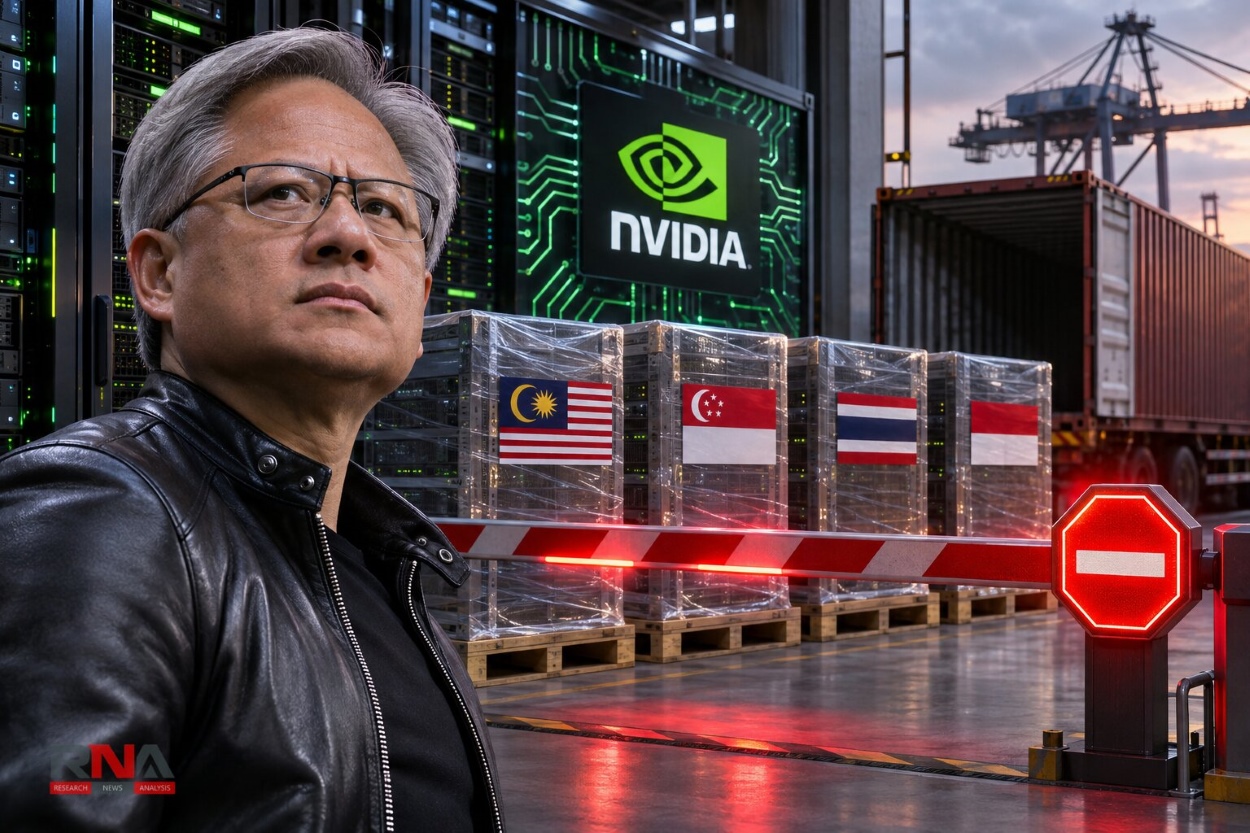
New Delhi: Days after reinstating Jensen Huang as its chief executive, American semiconductor giant Nvidia has reportedly directed its manufacturing partners to halt shipments of servers equipped with its chips to four Southeast Asian countries. The move comes as Washington intensifies efforts to prevent Chinese technology companies from accessing advanced American artificial intelligence processors through overseas data centres.
Malaysia, Singapore, Thailand and Indonesia are affected by the directive, which threatens to disrupt billions of dollars in data centre investments across Southeast Asia. The development also marks a significant expansion in the commercial fallout of the increasingly bitter technological rivalry between the United States and China.
The Financial Times first reported the shipment restrictions on Thursday, citing three people familiar with the matter, with Reuters subsequently reporting the development. Nvidia’s manufacturing partners, including Dell Technologies and Super Micro Computer, reportedly informed customers in the four countries that orders for servers incorporating Nvidia processors would not be dispatched.
It remains unclear how long the suspension will last or whether certain customers could secure exemptions. The restrictions come as Nvidia and its commercial partners seek to establish compliance with Washington’s tightening export-control requirements.
Washington targets the cloud computing loophole
At the heart of the controversy is a fundamental weakness in the American semiconductor export-control regime. Although Washington has progressively restricted China’s ability to purchase high-performance AI chips, Chinese companies have been able to access comparable computing resources remotely through data centres operating in third countries.
The US commerce department’s Bureau of Industry and Security (BIS) introduced a new set of regulations on November 19, 2026, to address this issue. The regulations, officially titled “Addressing Remote Access to Advanced Semiconductors”, extend American export controls beyond the physical movement of semiconductor products to certain arrangements involving their remote utilization.
The regulations also introduce fresh licensing requirements for exports, re-exports and transfers of specified advanced computing products to or within Malaysia, Singapore, Thailand, Indonesia and Brazil. However, Brazil has not been identified among the countries affected by Nvidia’s reported shipment suspension.
Data centre operators already providing substantial computing resources to certain restricted foreign customers have been given 90 days to secure the necessary authorization. Industry executives have expressed concerns over the practical implementation of the regulations, particularly the licensing process and the uncertainty surrounding existing commercial commitments.
The underlying American national security concern is that advanced AI computing infrastructure can support not only commercial applications but also military research, intelligence analysis, cyberoperations and autonomous systems.
Southeast Asia’s data centre boom under threat
Over the past few years, Southeast Asia has emerged as a major destination for investments in digital infrastructure, partly because of growing demand from Chinese technology companies. Malaysia and Indonesia, in particular, have attracted substantial investments in data centres designed to handle increasingly computationally intensive AI workloads.
The shipment suspension could disrupt the financial arrangements underpinning some of these projects. Data centre developers typically secure substantial loans against long-term commitments from customers seeking access to high-performance computing infrastructure.
One prominent example involves Aolani, a Singapore-based cloud computing company that had planned to provide advanced computing services to ByteDance, the Chinese technology conglomerate that owns TikTok.
According to reports, lenders involved in the project have held back approximately $500 million in financing following the disruption. ByteDance could abandon the proposed arrangement if the regulatory uncertainty persists.
Nvidia’s Singapore subsidiary reportedly recorded revenues of $104 billion in 2025, representing an annual increase of 72 per cent. However, the figure does not exclusively represent sales to Singaporean customers, as the subsidiary also accounts for certain transactions involving China and Taiwan.
Huang’s return fails to soften export restrictions
The shipment suspension comes at a particularly sensitive moment for Nvidia. As RNA Media reported earlier, the company’s board reinstated Huang on November 23, just 11 days after his resignation following revelations concerning his personal relationships and allegations involving a suspected Chinese intelligence operative.
The US president, Donald Trump, subsequently claimed that he had personally intervened to facilitate Huang’s return. However, Washington’s scrutiny of Nvidia’s commercial dealings and the alleged diversion of American semiconductor technology to China has continued.
The controversy also involves Megaspeed, a Singapore-based cloud computing company and Nvidia commercial partner that has faced scrutiny over suspected unauthorized diversion of advanced AI processors to China. Washington has since blacklisted Megaspeed, although the espionage allegations surrounding Huang’s personal relationships remain unproven.
Huang has consistently argued that maintaining China’s commercial dependence on American semiconductor technology would serve Washington’s longer-term strategic interests. He has warned that excessively restrictive export policies could accelerate Beijing’s efforts to establish an independent semiconductor ecosystem.
Implications for India and the global AI race
India is not among the five countries specifically subjected to the new destination-based licensing requirements. Nevertheless, Indian cloud computing companies and prospective AI infrastructure investors will have to pay closer attention to customer identification, end-use verification and compliance with American export regulations.
India’s expanding domestic data centre industry could potentially benefit from investments redirected from affected Southeast Asian markets. However, such gains would depend on regulatory certainty, electricity availability, infrastructure costs and continued access to advanced American processors.
The latest restrictions also illustrate how control over computing power, rather than merely semiconductor manufacturing, is becoming an instrument of geopolitical competition. For countries seeking technological sovereignty, including India, the developments underscore the strategic importance of developing indigenous computing capabilities while diversifying access to critical foreign technologies.