

Trump announces Venezuela oil deal, says US has majority control of 65 billion barrels
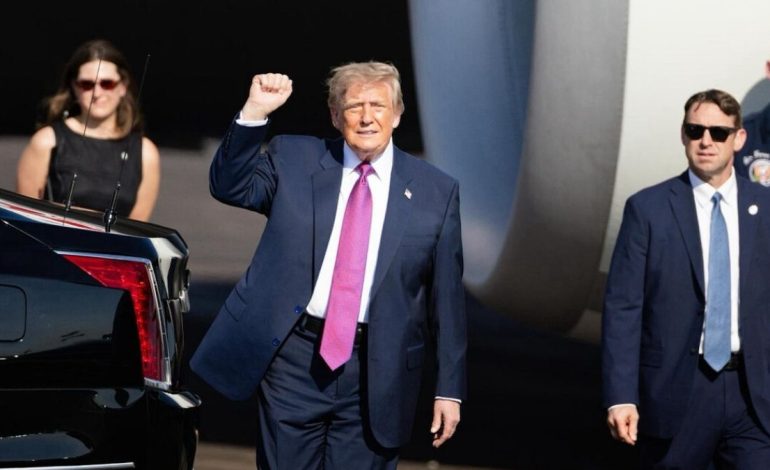
Trump announces US control over 65 billion barrels of Venezuela’s oil reserves. Image: @TrumpTruthOnX

New Delhi: The US president, Donald Trump, announced on Friday an agreement with Venezuela that he said would give the US majority control over more than 65 billion barrels of the country’s proven oil reserves. The deal, negotiated by Secretary of State Marco Rubio and Secretary of War Pete Hegseth with Venezuela’s interim president, Delcy Rodriguez, is intended to bring American investment into 17 oil fields, raise production and secure more crude for US refineries.
The announcement comes about nine months after US forces, acting on Trump’s orders, captured Venezuela’s then-president, Nicolas Maduro, and brought him to the US to face federal narcoterrorism and drug-trafficking charges.
Trump called it the “biggest oil deal in world history” and said the arrangement would come at no cost to US taxpayers. He did not, however, provide details on how the agreement would work or which companies would be involved.
The deal’s structure
According to reports, the fields under discussion are located mainly in Venezuela’s Orinoco Belt and the Lake Maracaibo region, two areas that contain some of the country’s most important oil resources. The agreement follows weeks of negotiations between Washington and Caracas.
Earlier reports had suggested the US was considering a lease-based model under which American oil companies could receive long-term rights to develop selected Venezuelan fields, to be allocated through an auction or tender process.
The final structure, however, remains unclear, and Trump has not said whether the US government itself will hold the controlling interest or whether control will run through a new company involving American private firms.
The Associated Press, citing a US official, reported that the arrangement would involve a new company jointly owned by US interests and a private operator, with the US holding an effective 55 per cent share through an equity stake and rights to purchase crude at cost. The same report said the company could receive rights lasting 100 years to develop the fields.
Why Venezuela needs the investment
For Venezuela, the deal is primarily about bringing money and expertise back into an industry that has been weakened over the past two decades. Venezuela has the world’s largest proven crude oil reserves, estimated at around 303 billion barrels, yet its production remains far below potential, with output currently around 1.25 million barrels per day.
Government mismanagement, a lack of investment and maintenance, economic crisis and sanctions have damaged Venezuela’s energy infrastructure, according to a January 2026 Congressional Research Service assessment of the country’s oil sector. Pipelines and refineries have also suffered from years of poor upkeep, and Venezuela’s heavy crude needs specialised equipment and, often, lighter hydrocarbons called diluents to make it easier to transport.
Export infrastructure is another bottleneck. Ageing, poorly maintained Venezuelan oil ports have struggled to handle rising exports, with some tankers waiting as long as 30 days to load crude.
Raising production will therefore require investment across the entire system, not just at the wellhead. That spans extraction, processing, pipelines, storage and ports.
Venezuela has already begun making changes to attract that investment. In January, Rodriguez signed legislation opening the oil sector to greater private and foreign participation, reversing decades of state-dominated policy.
Chevron, which has continued operating in Venezuela through joint ventures, is reportedly close to finalising an agreement to expand its projects there. That includes operations in the Orinoco Belt.
Reportedly, more than 500,000 barrels per day of Venezuela’s roughly 1.25 million barrels per day output was already going to US Gulf Coast refineries, which are suited to processing the country’s heavy, sour crude. The new agreement could deepen an energy relationship that has already expanded significantly this year.
Legal questions remain
The agreement could face legal challenges in Venezuela, where the state has historically retained a central role in the oil industry. The country’s revised oil law now allows greater participation by private and foreign companies, but it remains unclear whether the proposed long-term arrangement with US interests is fully covered by the new framework.
Questions have also been raised over whether Venezuela’s interim government has the authority to commit the country’s oil resources to an arrangement that could last for decades. The exact terms of the agreement, including the rights being granted to US companies, are yet to be made public.
For Rodriguez’s government, however, the deal offers a major potential source of revenue. Caracas estimates that developing the 17 fields could generate around $209 billion in tax revenue, while the US has estimated that private investment could reach nearly $100 billion.