India sends specialized rescue team to Nepal as China deploys tunnel experts
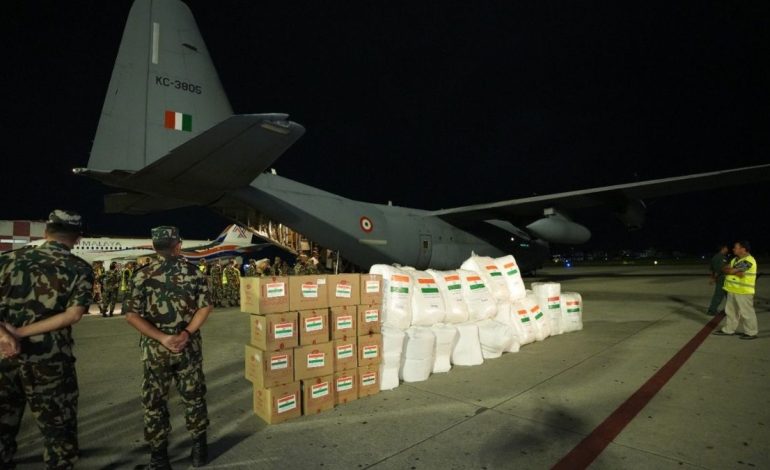
India Sends 11-Member Team to Flood-Hit Nepal. Image: X/@DrSJaishankar

New Delhi: India has sent an 11-member team, including tunnel rescue specialists and medical personnel, to Nepal to help with rescue operations after the floods along the Nepal-China border. China has also sent tunnel experts from Tibet at Kathmandu’s request, as Nepal seeks specialized assistance for difficult rescue operations while its own teams continue the wider search.
The Indian team, sent at Nepal’s request, includes medical personnel and tunnel rescue experts, and was deployed to areas where roads, bridges and other infrastructure have been severely damaged. S Jaishankar, the external affairs minister, confirmed the deployment on X, describing it as India’s third flight of assistance, carrying relief supplies alongside the 11-member medical and tunnel rescue team.
India’s assistance has extended beyond the specialist team. Indian Air Force aircraft have carried humanitarian supplies, including medicines and food, and have provided about 60 tonnes of relief material through three flights so far.
Nepal draws a line on what help it wants
Nepal’s foreign minister, Shisir Khanal, told Reuters that the country did not need help with search and rescue. He said, “We have already made requests for such specialized services and technical assistance in areas where we don’t have enough expertise and technical know-how.”
Khanal said Kathmandu had asked for help rescuing people trapped in tunnels, restoring transport and communication where bridges had been destroyed, identifying bodies, DNA testing, and storing bodies for longer periods.
China has sent five tunnel experts from Tibet to Nepal by helicopter at Kathmandu’s request, according to Chinese state media cited by Reuters. In a post on X, the spokesperson for the Chinese embassy in Nepal confirmed the deployment, saying the tunnel experts had arrived in Nepal to support rescue and relief efforts.
The two countries’ cooperation was also discussed at the diplomatic level. Khanal said in a post on X that he had spoken by telephone with his Chinese counterpart, Wang Yi, and that the two sides reaffirmed their commitment to strengthening emergency response, relief operations and real-time hydrological data sharing. Khanal also thanked China for its support to Nepal’s rescue and relief efforts.
About two dozen bridges have reportedly been destroyed by the floods. Separately, Nepal has also asked India and China to help construct 42 Bailey bridges to restore transport in the flood-hit areas. The portable structures are designed for fast assembly without heavy machinery.
Toll continues to rise
Nepal’s death toll has climbed past 600, with police in Kathmandu still recovering bodies from downstream districts, while China has confirmed at least seven deaths on the Tibetan side. The latest tally puts the number still missing across both countries at more than 3,000, with search operations complicated by damaged roads, difficult terrain and the risk of further flooding.
Even as rescue operations continue, Nepal has begun assessing the cost of rebuilding. Nepal’s finance minister, Swarnim Wagle, told Reuters on Saturday that the preliminary estimate for reconstruction stands between $4 billion and $5 billion, close to a tenth of the country’s economy.
“The initial estimate is between $4 billion and $5 billion. Just an estimate,” Wagle said. He added that Nepal expects to need “much less than what we needed for the 2015 earthquake,” when reconstruction cost around $9 billion. Loss and damage assessments, he said, were still under way.
Speaking separately to PTI in Devighat, Wagle said Nepal was approaching the crisis “in phases.” He said the immediate priority was rescuing people who could still be saved, including those trapped in hydropower plants.
The Nepal Army has airlifted 1,930 people to safety so far, including many foreigners, he said. Relief supplies are also being flown to areas such as Dhunche, Rasuwa and Syaphru Besi, which remain cut off as roads are not functional.
Wagle called the recovery of bodies swept downstream toward Chitwan and Nawalpur, and possibly across the border, a major challenge. He said the next phase would focus on temporary shelters and cash-for-work programmes, before Nepal turns to the “daunting task” of reconstruction.
Asked whether Nepal would seek help from other countries, Wagle said, “Absolutely.” He called the Indian government and the prime minister, Narendra Modi, “exceptionally generous,” recalling India’s support after the 2015 earthquake, when he was also in government.
Special supplies have already been flown in from New Delhi, he said. He added that India had indicated it would provide “very generous assistance” for reconstruction, with similar support expected from Nepal’s other neighbours.