



China opens key air facility at former CIA site in Laos, draws scrutiny across Southeast Asia
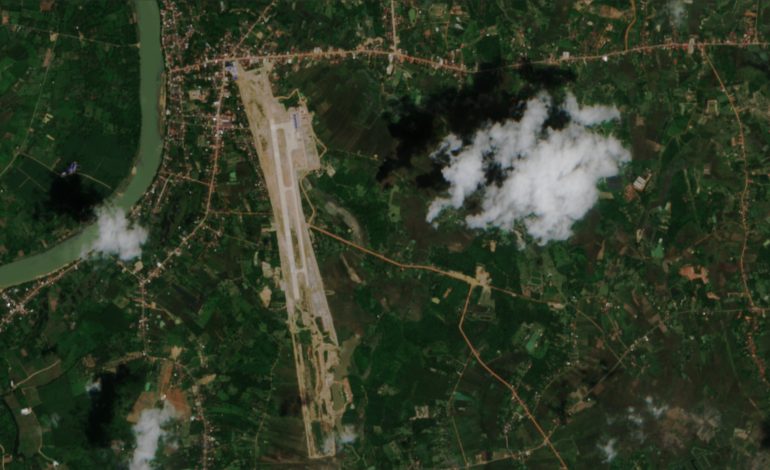
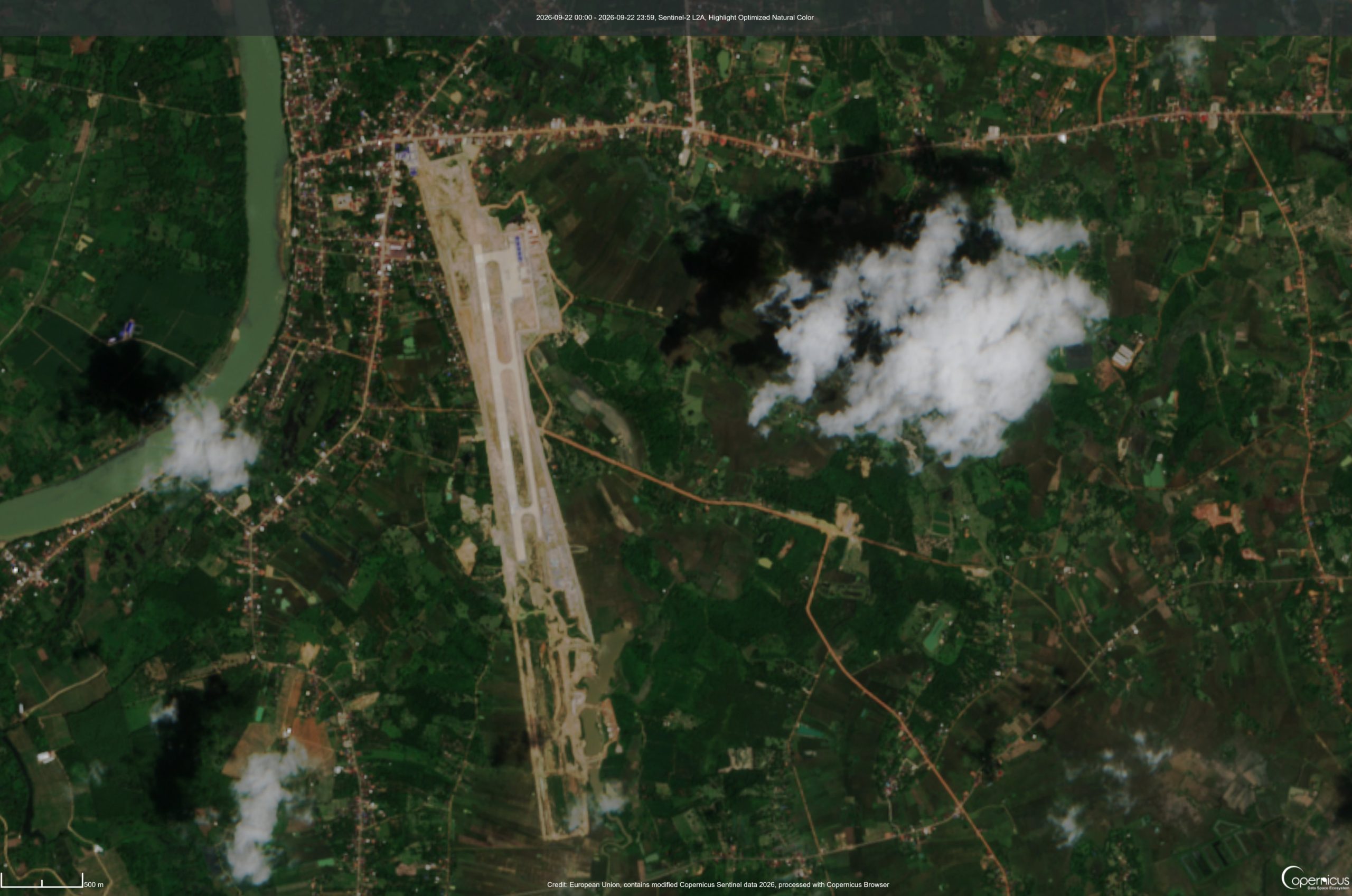
This Sentinel-2 imagery shows the Ban Keun airfield, which is being expanded. (Photo: X/@Tumoduss)

New Delhi: China has opened a joint military aviation facility at a former CIA-used airfield in Laos, expanding its defence presence in mainland Southeast Asia and raising questions about the site’s eventual role. Presented by Beijing as a centre for training Lao pilots, the development at Ban Keun places a Chinese-supported air facility near Thailand and on Vietnam’s western flank.
The China-Laos Joint Support and Training Centre and the China-Laos Friendship Aviation Academy began operating on September 29 this year, approximately 50 kilometres north of Vientiane. China’s defence ministry said the institutions would be jointly maintained and operated, support the training of Lao air force pilots and strengthen bilateral military cooperation without targeting any third country.
The opening marks a significant addition to China’s overseas military infrastructure, although describing Ban Keun as an established Chinese combat base would go beyond the evidence currently available. Its immediate importance lies in the access and working relationships it creates, alongside the possibility that its facilities could support a wider range of activities later.
Satellite imagery showed eight Chinese-made K-8 light attack and training aircraft, also known as the Hongdu JL-8, and more than two dozen support vehicles at the site. The images, captured shortly after the opening announcement, provided tangible evidence of aviation activity while also showing that construction remained incomplete.
The aircraft’s presence is consistent with a training mission, but their appearance alone does not establish who will operate them or whether China intends to station a permanent combat force there. Beijing’s initial announcement did not disclose the personnel strength, equipment allocation or detailed arrangements governing access to the airport.
Ban Keun’s history gives the opening an unusual resonance. It was a location once associated with American covert operations is now hosting an openly acknowledged Chinese-Lao military partnership. Previously known as Lima Site 44, the airfield formed part of the network used by the United States and the CIA during the conflicts in Laos and neighbouring Vietnam.
The CIA’s airline, Air America, provided the transport backbone for American-supported operations across Laos’s difficult terrain, moving troops, supplies and refugees between scattered locations. Its activities also included medical evacuations, rescuing downed airmen, reconnaissance and inserting or extracting teams operating away from established transport routes.
A historical account published by the CIA describes the campaign as the agency’s largest paramilitary undertaking up to that time. By the summer of 1970, Air America had roughly two dozen twin-engine transports, another two dozen short-take-off-and-landing aircraft and around 30 helicopters dedicated to operations in Laos.
That history explains the attention surrounding Ban Keun, but the facility’s present infrastructure offers a more useful guide to its military significance. According to a Lowy Institute analysis, its approximately 2,000-metre runway could accommodate several Chinese fighter types, although longer-range bomber operations would require a longer strip.
Runway length, however, is only one requirement for sustained military flying: fuel supplies, maintenance capacity, protected storage, communications and support personnel also determine what an airfield can deliver. The ability to receive an aircraft therefore needs to be distinguished from the capacity to sustain repeated combat missions, particularly during a prolonged crisis.
The airport has a parallel taxiway and parking positions for about two dozen aircraft, with room for further runway expansion. China’s foreign ministry did not answer its questions about permanent aircraft and crew deployments, while Laos did not respond to requests for details of the operating arrangements.
For Vietnam, the concern is primarily geographical and political: Laos and Cambodia have traditionally provided strategic depth along its western approaches. A stronger Chinese military presence there would add another consideration to Hanoi’s defence planning while it already faces competing Chinese claims in the South China Sea.
Analysts described the facility as a potential source of additional pressure on Vietnam, while cautioning against overstating its immediate operational value. Laos is landlocked, and China already possesses substantially larger and better-equipped airbases within its own territory.
The distinction matters because Ban Keun need not transform the regional military balance to influence diplomatic calculations. Even a limited training presence could deepen institutional ties, establish regular Chinese access and make subsequent cooperation easier, without immediately producing a major forward deployment.
The project also fits into an expanding, though still limited, network of Chinese overseas military facilities. China established its first acknowledged foreign military base in Djibouti in 2017, while a Chinese-funded expansion of Cambodia’s Ream naval base was inaugurated in 2025 alongside a joint support and training arrangement.
These facilities have different functions and operating conditions, making it misleading to treat them as interchangeable components of a fully developed global basing system. Ban Keun nevertheless introduces an aviation-focused element into China’s regional partnerships and offers experience in managing military activity beyond its borders.
For Laos, the immediate attraction is access to training and support for a small air force whose equipment has historically included a substantial Russian component. ISEAS–Yusof Ishak Institute scholar Ian Storey argued that the new arrangement could indicate a greater future reliance on China for aviation requirements.
Storey noted that Laos ordered 10 Russian Yak-130 training aircraft in 2018 but had received only four, one of which crashed in 2024. A separate agreement with Russia to establish a pilot-training facility at Xieng Khouang appeared to remain unresolved, providing useful context for the appeal of the Chinese-supported project.
Economic ties form another part of the relationship, with Chinese investment and lending financing major infrastructure projects in Laos. The Lowy Institute’s assessment notes that China is the country’s largest creditor and suggests that the long-term significance of Ban Keun will depend on future access arrangements, deployments and infrastructure upgrades.
Financial dependence does not, by itself, establish that Laos has granted China unrestricted military rights or abandoned its efforts to balance external partners. The publicly disclosed training arrangement leaves important questions unanswered about sovereignty, operational control and what either side could authorize during a regional emergency.
For India and other Indo-Pacific countries assessing the development, those practical arrangements will be more revealing than the terminology used at the inauguration. Permanent deployments, substantial maintenance infrastructure or a demonstrably expanded mission would provide stronger evidence of a change in role than the presence of training aircraft alone.
Ban Keun has already strengthened China’s defence relationship with Laos and created a new aviation foothold in a strategically sensitive neighbourhood. Whether it develops into a larger operational base will depend on decisions and construction still to come – a distinction central to understanding both the significance of the opening and its present limits.



