



Russian strike on Kramatorsk buses kills 33 Moscow intensify attacks on Ukraine
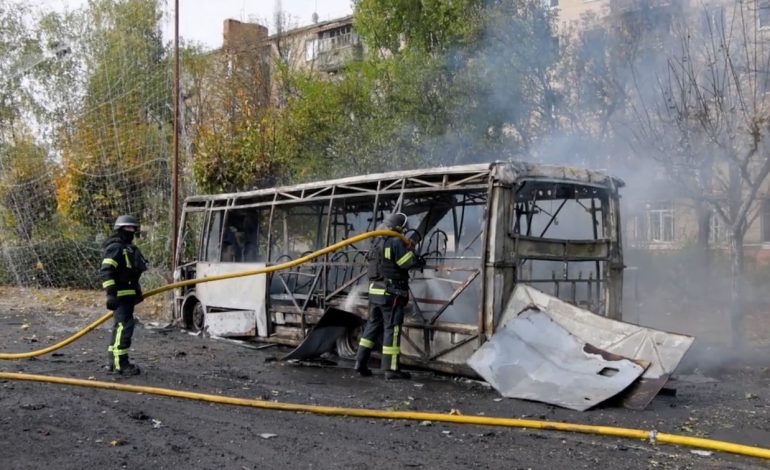
Screenshot from a video posted by Volodymyr Zelenskyy shows firefighters putting off flames from a charred bus that was hit by a Russian projectile.

New Delhi: A Russian aerial attack struck a street used by passenger buses in the eastern Ukrainian city of Kramatorsk on Thursday, killing at least 33 people and injuring 18 on Thursday, according to Ukrainian authorities. The attack prompted the suspension of public transport in Kramatorsk and neighbouring Sloviansk, two important Ukrainian-held cities facing mounting pressure from Russian forces.
The Donetsk regional prosecutor’s office said the strike occurred at about 10am local time and involved two buses carrying passengers. Officials said an aerial bomb hit the area, damaging public transport and a residential building, although the precise circumstances remained under investigation.
Photographs taken at the scene by Radio Free Europe/Radio Liberty showed a burned-out passenger bus and bodies around the wreckage. The reported death toll rose sharply as emergency workers assessed the aftermath, with earlier accounts putting the number killed at 12 and then 30.
The head of the Donetsk regional military administration, Vadym Filashkin, accused Russia of deliberately attacking civilian transport to cause mass casualties. He ordered public transport services suspended in both cities, saying the deteriorating security situation made it impossible to risk passengers’ and drivers’ lives.
The president of Ukraine, Volodymyr Zelenskyy, described the location as an ordinary public transport stop and condemned the attack. Moscow had issued no immediate response to the incident. Russia generally denies deliberately targeting civilians, while Ukrainian officials’ allegations about the intended target have not been independently established.
In a post on X, Zelenskyy said, “Doctors are now fighting to save the lives of people injured in the Russian strike on Kramatorsk,” informing further that the Russian strikes effectively hit two city minibuses. “Some of those killed have still not been identified because of the severity of their injuries,” he said.
Then the Ukrainian leader warned that the attacks “won’t go unanswered.”
Kramatorsk and Sloviansk form part of Ukraine’s eastern defensive network, often described as a “fortress belt”, protecting territory in the Donetsk region. Russia has demanded the surrender of the remaining Ukrainian-held areas of the region as a condition for ending the fighting, a demand Kyiv rejects.
Their military importance has exposed the cities and surrounding transport routes to increasingly frequent attacks, even as civilians continue to live and travel there. Local officials report intensified Russian drone and guided-bomb strikes, bringing the danger of the approaching front line into streets used for everyday journeys.
The Kramatorsk attack followed a Russian missile strike on a residential building in Pryluky, in the northern Chernihiv region, on Wednesday. By the following morning, authorities said 22 people had been killed, including five children, and 54 injured, including seven children, with the search-and-rescue operation completed.
The latest attacks come as Ukraine faces an intensified aerial campaign before winter, with worsening electricity outages adding to the pressure on civilians. Zelenskyy has urged allies to provide further air-defence support as missile and drone attacks place continuing demands on Ukraine’s interception capabilities.
His requests include systems capable of intercepting ballistic missiles, ammunition for combat aircraft and investment in interceptor production. He said talks with partners scheduled for October 8 and October 9 could produce concrete measures to strengthen Ukraine’s defences.
Meanwhile, the war’s long-range attacks extended to Russian digital infrastructure, with a drone strike causing a fire at a Yandex data centre in Sasovo, in the Ryazan region. The company confirmed damage to part of the facility’s infrastructure, although its statement to AFP did not identify the drone’s origin.
Yandex suspended operations at the site, one of its five large data centres, while working to restore affected services. The company said its principal services continued operating, although some functions could remain unavailable to users.
Kramatorsk has previously suffered a major attack on civilian transport infrastructure: a missile strike hit its crowded railway station on April 8, 2022, as people gathered to evacuate. A subsequent Human Rights Watch investigation, conducted with SITU Research, attributed that cluster-munition attack to Russian forces and described it as an apparent war crime.