

Israeli settlers set fire to mosques, homes, farmland as West Bank violence surges
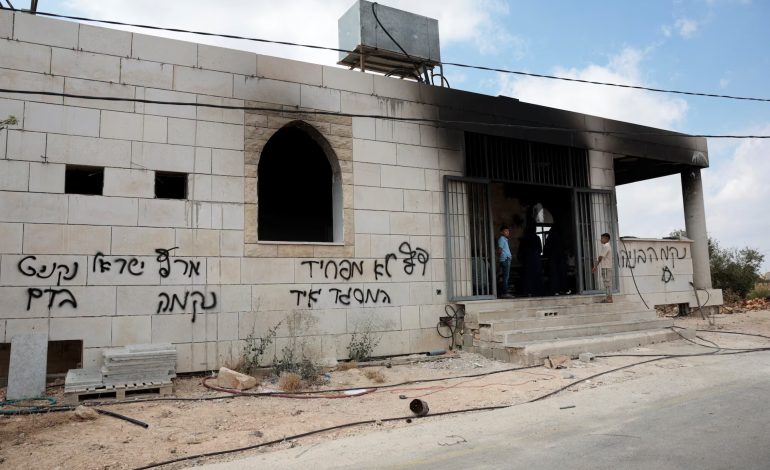
A mosque in Qusra that was set on fire graffiti in Hebrew painted on by Israeli settlers in West Bank. (Photo: X/@AdHaque110)

New Delhi: Israeli settlers stormed a string of Palestinian villages in the occupied West Bank overnight on Sunday, setting fire to two mosques, torching vehicles and farm equipment, and daubing walls with Hebrew graffiti, according to Palestinian officials and multiple witnesses. The attacks were among the most extensive in a year already marked by a sharp rise in settler violence.
These attacks came two days after a shootout near the village of Tal left four Palestinians and two Israelis dead, including a local settlement security coordinator.
What happened in Qusra and Kour
In Qusra, south of Nablus, settlers set alight the Al-Rahma Mosque, an unfinished structure still under construction. Abdel Azim Wadi, the town’s mayor, said the fire destroyed the building’s entrance and scorched its stonework, and that attackers had spray-painted the Hebrew word for “revenge” on its walls, along with a reference to Benayahu Mellet, an Israeli reservist killed in Friday’s shooting near the settler outpost of Havat Gilad.
Wadi told Reuters the village had faced repeated settler attacks since 2011, adding these had intensified since the Gaza war began.
In Kour, near Tulkarm, three settlers attempted to set fire to another mosque at dawn, according to Farid Jiyousi, a member of the village council. Worshippers extinguished the blaze before it reached the main prayer hall, he said, describing it as the first such attack the village had experienced. Hebrew graffiti was also sprayed on the mosque’s exterior.
The Palestinian ministry of endowments and religious affairs said settlers had burned the Kour mosque and left racist slogans on its walls, and it called the wave of attacks a “systematic campaign” against Palestinian religious sites, appealing to the international community to intervene.
Homes, vehicles, farmland targeted
The violence was not confined to religious sites. Reports from the villages of Beitillu and Khirbet Abu Falah described five vehicles, along with tractors and trucks, set ablaze. In Beit Furik, east of Nablus, settlers reportedly torched a Palestinian home and left slogans calling for revenge against Arabs.
In East of Ramallah, a group of settlers attacked a stone-cutting facility in the Ein Samia area of Kafr Malik before dawn, wounding several workers and setting equipment on fire before withdrawing, according to the Palestinian news agency, Wafa. Two Palestinians injured in the wider unrest were taken to hospital for treatment.
Palestinian residents also reported that settlers had deliberately set fire to farmland and olive groves near Tal, the village at the centre of Friday’s deadly clash, compounding losses already suffered by families there.
Separately, settlers were reported to have established a new outpost on land near Umm Safa, northwest of Ramallah, pitching tents in the Wadi Al Zaytoun area even as the security operation continued elsewhere in the territory.
Israel’s response
The Israeli military said troops dispatched to Qusra had found graffiti and evidence of arson and were searching for suspects, with police to be sent to gather evidence. “The security forces strongly condemn incidents of this kind, including harm to religious sites, and will continue to act decisively to maintain security and public order in the area,” it said in a statement.
At the same time, the military confirmed it had launched a broader “counterterrorism operation” across the northern West Bank, detaining more than 40 Palestinians in Nablus, Tulkarm, Jenin and Salfit. Entrances to the village of Sinjil were sealed off, and the Israeli military’s Central Command chief, Major General Avi Bluth, barred Palestinian labourers from entering Israeli communities in the West Bank, exempting industrial zones, in what a security source described as an effort to reduce friction between the two populations.
The Israeli prime minister, Benjamin Netanyahu, who faces an election in October, ordered reinforcements to the area following Friday’s killings and said Israel would accelerate the authorization of new settlements to bolster security. Hardline members of his coalition took a harder line still. Israel’s finance minister, Bezalel Smotrich, said the Palestinian villages of Tell, Iraq Burin and Beit Furik “need to look exactly like the refugee camps in Nablus and Tulkarm.”
This was an apparent reference to a January 2025 military operation that rights groups have described as amounting to war crimes. National security minister Itamar Ben-Gvir said Palestinian towns linked to the Tal killings should be treated the way Beit Hanoun was treated in Gaza, adding that for every Israeli killed, “the enemy must absorb the loss of lands and homes”.
The Palestinian Authority president, Mahmoud Abbas, wrote to several world leaders, including the European Union, the Arab League and the president of the UN security council, calling for urgent international action against what he termed Israeli aggression and settler terrorism. The Palestinian foreign ministry condemned the killings near Tal in the strongest terms, describing them as part of a renewed campaign of displacement.
Year of escalating settler attacks
The overnight arson attacks form part of a broader pattern. According to figures compiled by the United Nations and the Palestinian Authority, settler-related violence has killed dozens of Palestinians and wounded hundreds more this year alone, a marked rise since Israel’s war in Gaza began in October 2023 following Hamas’s October 7 attack, in which Gaza militants killed more than 1,000 Israelis.
Human Rights Watch said the Palestinian death toll in the West Bank since July 19 had reached 10, and warned that the rhetoric from senior Israeli ministers calling for the destruction of Palestinian villages risked tipping the situation towards mass atrocities. The organization pointed to the International Court of Justice’s July 2024 finding that Israel’s occupation of Palestinian territory is unlawful and breaches the prohibition on racial segregation.
Most countries and UN bodies regard Israeli settlements in the West Bank as illegal under international law, a position Israel disputes. Outposts – smaller, unauthorised settlements such as the one reportedly established near Umm Safa this week – are considered illegal even under Israeli law, though they are frequently retroactively legalized.
Not all Israeli voices have endorsed the settler action. Ahmad Tibi, an Arab member of the Knesset, wrote on X that the burning of a mosque without arrests amounted to “Jewish terrorism”, asking how Israelis would react “if a Palestinian, or even a Frenchman, had set fire to a synagogue”.