



₹50 crore DRDO-CSIR project develops lighter bulletproof glass for armoured vehicles
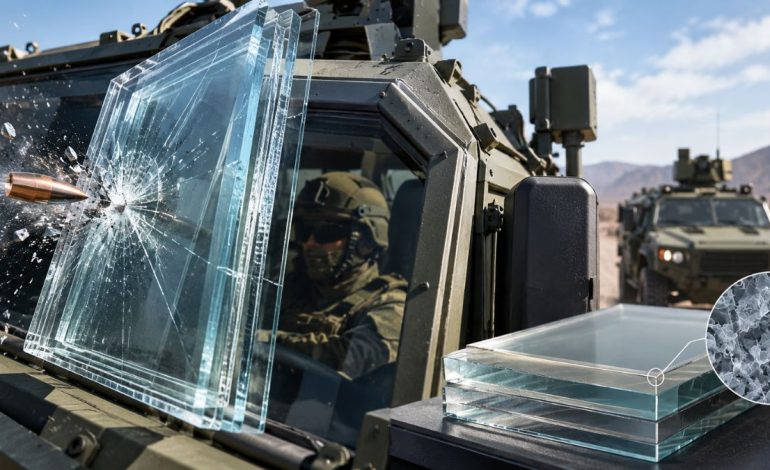
Representative image (Image courtesy: AI generated picture via DALL-E)

New Delhi: The Defence Research and Development Organisation (DRDO) and the CSIR-Central Glass and Ceramic Research Institute (CSIR-CGCRI) are developing indigenous lightweight transparent armour for military vehicles under a ₹50 crore, four-year project that has reached an advanced stage. The technology is designed for multi-shot ballistic protection while aiming to cut the weight and thickness of conventional imported transparent armour by 30–50 per cent, with further testing and manufacturing scale-up still required.
Transparent armour protects crews while retaining visibility, but increasing ballistic resistance usually adds material, thickness and weight. Reducing that burden could help preserve vehicle mobility and payload capacity without compromising the required level of protection.
CSIR-CGCRI project leader Atiar Rahaman Molla told PTI that the programme intended to develop robust multi-shot protection while substantially reducing weight and thickness. The project is being executed with DRDO laboratories including the Naval Materials Research Laboratory in Maharashtra and the Terminal Ballistics Research Laboratory (TBRL) in Chandigarh.
The material is a glass ceramic containing uniformly dispersed nanometre scale crystals within a specially engineered glass matrix. CSIR technical material says controlled crystallization produces crystals roughly 20–30 nanometres in size, strengthening and toughening the material while retaining transparency.
CSIR-CGCRI lists high strength transparent nanocrystalline glass ceramics for armoured vehicles among its strategic research areas. Its specialty glass division has been working on transparent armour materials as part of a broader programme in advanced glass technologies.
Initial ballistic trials at TBRL stopped rounds fired from a trichy assault rifle from 10 metres at about 695 metres per second, according to project details. The rifle was described as comparable to an AK-47 in the testing context, but the result does not constitute complete ballistic qualification.
The programme’s stated objective is more demanding: multi-shot protection against direct AK-47 fire at 100 metres under applicable BIS V and VI test methods. The next trials will fire multiple rounds in quick succession to determine whether the transparent armour retains its protective performance after repeated impacts.
The project is intended to move the technology from laboratory development towards large scale manufacturing, with DRDO expected to select an industry partner. Multi shot validation and manufacturing scale-up still remain before any eventual integration into defence platforms.
Potential applications extend beyond armoured vehicles to weight sensitive aircraft, naval systems and security infrastructure, although these remain prospective uses rather than confirmed induction programmes. CSIR-CGCRI has also reported industry interest in commercializing its glass ceramic technology.