



‘We are living through a period of significant strategic churn’: Navy chief’s warning as INS Nipun is commissioned
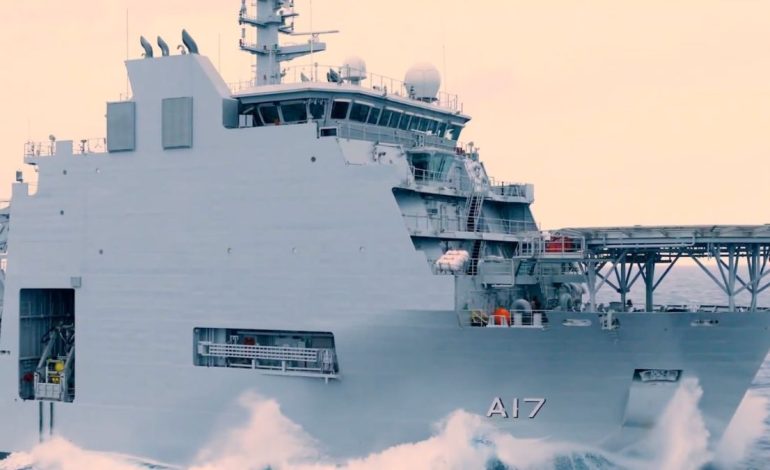
INS Nipun commissioned at the Naval Dockyard in Mumbai. Image - X/@IndiannavyMedia

New Delhi: The Indian Navy on Monday commissioned INS Nipun, the second diving support vessel (DSV) of the Nistar class, at the Naval Dockyard in Mumbai. Admiral Krishna Swaminathan, chief of the naval staff, presided over the ceremony in the presence of Vice Admiral Sanjay Vatsayan, flag officer commanding-in-chief, Western Naval Command, along with senior naval officers, representatives from Hindustan Shipyard Limited (HSL), veterans and families of the commissioning crew.
Adm Swaminathan’s remarks placed the commissioning in the context of a wider shift in the maritime security environment. “We are living today through a period of significant strategic churn. The maritime environment is becoming increasingly contested. The threat perception in it is constantly evolving and manifesting in newer forms of challenge and complexity,” he said, addressing the ceremony.
He said combat readiness remains the Navy’s foremost responsibility and highest priority, and that India cannot always know what threat will appear next, but can still prepare for it.
“While it might not always be possible to predict the exact nature of threats that our nation could face in the future, what we can certainly do is be prepared for the threats that we anticipate and build credible capability that enables us to tackle them effectively and on time wherever and whenever they may arise,” he said.
On why Nipun will be based on India’s west coast under the Western Naval Command, he pointed to instability well beyond India’s shores. “With West Asia in turmoil, global maritime highways under threat, and nations across the region re-arming at an accelerated pace, the Western Naval Command will continue to remain at the vanguard to tackle all challenges we face along and off the western seaboard,” he said.
About Nipun
That could mean a submarine in trouble, a wreck that needs clearing, or a diver needing support at depths ordinary ships cannot reach.
It can support diving operations down to 300 metres. It carries saturation-diving systems, a dynamic positioning system, diving compression chambers, self-propelled hyperbaric lifeboats and remotely operated vehicles (ROVs).
Its most important capability is one most people will never see in use. Nipun can embark and operate the Navy’s deep submergence rescue vessel (DSRV), turning it into a mother ship for submarine rescue.
That means it can carry the DSRV to a submarine in distress and support the evacuation of its crew.
Adm Swaminathan explained why that matters. “Submarine rescue in particular is a discipline where preparedness admits very little margin for delay. Nipun’s ability to embark and operate the DSRV expands our capacity to assist a distressed submarine quite significantly, whether our own or that of a partner navy,” he said.
He added that this could help India become a reliable submarine-rescue partner in the region. Nipun’s diving capabilities, he said, could also support partner nations in salvage work and humanitarian assistance and disaster relief (HADR) missions.
The name Nipun comes from Sanskrit and means “one who is adept, capable and well-versed in a particular discipline” – a fitting label for a ship built for deep-sea diving and rescue.
Nipun was designed and built by Hindustan Shipyard Limited (HSL) and handed over to the Navy at Visakhapatnam on July 30, as RNA Media had reported. It was constructed to the classification rules of the Indian Register of Shipping (IRS) and carries nearly 75 per cent indigenous content, reflecting the government’s vision of an “Atmanirbhar Bharat” or self-reliant India.
Nipun’s sister ship, INS Nistar, was commissioned in July last year and is based on India’s east coast. Nipun completes the pair, giving the Navy dedicated deep-sea.
With the hoisting of the commissioning pennant, Nipun has formally entered operational service with the Indian Navy. Adm Swaminathan was careful to note that commissioning a ship is only the starting point. “The real measure of successful induction is how rapidly and effectively we convert this new platform into deployable operational capability,” he said.
Nipun’s arrival is part of a much larger build-up. The Navy is on course to commission 19 warships in 2026 alone, after 14 in 2025 including a submarine, which would put 33 vessels into service in just 24 months, a pace reports describe as unprecedented for India’s shipbuilding programme.