Pacific Islands Forum opens in Palau under strain as five leaders stay away
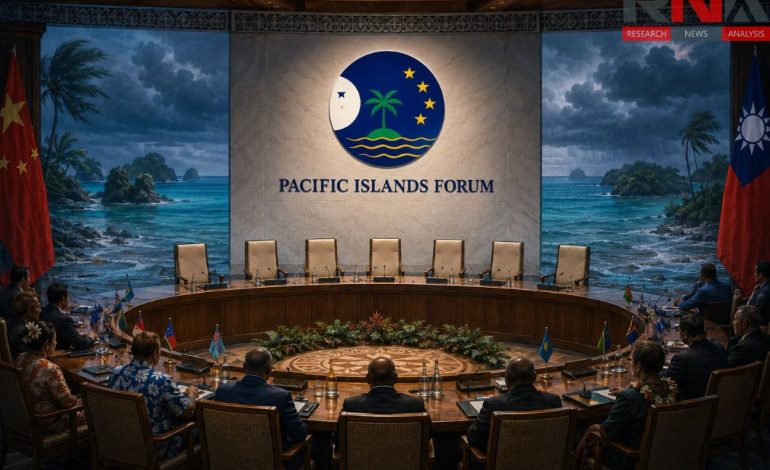
RNA Media illustration for representation.

New Delhi: The 55th Pacific Islands Forum leaders meeting opened in Palau on Monday with five national leaders absent, reducing the political weight of a summit intended to demonstrate regional unity. The disruption comes as the 18-member grouping confronts climate threats, economic vulnerability, transnational crime and strategic tensions sharpened by China’s military activity and its dispute with Taiwan.
Those not attending include the prime ministers of Fiji, Sitiveni Rabuka; Vanuatu, Jotham Napat; Samoa, La’auli Leuatea Schmidt; and Solomon Islands, Matthew Wale, as well as the president of Kiribati, Taneti Maamau. Ministers and senior officials are representing the five countries, allowing them to participate in negotiations even without their leaders.
Wale had reached Palau but returned home after the home affairs minister, Manasseh Maelanga, lodged a no-confidence motion accusing him of taking decisions on important national matters without proper Cabinet consultation or approval. The political challenge also interrupted expectations that Wale might advance discussions with Australia on a proposed bilateral security agreement during the summit.
Kiribati said Maamau was unable to travel because parliament was sitting and flight options were limited, while no single explanation has emerged for the other absences. There is no firm evidence that the five leaders are acting together or staging a coordinated boycott, although their non-attendance has inevitably raised questions about the priority some governments attach to regional diplomacy.
The withdrawals are particularly significant because the PIF generally makes its most important decisions through consensus and relies heavily on direct engagement among leaders. Oliver Nobetau, the director of the Lowy Institute’s Pacific Islands programme, said the absences would dilute what the gathering could achieve and might indicate that some governments see greater immediate value in bilateral negotiations.
Hosted by the president of Palau, Surangel Whipps Jr, the gathering in Koror runs until September 4 under the theme “B.E.L.A.U. – Building Economies: Life. Action. Unity.” Whipps said stronger economies must improve people’s livelihoods, generate sustainable opportunities and reinforce regional integration rather than be treated as an end in themselves.
Climate resilience remains central to the programme, with island nations facing rising seas, extreme weather, water insecurity and growing pressure on food systems. Leaders are expected to consider a regional climate declaration, proposals to move the Pacific towards 100 per cent renewable energy by 2035 and practical steps ahead of COP31 in Turkiye in November.
The summit is also taking place against an increasingly visible contest between China and Taiwan for diplomatic influence across the Pacific. Taiwan’s foreign minister, Lin Chia-lung, is in Palau for associated events and meetings with the island’s three remaining Pacific diplomatic partners – Palau, Tuvalu and the Marshall Islands – despite objections from Beijing.
Taiwan participates as a PIF development partner rather than as a formal dialogue partner, an arrangement that has survived repeated Chinese efforts to restrict Taipei’s access. Beijing, which regards the self-governed island as part of China, has argued that Taiwanese officials have no standing to participate in the forum.
China issued a travel advisory in July describing Palau as unsafe for tourists, prompting the US embassy in Koror to accuse Beijing of using tourism as an instrument of coercion. The dispute carries broader strategic importance because Palau has a Compact of Free Association with the United States, under which Washington is responsible for its defence and enjoys extensive military-access rights.
Regional security discussions are also likely to revisit China’s ballistic-missile test in July, which caused alarm after the projectile landed in the Pacific near Tuvalu’s exclusive economic zone. Pacific foreign ministers subsequently failed to agree on a statement specifically criticizing Beijing, exposing divisions between governments demanding a firm response and countries wary of singling out China.
Palau has urged fellow members to condemn the launch, but Kiribati and Nauru have resisted language directed solely at Beijing and argued that other powers also conduct missile tests in the region. The resulting disagreement has become a test of whether the PIF’s consensus model can produce meaningful collective action when members have sharply different strategic relationships.
The US, China, Japan and Singapore are among the dialogue partners returning after outside countries were excluded from the 2025 meeting in Solomon Islands during an argument over Taiwan’s participation. The forum is considering a tiered partnership system that would reserve direct access to leaders for countries judged to have made the most substantial contributions to regional priorities.
Australia’s prime minister, Anthony Albanese, is attending and is expected to emphasize Canberra’s work on regional security, infrastructure, climate action and labour mobility. His visit follows Australia’s security agreement with Fiji and comes as Canberra seeks to strengthen its role in a region where China has expanded its diplomatic, economic and security presence.
The absent leaders will not prevent their governments from contributing to negotiations, but their withdrawal narrows the space for the private, leader-level bargaining through which difficult compromises are often reached. The meeting’s real measure of success will therefore be whether the remaining delegations can move beyond geopolitical disputes and deliver practical agreements on climate resilience, energy security, drug trafficking and economic stability.