

Rolls-Royce offers India new engine for its AMCA stealth fighter, pitches full tech transfer
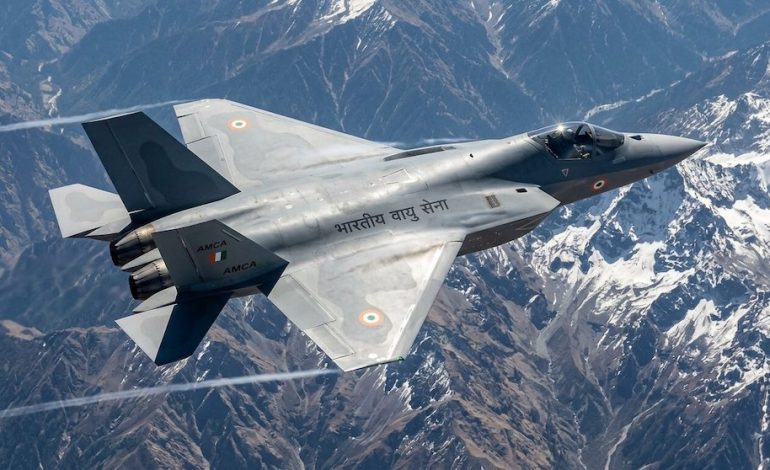
Concept image of an AMCA stealth fighter jet.

New Delhi: British aerospace company Rolls-Royce has formally proposed to co-develop a purpose-built jet engine for India’s fifth-generation stealth fighter programme and to establish a dedicated aero gas-turbine complex on Indian soil. This move could mark a decisive turn in the country’s long and often frustrating pursuit of propulsion self-reliance.
The company’s executive vice-president (transformation India), Sashi Mukundan, told TOI that Rolls-Royce, backed by the UK government, has offered to establish an aero gas-turbine complex in India with a complete transfer of technology. The proposal is aimed primarily at developing an engine to power the advanced medium combat aircraft (AMCA) – the Defence Research and Development Organisation (DRDO) and Aeronautical Development Agency’s (ADA) flagship fifth-generation stealth fighter project.
While the initial AMCA-Mk1 variant is expected to be powered by the American GE F414 engine, the more advanced AMCA-Mk2 will require a new indigenous powerplant in the 110–130 kN thrust class to unlock its full performance potential. It is for this higher-end variant that Rolls-Royce is pitching its offer.
Rolls-Royce officials confirmed that the engine core being offered will be an entirely new design – not based on any existing Rolls-Royce engine family – providing India with a scalable propulsion architecture capable of supporting future upgrades. The engine’s thrust specifications – 110 kN wet thrust with potential growth to 120–130 kN – are distinct from the powerplant the company is developing for the UK-Italy-Japan Global Combat Air Programme (GCAP).
Rolls-Royce has targeted ground trials for the AMCA engine by 2032 and a first flight by 2034.
Mukundan stated that the entire engine design activity for the AMCA powerplant could be undertaken domestically, with relevant technologies transferred and all newly generated intellectual property jointly owned with India. He was unambiguous about the strategic significance of that offer. Mukundan said owning design intellectual property grants a nation the freedom to independently upgrade, adapt, and develop future engine variants without foreign restrictions.
Rolls-Royce already has a longstanding presence in India and maintains joint ventures with companies including Hindustan Aeronautics Limited (HAL). The company has powered Indian Air Force aircraft including the SEPECAT Jaguar, giving it institutional familiarity with the country’s military aviation ecosystem.
Rolls-Royce is not, however, the sole contender. France’s Safran has also offered a joint development programme based on the M88 engine used in the Rafale fighter and has promised full technology transfer, while America’s GE has proposed an enhanced version of its F414 engine. Safran has an entrenched relationship with the Air Force, supplying the M88 engines for its Rafale fleet, whereas Rolls-Royce has a historical connection through the Jaguar fleet.
India’s jet engine saga
The Rolls-Royce offer lands against the backdrop of one of India’s most persistent defence technology shortfalls: the inability to produce a combat-ready indigenous jet engine.
The challenge has deep roots. India’s first indigenous fighter, the HF-24 Marut of the 1960s and 1970s, failed to realize its potential as a supersonic combat aircraft for want of a suitable engine.
In 1986, DRDO’s Gas Turbine Research Establishment (GTRE) in Bengaluru was assigned the task of developing the Kaveri engine to power the-then nascent light combat aircraft (LCA) Tejas. GTRE developed nine prototype Kaveri engines, as well as four core engines that underwent 3,217 hours of engine testing, including trials in Russia, but they failed to meet the required parameters to power a fighter. Instead of the specified wet thrust of 81 kN, the Kaveri generated only 70.4 kN.
The Comptroller and Auditor General was scathing in its 2011 assessment. The CAG report noted that GTRE had been unable to deliver an engine that could power the LCA despite a cost overrun of 642 per cent and a delay of approximately 13 years, and warned the project faced the prospect of entering into a joint venture with a foreign house for further development.
In September 2008, the Kaveri was formally separated from the Tejas project. Consequently, the Tejas-Mk1 and the Tejas-Mk2 adopted the GE F404 and GE F414 engines, respectively. India had successfully built a competitive fighter airframe – but without the heart to drive it.
Although the Kaveri failed to meet fighter engine requirements, it found new life in a non-afterburning variant, with DRDO exploring applications in unmanned aerial vehicles – especially the Ghatak stealth drone programme.
The AMCA now represents India’s clearest opportunity to break that cycle. Developed under the Atmanirbhar Bharat initiative, the AMCA plans to introduce the fifth-generation stealth fighter by the mid-2030s, with initial prototypes using foreign engines, but the co-developed 110 kN powerplant expected to power future variants and reduce long-standing dependence on external suppliers.
Whether the government selects Rolls-Royce, Safran, or another partner, the decision will shape not just one aircraft programme but India’s entire trajectory as an aerospace power for a generation. New Delhi, which has already spent over four decades without a combat-ready indigenous engine, can ill afford another false start.