
In Parliament, government details evacuation operations, expands crisis response for distressed nationals abroad
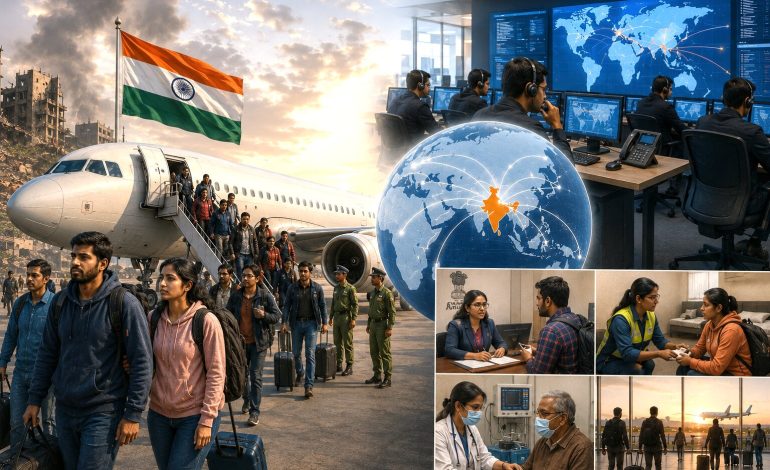
RNA Media illustration for representation.

New Delhi: The government on Friday outlined the scale of its evacuation and consular assistance efforts for distressed Indian nationals overseas. It informed the Lok Sabha that thousands of citizens have been rescued or assisted through conflict evacuations, repatriation operations and routine consular interventions over the past three years.
Replying to an unstarred question from Lok Sabha member Shashank Mani, the minister of state for external affairs, Kirti Vardhan Singh, said the government has adopted a structured, multi-layered mechanism to protect Indian nationals abroad during conflicts, natural disasters, labour disputes, medical emergencies and other emergencies. The minister said the Ministry of External Affairs, working through Indian missions and posts overseas, has conducted multiple evacuation operations and facilitated the return of Indian nationals caught in crises across several regions of the world.
According to the government, one of the largest recent operations was Operation Sindhu in Iran in 2025, under which 3,597 Indian nationals were evacuated, excluding 14 Overseas Citizen of India (OCI) card holders and 14 foreign nationals. The same operation also evacuated 818 Indians from Israel during the conflict.
The government also highlighted the humanitarian assistance extended during Sri Lanka’s crisis in 2025 through HADR (humanitarian and disaster relief) Operation Sagar Bandhu, which facilitated the return of 2,500 Indians. Of these, 424 were evacuated aboard special Indian Air Force flights free of cost, while another 2,076 returned on commercial flights facilitated by the government.
Among other recent operations, the government listed Operation Kaveri in Sudan in 2023, which evacuated 4,097 people, including foreign nationals; Operation Ajay in Israel in 2023, which brought back 1,343 people; Operation Indravati from Haiti in 2024; evacuations from Syria and Iraq; and the repatriation of 1,741 Indians forced to work in cyber-scam centres along the Thailand-Myanmar border.
During the recent West Asia crisis in 2026, India also facilitated the movement of 2,557 Indian nationals from Iran through Armenia so they could return home on available commercial flights.
Beyond organized evacuation missions, Singh said the government has continued to assist Indians facing other emergencies abroad. Country-wise data submitted to Parliament showed that Indian missions handled large volumes of cases involving labour disputes, medical emergencies and other unforeseen circumstances in countries such as Saudi Arabia, Oman, Kuwait, Malaysia, Qatar, Sri Lanka and the Gulf region.
The minister said the government has strengthened crisis management through a combination of travel advisories, 24×7 control rooms at the embassies/high commissions and other missions abroad, emergency communication channels and logistical assistance, including temporary shelter, meals, transportation and cross-border movement whenever required.
He informed Parliament that the ministry’s rapid response cell coordinates with various ministries, the armed forces and other government agencies to execute evacuation operations. The ministry is also conducting final trials of a “digital emergency response solution” designed to support planning and execution of future evacuations.
The junior foreign minister further said Indian citizens can seek assistance through embassies and consulates via walk-in services, email, multilingual emergency helplines, WhatsApp, social media and grievance portals such as MADAD, CPGRAMS and eMigrate. Missions also organize consular camps and open houses to provide easier access to services.
The minister added that labour wings have been established in Indian missions in countries with large Indian migrant populations, while Pravasi Bharatiya Sahayata Kendras at locations including New Delhi, Dubai, Riyadh, Jeddah and Kuala Lumpur provide counselling and guidance to Indian workers. Shelter homes are also available in Gulf countries for Indian women in distress.
He further said bilateral labour agreements and migration and mobility partnerships with several destination countries have strengthened mechanisms for worker protection, legal assistance and grievance resolution.
On nationals attacked, detained, exploited, etc
Answering a related set of questions from Lok Sabha members Ramasahayam Raghuram Reddy, Dr Kirsan Namdeo and Dr Amar Singh, Kirti Vardhan Singh said Indian missions abroad have continued to respond promptly to incidents involving attacks, harassment, detention and exploitation of Indian citizens, students and workers during the past three years.
The junior foreign minister said every reported case is taken up with the authorities of the host country to ensure proper investigation and action under local laws. Such issues are also raised through diplomatic channels and during bilateral engagements, including at the highest political levels where appropriate.
Data tabled in Parliament showed that many reported cases involved labour grievances and exploitation rather than physical attacks. Among the largest categories were 12,733 cases in Malaysia involving labour complaints, detention and deportation; 10,111 assistance and repatriation cases in Kuwait; 2,489 Indians rescued from scam centres in Cambodia; 2,318 rescued from the Golden Triangle Special Economic Zone in Lao PDR; 2,078 rescued from cyber-scam centres in Myanmar; and 1,964 similar rescue cases in Thailand.
The government also reported labour grievance cases in Bahrain and Seychelles, detention cases in Saudi Arabia, attacks on Indians in countries including Canada, Ireland, Latvia, Slovenia and the United States, student-related grievances in Germany and Ukraine, and visa violation and exploitation cases in Sri Lanka.
Responding to questions on diplomatic initiatives and future preparedness, Singh said safeguarding Indian nationals abroad remains a priority for the government. He said India maintains continuous contact with host governments through diplomatic channels during crises, while advisories, emergency communication systems and evacuation mechanisms are activated whenever required.
The minister reiterated that the rapid response cell coordinates inter-ministerial action during emergencies and said the digital emergency response solution under final trials is expected to further strengthen India’s ability to plan and execute evacuation operations during future international crises.
India has significantly expanded overseas crisis response capabilities over the past decade as the size of its global diaspora has grown. According to official estimates, more than 35 million people of Indian origin, including non-resident Indians and persons of Indian origin, live across the world, making consular protection and emergency evacuation an increasingly important component of India’s foreign policy and diplomatic engagement.