

WHO flags India as high-risk country as El Nino intensifies. Why is it a global health emergency and what are the dangers?
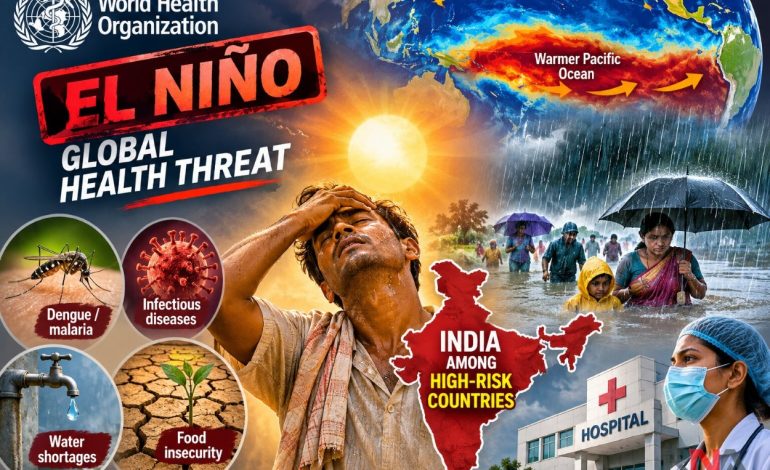
RNA Media illustration for representation.

New Delhi: The World Health Organization has activated its highest level of emergency response to the intensifying El Nino phenomenon, warning that extreme heat, disrupted rainfall and climate-related diseases could trigger serious public health crises across several countries, including India. The warning comes as international climate agencies report an exceptionally powerful El Nino developing in the Pacific Ocean, raising concerns over worsening water shortages, infectious diseases, food insecurity and pressure on already stretched healthcare systems.
In its strategic preparedness and response plan, released earlier this month, WHO placed its global response at Grade 3 – the organization’s highest internal emergency classification – requiring coordinated action across its headquarters, regional offices and country operations. The plan covers October 2026 to September 2027, with an initial funding requirement of approximately $35 million for the first six months to strengthen surveillance, protect vulnerable populations and maintain essential medical services.
India features among countries facing high or very high public health risks in WHO’s September 2026 global assessment, alongside several South Asian neighbours, including Bangladesh, Nepal, Bhutan, Sri Lanka and the Maldives. The assessment identifies an interconnected set of dangers involving heat-related illnesses, mosquito-borne infections, contaminated water, agricultural disruptions and the deterioration of existing medical conditions.
Why El Nino has become a global health concern
El Nino occurs when surface waters across the central and eastern equatorial Pacific become unusually warm, altering atmospheric circulation and influencing weather patterns thousands of kilometres away. These changes can suppress rainfall in some regions, intensify precipitation in others and increase the likelihood of extreme temperatures, although their precise effects vary considerably between countries and seasons.
The latest forecast from the US National Oceanic and Atmospheric Administration, issued on November 12, indicates that El Nino is continuing to strengthen, with a probability exceeding 79 per cent of strong to very strong conditions persisting through January–March 2027. The agency also estimates a roughly 60 per cent chance that the event will reach historically exceptional intensity during the closing months of 2026, although it cautions that the severity of individual regional impacts cannot be predicted from El Nino’s strength alone.
WHO’s concern extends beyond the weather phenomenon itself because climate disruptions can create conditions in which existing health threats become more difficult to control. Prolonged heat increases dehydration and heatstroke risks, drought reduces access to safe drinking water, and flooding can contaminate water supplies and accelerate the spread of infectious diseases.
Why India faces particular risks
India’s vulnerability is closely connected to its dependence on monsoon rainfall, large population, substantial outdoor workforce and uneven access to reliable healthcare and sanitation. In an August 12 parliamentary statement, the government said the India Meteorological Department had revised its forecast for this year’s southwest monsoon to 90 per cent of the long-period average, indicating below-normal seasonal rainfall.
The same statement reported that June rainfall had been 35 per cent below normal, with deficits affecting 70 per cent of districts, before some recovery in July. Such uneven rainfall can place considerable pressure on farming communities, drinking-water supplies and food production even when subsequent rainfall temporarily improves national averages.
The health implications are particularly serious because dry conditions and flooding can both increase disease risks through different mechanisms. Water stored in uncovered containers during shortages provides breeding grounds for dengue-carrying mosquitoes, whereas heavy rainfall and poor drainage can facilitate infections such as leptospirosis through contact with contaminated water.
WHO also identifies malaria as a concern in parts of northeast India, where climatic conditions and local disease patterns can make transmission particularly difficult to control. Children, pregnant women, older adults, people with chronic illnesses and agricultural or construction workers face disproportionate exposure to these overlapping threats.
Climate disruption could deepen India’s health challenges
The danger is not confined to infectious diseases, as sustained heat can aggravate cardiovascular, respiratory and kidney disorders, particularly among people without adequate cooling or dependable medical care. Agricultural losses and rising water stress can also undermine household incomes and nutrition, creating longer-term health consequences that may persist after the immediate weather emergency subsides.
However, El Nino does not automatically produce drought or a failed Indian monsoon, and scientists emphasize that other atmospheric and oceanic influences can modify its effects. The government has acknowledged that the Indian Ocean Dipole, Madden–Julian Oscillation and regional ocean–atmosphere interactions also influence rainfall, making localized forecasts essential for effective planning.
WHO urges preparedness
WHO’s response emphasizes four priorities – early detection and monitoring, protection and prevention, medical care and support, and stronger coordination between health authorities. The organization recommends integrating weather forecasts with disease surveillance, preparing hospitals for extreme heat, protecting drinking-water supplies and ensuring uninterrupted access to essential medicines.
For India, the warning underlines the need for closer coordination between meteorological agencies, state health departments, disaster management authorities and local administrations. The central challenge is to anticipate where climatic stress could translate into disease outbreaks or healthcare emergencies, rather than respond only after hospitals begin recording increased admissions.
Importantly, WHO’s Grade 3 classification does not mean that a nationwide health emergency has already occurred in India or that every region will experience severe consequences. It signifies an exceptional international preparedness effort against a climate phenomenon whose potentially serious health effects will depend significantly on local vulnerabilities, the evolving weather situation and the effectiveness of preventive action.