Sheikh Hasina questions Dhaka’s $2.3 billion China fighter jet purchase, vows Bangladesh return
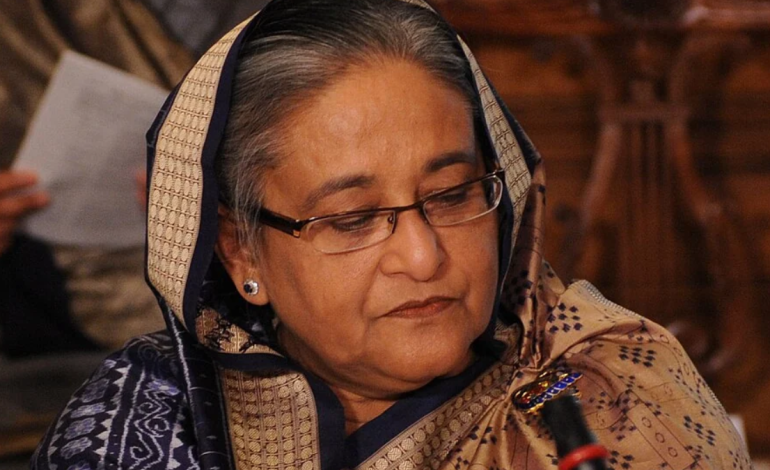
Sheikh Hasina questions Dhaka’s $2.3 billion China fighter jet purchase. (Image courtesy: Wikimedia)

New Delhi: Former Bangladesh prime minister, Sheikh Hasina, has questioned Dhaka’s reported plan to acquire J-10CE fighter aircraft from China, warning that major defence purchases must be justified by military needs and the country’s financial position. She also raised concerns over the regional consequences of the deal, saying Bangladesh should not allow its growing defence cooperation with Beijing to affect its relations with other countries.
In an interview with IANS, Hasina said Bangladesh had the right to strengthen its armed forces but needed to examine whether it could afford the proposed aircraft. She called for transparency in the procurement process and a proper assessment of the country’s defence requirements.
Hasina also spoke about her own political future, making clear that the possibility of arrest, imprisonment or death would not prevent her from returning to Bangladesh. She recalled coming back to the country in 1981 and 2007 despite political risks, saying she did not want to remain away while her people were facing difficulties.
The former prime minister said she would rather die in Bangladesh than stay away from her homeland. She also expressed hope that her personal situation would not damage relations between New Delhi and Dhaka.
Awami League exclusion and tribunal verdict
Hasina questioned why the Awami League was being kept out of the electoral process if the authorities believed the party no longer enjoyed public support. The Yunus-led interim administration had banned the party and its affiliated organizations through a notification issued last year on May 12.
She argued that voters, rather than administrative restrictions, should determine the party’s political future. She said the Awami League should be allowed to campaign and contest elections, even if voters ultimately chose another party.
She also rejected the International Crimes Tribunal verdict against her, alleging that the proceedings did not give her a genuine opportunity to defend herself. She said she would consider the legal options available to challenge the judgment.
Disputes allegations over 2024 uprising
On the deaths during the 2024 uprising, Hasina denied ordering security forces to kill innocent people. She said her government had set up a judicial inquiry commission in July 2024 to investigate the incidents but accused the subsequent administration of discontinuing its work.
She questioned the decision to stop that inquiry while pursuing murder cases against her and thousands of Awami League members. She also alleged that participants in the uprising had received legal protection for certain acts classified as political resistance.
Hasina further questioned whether the movement had delivered the changes promised to young protesters. She pointed to continuing violence, unemployment concerns and the influence of extremist groups, while referring to Muhammad Yunus’s description of the uprising as “meticulously designed” at the Clinton Global Initiative.
Minority safety
She also raised concerns over attacks on religious minorities, including Hindus, Buddhists and Christians. She cited incidents involving residential properties and places of worship and called for those responsible to face justice.
Hasina brought up the case of Hindu leader Chinmoy Krishna Das, saying he was unable to meet his seriously ill mother while in custody. According to Hasina, he received parole for five hours only after her death to attend the funeral.
She also pointed to extortion, mob violence and attacks on women as concerns that required urgent attention. Hasina accused the authorities of focusing on cases against Awami League members instead of addressing the security and livelihood concerns of ordinary citizens.
Economic concerns and India-Bangladesh ties
Hasina described Bangladesh’s economic position as increasingly difficult, citing banking sector problems and pressure on businesses. She referred to the IMF’s projected growth of 3.2 per cent for the current fiscal year and compared it with the expansion achieved during her administration.
On India, she said the relationship should not become dependent on the political dispute surrounding her. She highlighted the countries’ shared interests in trade, energy, connectivity and security, as well as their historical ties dating back to the 1971 Liberation War.
Hasina declined to comment on how India should handle her situation, saying decisions on the matter rested with the Indian government. She also argued that cooperation between the neighbours would be stronger with a representative government in Dhaka.
Recalling agreements on the land boundary, Ganges water-sharing and maritime issues, she said disagreements could be resolved through negotiations. She called for both countries to preserve their relationship despite political differences.