
Volkswagen turns heat on Mercedes, BMW and Kia in $1.2 billion India tax battle
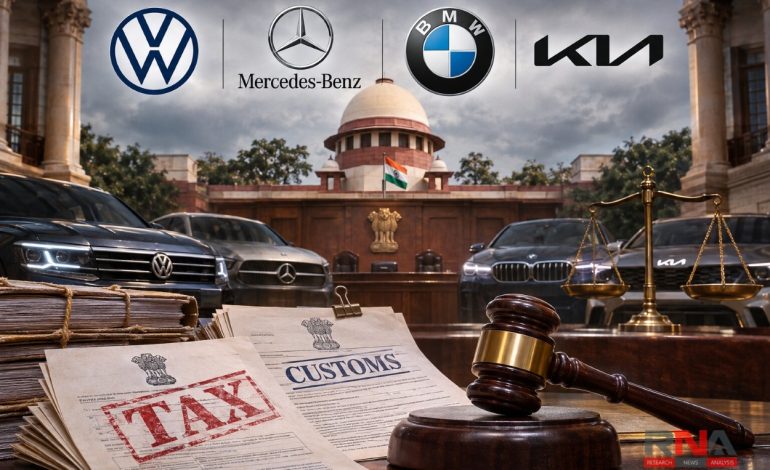
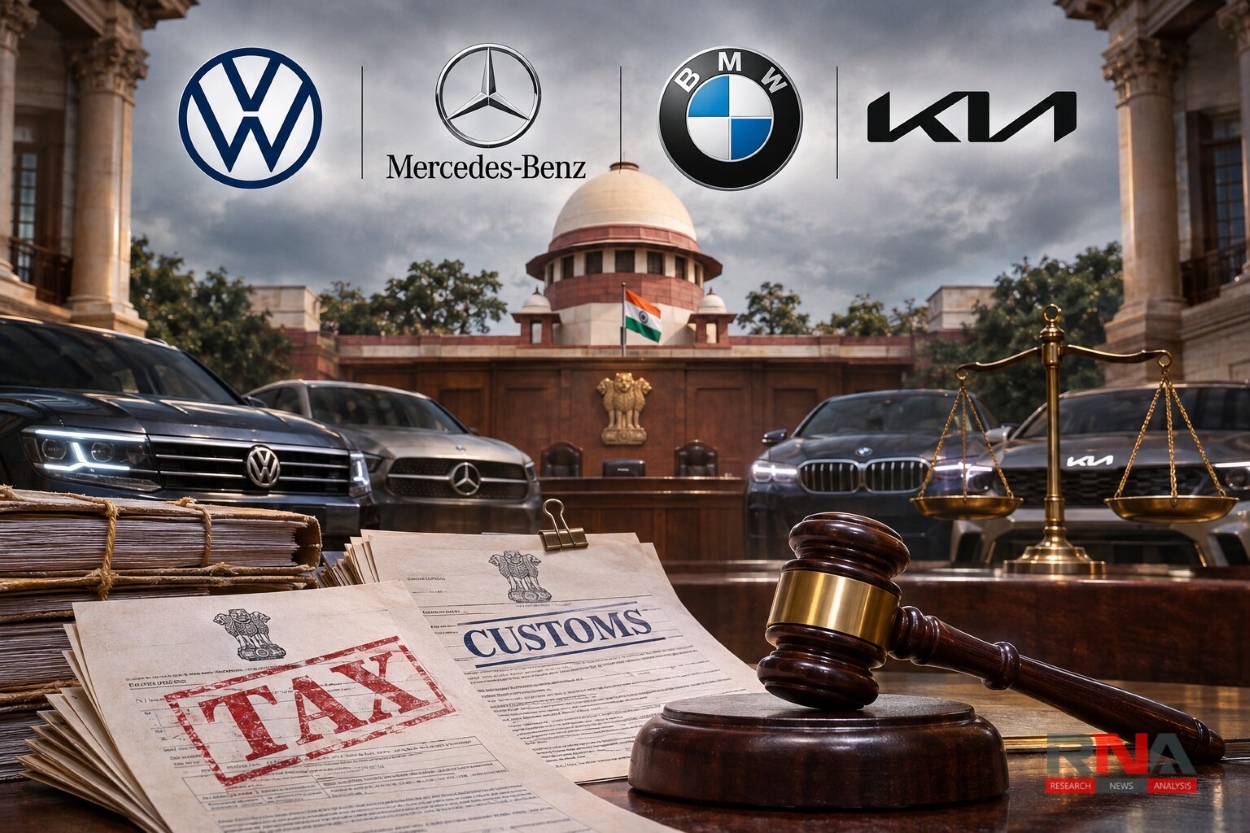
RNA Media illustration for representation.

New Delhi: German automobile giant Volkswagen has widened the scope of its $1.2 billion customs duty dispute with India by alleging that several of its competitors, including Mercedes-Benz, BMW and Kia, follow similar practices while importing vehicle components into the country. The development could have far-reaching implications for foreign carmakers operating in India, the world’s third-largest automobile market, and their manufacturing and investment strategies.
Volkswagen, which has been fighting the Indian customs authorities in court since 2025, has challenged the government’s assertion that it alone adopted an import mechanism that enabled it to pay substantially lower customs duties on components subsequently assembled into finished vehicles. The company maintains that it has complied with Indian laws and has been unfairly singled out for scrutiny.
In a submission dated November 10, 2026, before the Bombay high court, Volkswagen’s Indian subsidiary, Skoda Auto Volkswagen India, cited the import records of several competing automobile manufacturers to contest the government’s position. The contents of the court filing, which is not publicly available, were first reported by Reuters on Friday.
The immediate stakes are particularly high for Volkswagen, which has warned that the tax liability could jeopardize its entire investment in India. Despite its longstanding presence in the country through multiple brands, the German automobile group commands only around 2 per cent of the Indian car market.
What triggered the billion-dollar tax dispute?
At the heart of the dispute is the classification of imported automobile components under India’s customs regulations, which prescribe different duty structures depending on the nature of the imports. While individual components have historically attracted duties ranging from 5 to 15 per cent, completely knocked-down (CKD) vehicle kits have attracted substantially higher levies of around 30–35 per cent under the applicable tariff regime.
A CKD kit broadly comprises the components required to assemble a vehicle at a manufacturing facility in the destination country. The differential tariff structure is intended to encourage deeper localization of automobile manufacturing rather than merely assembling vehicles using predominantly imported components.
Indian customs authorities have alleged that Volkswagen circumvented this distinction by importing components for its Volkswagen, Skoda and Audi vehicles through multiple consignments. Investigators contend that these imports effectively constituted unassembled vehicles despite being declared as individual automobile parts.
The authorities issued a show-cause notice in September 2024, with the disputed duties initially reported at $1.4 billion. The investigation also examined Volkswagen’s use of an enterprise software system called Nadin, which the authorities alleged facilitated the import arrangement.
Volkswagen has rejected that interpretation, maintaining that the software is a production and supply-chain management tool used across its global operations. The company subsequently approached the Bombay High Court seeking to have the customs notice set aside.
Volkswagen challenges selective enforcement
In its latest submission, Volkswagen presented 2024 import data pertaining to BMW, Mercedes-Benz, Kia, Japan’s Isuzu Motors and JSW MG Motor India. It argued that the import practices of comparable manufacturers were inconsistent with the customs authorities’ contention that Volkswagen alone had adopted the disputed duty classification.
The figures cited by Volkswagen included 390,360 major component shipments by BMW and 80,972 by Mercedes-Benz under the lower-duty category. However, as ET Now reported, shipment volumes do not independently establish that the companies followed identical manufacturing or import arrangements.
That distinction could prove crucial because importing large quantities of components does not necessarily amount to importing complete vehicles in disassembled form. Differences in domestic sourcing, manufacturing processes and the composition of individual consignments could materially affect their customs classification.
Kia maintained that its component imports complied with applicable laws, while the other manufacturers named in the submission did not respond to Reuters’ queries. Notably, Kia itself had previously faced a separate $150 million customs demand involving allegations of misclassification of imported automobile components.
Crucial court ruling on November 30
The Bombay high court is expected to deliver a ruling on Monday, although the immediate decision may concern a narrower legal question rather than the merits of the alleged duty evasion. The court is examining whether customs authorities were legally entitled to scrutinize Volkswagen’s imports stretching back 12 years.
Volkswagen has challenged the notice on the grounds that it exceeds the statutory limitation period. The customs department, however, has argued that the period must be calculated from the finalization of provisional assessments and has alleged that the company failed to furnish all the requisite documentation.
During an earlier hearing in February 2025, the court directed the authorities to explain why the notice should not be considered time-barred. A ruling on this issue could substantially influence the subsequent course of the litigation without necessarily settling the controversy over tariff classification.
Implications for India’s automobile industry
The dispute comes at a sensitive juncture in India’s economic engagement with Europe, following the conclusion of negotiations on the India-European Union free trade agreement (FTA) on January 27 this year. As RNA reported earlier, the agreement envisages substantial reductions in automobile tariffs and the phased elimination of duties on most car components over five to 10 years.
Although prospective tariff concessions would not automatically extinguish past customs liabilities, the Volkswagen litigation highlights the importance of regulatory predictability for manufacturers making long-term capital investments. It also comes as Volkswagen has been exploring a partnership with India’s JSW Group to strengthen localization and expand its presence in the Indian market.
For New Delhi, the case involves an equally important consideration – protecting government revenue and ensuring that tariff incentives genuinely promote domestic manufacturing. Allowing companies to circumvent higher duties through artificial arrangements, if established, could undermine manufacturers that have invested substantially in indigenous component production and supply chains.
The eventual outcome could therefore extend well beyond Volkswagen’s financial liability. It could determine how international automobile manufacturers structure their Indian operations, how customs authorities distinguish component imports from vehicle kits, and how India reconciles its manufacturing ambitions with its commitments to greater international trade integration.