
Trump orders sharp cut in US-South Korea drills as North Korea steps up missile tests
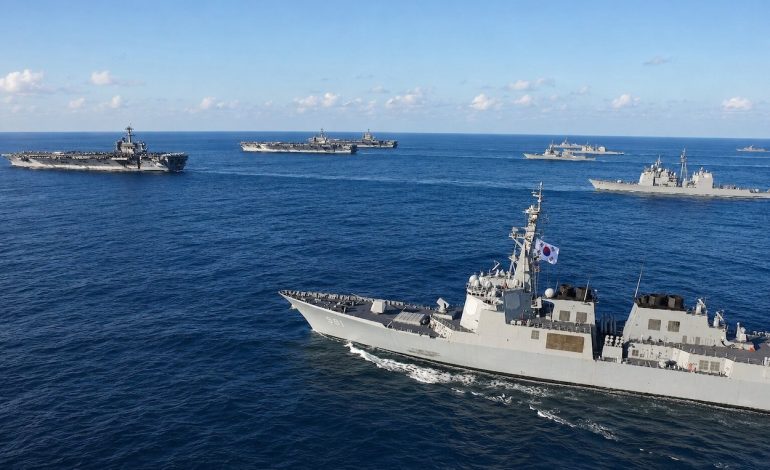
This screenshot from a South Korea defence ministry handout video shows US and South Korean warships in Exercise Ulchi Freedom Shield.

New Delhi: The US president, Donald Trump, has ordered the Pentagon to substantially reduce joint military exercises with South Korea, reviving concerns about allied military readiness as North Korea accelerates its missile programme. The directive was issued only hours before the annual Ulchi Freedom Shield exercise began on Monday, involving about 18,000 South Korean military personnel.
Trump said it was too late to cancel the exercise but instructed the US defence secretary, Pete Hegseth, to reduce American participation significantly. He described the drills as expensive and argued that they sent an “inappropriate and hostile” signal to North Korea, which he claimed had remained restrained during his presidency.
The Pentagon referred questions about the order to the White House, which did not immediately explain how the exercise would be curtailed or which elements would be affected. South Korea’s Joint Chiefs of Staff said the drills had begun as scheduled and declined to comment directly on Trump’s announcement, while the presidential office and foreign and defence ministries offered no immediate response because Monday was a public holiday.
Ulchi Freedom Shield is scheduled to continue until August 27 and combines computer-assisted command-post simulations with field training. This year’s exercise has been designed to test the allies’ ability to counter increasingly complex threats, including drone attacks, cyberwarfare, ballistic missiles and disruption of the Global Positioning System.
US Forces Korea describes the exercise as an annual, defensive programme intended to strengthen coordination among the South Korean joint chiefs of staff, Combined Forces Command, United States Forces Korea and the United Nations Command. It incorporates live, virtual and field-based training across several military domains.
Trump linked his decision partly to his relationship with the North Korean leader, Kim Jong-un, saying the two men continued to share a “very good relationship”. He also criticized Seoul for refusing what he described as a request to assist US efforts against Iran, although the South Korean government did not immediately address that assertion.
The move comes despite two North Korean ballistic-missile launches in less than a week and repeated warnings that Pyongyang is improving both its nuclear delivery systems and conventional capabilities. South Korea detected a missile launched from the eastern coastal area of Wonsan on August 12, six days after another ballistic missile was fired from the same region.
The August 11 missile travelled about 700 kilometres before falling into the sea off the peninsula’s eastern coast, according to South Korean and Japanese defence authorities. It was North Korea’s 11th suspected ballistic-missile test of 2026, with this year’s launches including short-range ballistic missiles, artillery rockets and other tactical weapons.
Seoul convened an emergency national security meeting after the launch and condemned it as a violation of UN security council resolutions. The US Indo-Pacific Command said the missile posed no immediate threat to American personnel, territory or regional allies, but reaffirmed Washington’s commitment to their defence.
Pyongyang routinely portrays US-South Korean exercises as preparations for an invasion and has frequently conducted weapons tests around major allied drills. Washington and Seoul reject that characterization, maintaining that the exercises are defensive and essential for ensuring that their forces can operate together during a crisis.
Trump’s assessment that North Korea has been unthreatening contrasts with growing concern over its military cooperation with Russia. North Korean troops that fought alongside Russian forces in the war against Ukraine are believed to have gained experience in drone warfare, battlefield communications and modern combined-arms operations.
American military officials have warned that Pyongyang has also continued developing missiles capable of reaching the continental United States. Lieutenant General Joseph Jarrard, a senior US Northern Command officer, said recently that North Korea had demonstrated sufficient missile propulsion to deliver a nuclear payload anywhere in North America.
The president’s decision echoes his approach during his first term, when he suspended major military exercises following his June 2018 summit with Kim in Singapore. Trump then called the drills provocative and costly, arguing that their suspension could support negotiations over North Korea’s nuclear programme.
Trump met Kim three times between 2018 and 2019, but their diplomacy failed to produce a lasting denuclearization agreement. North Korea subsequently expanded its nuclear arsenal and developed a wider range of ballistic missiles, including solid-fuel systems intended to shorten launch-preparation times and make detection more difficult.
The United States maintains about 28,500 troops in South Korea under a mutual-defence arrangement dating from the Korean War. Trump has repeatedly pressed Seoul to assume a larger share of the cost of their deployment, placing burden-sharing at the centre of his approach to the alliance.
The decision could also complicate South Korea’s efforts to secure the eventual transfer of wartime operational control of its forces from Washington to Seoul. That process is conditions-based and depends partly on the ability of the two militaries to demonstrate effective command integration through joint exercises.
Some analysts believe the reduction may be intended to create political space for another diplomatic opening with Pyongyang. Jenny Town, director of the 38 North programme at the Stimson Center, told Reuters that the decision could form part of a wider attempt to revive engagement, although its abrupt execution might make little impression on the North Korean leadership.
Victor Cha, who heads the Korea programme at the Center for Strategic and International Studies, suggested Trump could also be seeking to weaken Pyongyang’s increasingly close relationship with Moscow. Any diplomatic benefit, however, would depend on North Korea offering reciprocal restraint rather than treating the reduced exercises as a unilateral concession.
The order has drawn criticism in Washington, with senator Mark Kelly, a Democrat and former US Navy officer, calling the weakening of the drills a short-sighted mistake. He argued that the United States’ ability to defend South Korea rested on forces being properly trained and capable of coordinating during an emergency.
For Seoul and other US allies in the Indo-Pacific, the immediate concern is whether the directive represents a tactical effort to reopen communication with Kim or a wider retreat from established deterrence arrangements. With North Korea continuing missile tests and acquiring battlefield experience through Russia, the scale and duration of the reduction – and whether Pyongyang responds in kind – will determine its strategic consequences.