


India’s nuclear arsenal may reach from 190 to 225 warheads as New Delhi’s focus tilts firmly towards China, study finds
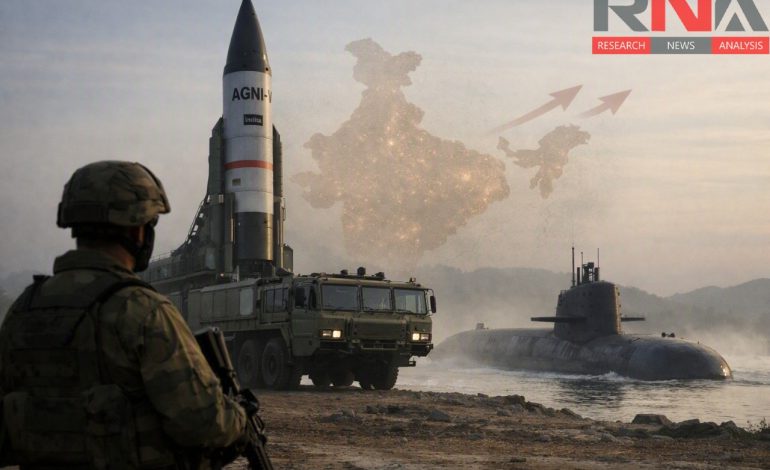
RNA Media illustration for representation.

New Delhi: India’s nuclear weapons stockpile has grown to an estimated 190 assembled warheads, with the country’s fissile-material stocks theoretically sufficient to build as many as 225. This is the central finding of the latest independent assessment by the Nuclear Information Project of the Federation of American Scientists (FAS), published on Wednesday.
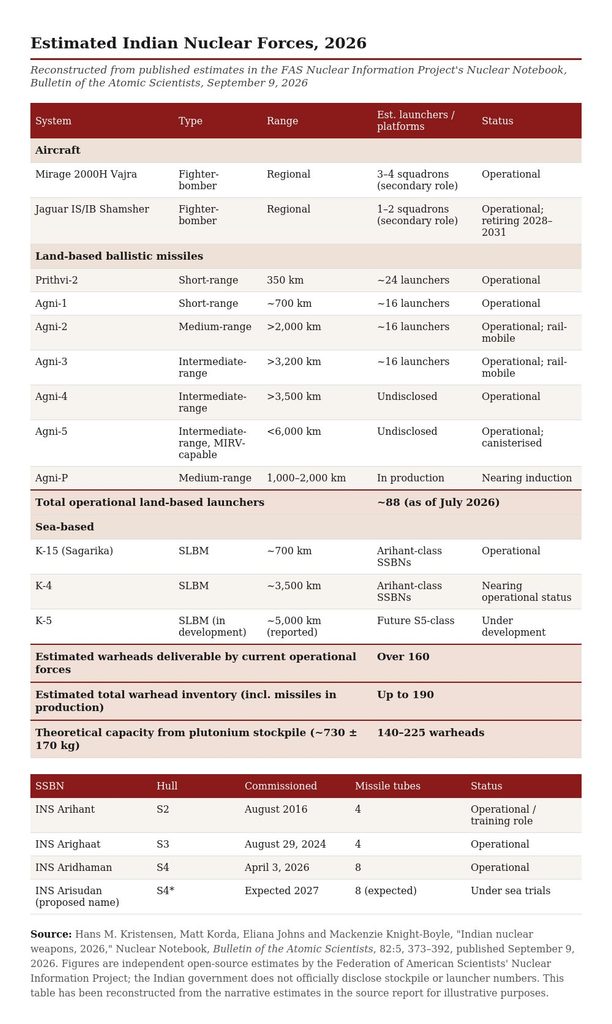
The assessment, part of the long-running Nuclear Notebook series carried by the Bulletin of the Atomic Scientists, is authored by Hans M Kristensen, Matt Korda, Eliana Johns and Mackenzie Knight-Boyle. It concludes that India currently operates nine distinct nuclear-capable delivery systems – two aircraft types, six land-based ballistic missiles and one sea-based missile – with at least two more nearing completion. Together, the researchers estimate, India’s operational forces can already deliver more than 160 warheads, with the remainder held for missiles still entering production.
The most significant recent milestone is naval. India commissioned its third indigenously built nuclear-powered ballistic missile submarine (SSBN), INS Aridhaman, on April 3. The boat is noticeably longer and wider than its two predecessors and is believed to carry eight missile tubes – twice the number fitted on INS Arihant and INS Arighaat.
A fourth Arihant-class boat, expected to be named INS Arisudan, is scheduled for commissioning in 2027. Beyond that, the Navy is already developing a larger next-generation class, the S5, which satellite and other imagery suggest could carry 12 or more launch tubes. A new shipbuilding hall under construction at Visakhapatnam is thought to be intended for this programme.
On the production side, India’s new 500-megawatt Prototype Fast Breeder Reactor at Kalpakkam in Tamil Nadu reached first criticality in April this year, more than a decade behind schedule. Operated at 80 per cent efficiency, the reactor could theoretically yield around 140 kilograms of weapons-grade plutonium a year, enough for up to 35 additional warheads annually, though the researchers caution this is a technical ceiling rather than a confirmed production rate.
The International Panel on Fissile Materials had earlier estimated India’s stock of separated weapons-grade plutonium at approximately 730 kilograms, plus or minus 170 kilograms, as of early 2026. At roughly four kilograms of plutonium per warhead, this would theoretically support between 140 and 225 warheads. The FAS team notes, however, that uncertainty over India’s actual warhead designs – ranging from simple fission devices to boosted or thermonuclear types – makes precise conversion of plutonium stocks into warhead numbers unreliable, and that India has probably not converted all its plutonium into finished weapons.
India’s nuclear doctrine has historically centred on Pakistan, but the report finds that the country’s newer, longer-range missiles point increasingly towards China. Most of the newer Agni-series missiles have ranges that make sense chiefly against Chinese targets, a shift reinforced since the 2017 Doklam standoff and the deadly Galwan valley clash of June 2020. India’s former chief of defence staff had already told reporters in November 2021 that China had become the country’s principal security threat.
This reorientation is most visible in the Agni-5 programme. In March 2024, under what the government called Mission Divyastra, India carried out the first test of an Agni-5 fitted with multiple independently targetable re-entry vehicle (MIRV) technology, and a second such test followed in May 2026. Given the missile’s payload limits and the relatively heavy warheads India is believed to use, the researchers estimate the Agni-5 will likely carry no more than three warheads once the capability matures.
India’s land-based missile force remains its largest leg by launcher count. The Army is estimated to field around 88 operational nuclear-capable launchers as of July 2026, spread across the short-range Prithvi-2 and Agni-1, the medium-range Agni-2, and the intermediate-range Agni-3 and Agni-4. A further missile, the medium-range, canister-launched Agni-P, is close to entering service and is expected eventually to replace the older Prithvi-2 and Agni-1.
Several of these systems are also moving onto rail. India has built rail-mobile missile garrisons at Dehu in Pune district and at Missa in Nagaon district, alongside a testing and integration facility at Panagarh in West Bengal. The Agni-P was rail-launched for the first time in September 2025, adding a harder-to-track option to a force that already includes the rail-capable Agni-2 and Agni-3.
The air leg of the triad still rests on ageing aircraft, though this is changing. Three or four squadrons of Mirage 2000H and Jaguar fighters are believed to retain a secondary nuclear strike role, but the Jaguar fleet is now due to begin retiring between 2028 and 2031, later than earlier plans. The French-built Rafale, of which 36 are already in service, is seen as the likely successor for the nuclear mission; the Ministry of Defence’s Defence Acquisition Council approved the purchase of a further 114 Rafales in February this year, most to be manufactured domestically, on top of a separate April 2025 order for 26 carrier-based Rafale Marine jets.
On the conventional side, India signed a $7.5-billion deal with Hindustan Aeronautics Limited in September 2025 for 97 Tejas-Mk1A fighters, while the more advanced Tejas-Mk2 remains under development to eventually replace the Jaguar outright. Both programmes fall outside India’s nuclear force structure but are central to the wider modernisation of the Air Force.
Tensions with Pakistan remain the most immediate flashpoint. After militants killed 26 people in Indian-administered Kashmir in April 2025, India launched Operation Sindoor, striking what it described as terrorist infrastructure inside Pakistan. The clash, described by some observers as the worst between the two countries in over two decades, prompted Pakistan to convene its National Command Authority, the body overseeing its nuclear arsenal.
Such episodes are not new. Indian and Pakistani troops exchanged fire along the Line of Control in November 2020, and Indian aircraft struck near Balakot in February 2019 after a suicide bombing, triggering a similar convening of Pakistan’s nuclear command structure at the time.
Accidents add a further layer of risk. In March 2022, India accidentally fired a conventional BrahMos cruise missile 124 kilometres into Pakistani territory, damaging civilian property; New Delhi did not issue a public statement for two days, and Islamabad said it was not alerted through the military hotline. The FAS researchers warn that a similar accident during a period of heightened tension could escalate far more dangerously.
India’s no-first-use doctrine, declared after its 1998 tests, has also been quietly qualified over time. A 2003 clarification reserved the right to respond to chemical or biological attacks with nuclear weapons, and the then defence minister, Manohar Parrikar, suggested in 2016 that India should not be “bound” by “no first use” doctrine, although his office later called this a personal view. The current defence minister, Rajnath Singh, added to the ambiguity in an August 2019 social media post stating that India had “strictly adhered” to the doctrine but that future conduct would depend on circumstances.
Supporting the sea-based leg, India is building a new submarine base, INS Varsha, near Rambilli on the east coast, roughly 50 kilometres south of the Visakhapatnam shipyard. Satellite imagery examined by the researchers shows extensive tunnelling and underground works, consistent with a facility designed for missile loading away from public view.
Piecing all this together is unusually difficult, the report notes, because India has never officially disclosed the size of its arsenal. In 2016, the government exempted its Strategic Forces Command from the Right to Information Act, further restricting public access to information that researchers, journalists and analysts might otherwise use to verify claims about the programme.
With a fast breeder reactor now operational, a MIRV-capable missile in testing, a growing submarine fleet and further missiles still in the pipeline, the FAS team expects India’s warhead stockpile to keep expanding over the coming years. The full technical assessment, including detailed force tables, is published in the Bulletin of the Atomic Scientists (volume 82, issue 5, pages 373–392) and is freely available in PDF form through Taylor & Francis.