


Ukraine rejects Musk’s Starlink drone-strike claim after satellite service restored
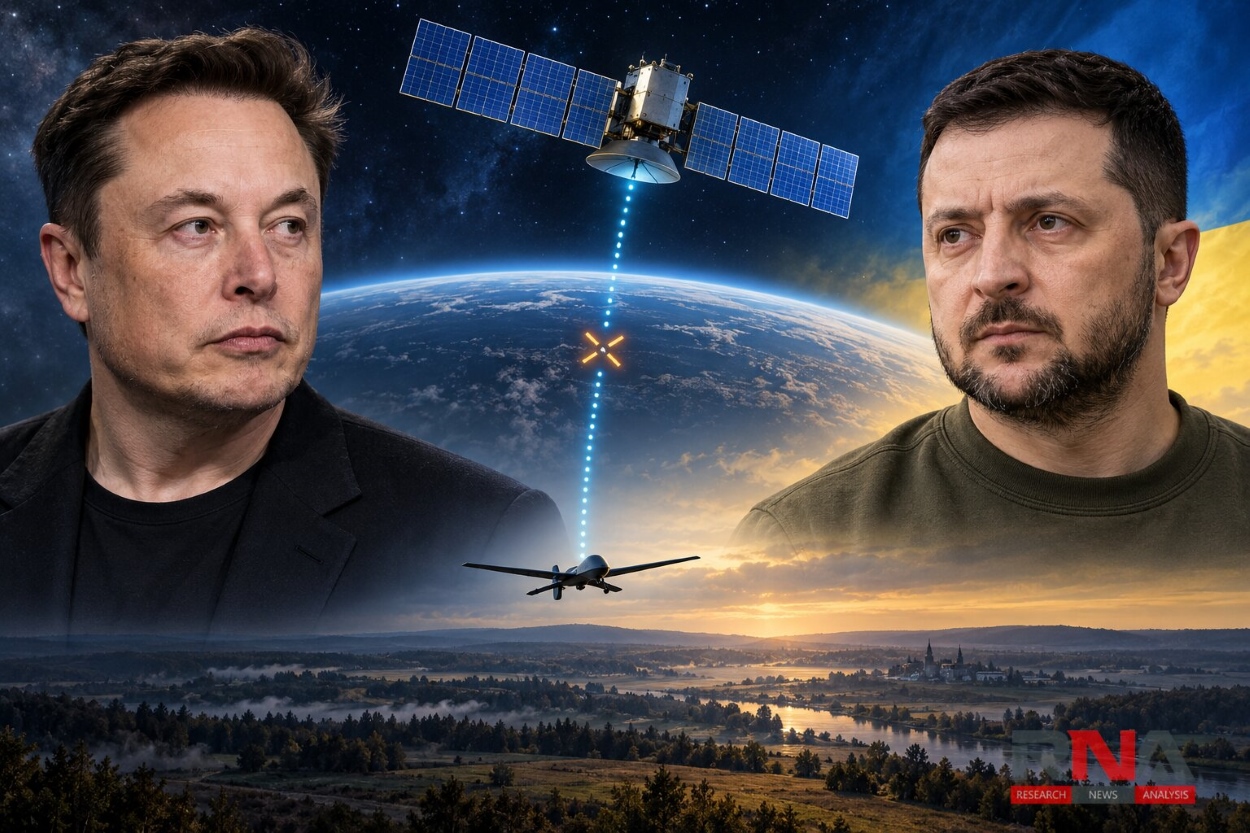
RNA Media illustration for representation.

New Delhi: Ukraine has rejected Elon Musk’s allegation that its military misused civilian Starlink connections for offensive drone strikes, saying existing technical restrictions made medium- and long-range attacks using the service impossible. The dispute followed the restoration of high-speed Starlink and Starshield connectivity after more than a week of disruption that Ukrainian officials said hampered drone operations, air defence and frontline communications.
The SpaceX chief executive said on Saturday that Ukrainian forces had breached Starlink’s terms of service by using the commercial satellite network for offensive attacks. In a post on X, he said offensive drone strikes were prohibited and that SpaceX had closed a loophole permitting such use, while maintaining that decisions concerning the military-focused Starshield service rested with the US government.
Ukraine’s response centred on the distinction between the two services and the restrictions already governing civilian terminals. A defence technology adviser to the Ukrainian president, Serhii Beskrestnov, also known as “Flash”, said commercial Starlink terminals operating within Ukraine, including Russian-occupied territory, had been subject to movement-speed limits of 70–90km/h since February this year.
Beskrestnov also said civilian Starlink did not operate over Russian territory, arguing that these geographical and speed restrictions prevented its use for the medium- and long-range strikes under discussion. His rebuttal challenged Musk’s explanation for the restrictions, rather than denying that Ukraine conducts drone attacks against Russian military and industrial targets.
A former adviser to Ukraine’s defence minister, Serhii Sternenko, offered a further explanation of how military access was organized. He said stationary terminals could be registered for civilian or military use, but terminals requiring connectivity while moving had to receive separate authorization and be connected to Starshield.
According to Sternenko’s account, drone missions requiring satellite communications therefore operated through Starshield, rather than ordinary commercial Starlink. That distinction is central to the disagreement: Musk defended restrictions on civilian Starlink, while Ukrainian officials questioned why connectivity supporting authorized military operations had also been curtailed.
The practical effects extended beyond Ukraine’s offensive operations, according to military personnel interviewed during the disruption. Ukrainian officials and an officer told CNN that connection losses affected reconnaissance aircraft and interceptor drones used against Russian attacks, with some equipment losing its satellite link when travelling above approximately 160km/h.
These were restrictions linked to the movement speed of connected equipment, rather than simply slower internet downloads. The officer described interruptions lasting 10–15 seconds and unusually heavy losses of equipment, illustrating how an apparently technical limitation could interrupt missions across different parts of the battlefield.
On Saturday, Ukraine’s defence ministry confirmed that its monitoring systems were recording stable connections at movement speeds above 400km/h. The ministry said operating speeds had been restored and that it would continue monitoring both services.
The president of Ukraine, Volodymyr Zelenskyy, said in his address announcing the restoration that connectivity began returning overnight and had reached the required speeds by that morning. He emphasized its importance for frontline logistics and protection against Russia’s jet-powered Shahed attack drones, thanking American officials and other partners who had helped resolve the problem.
However, the restoration did not settle who had authorized the restrictions affecting Starshield. Musk maintained that the US government controlled that service, while the US president, Donald Trump, denied ordering the curbs; the vice-president, JD Vance, nevertheless suggested there had been coordination between the White House and Musk.
Starlink and Starshield have become important components of Ukraine’s wartime communications, supporting troops, logistics and drone operations when other connections are unavailable or disrupted. The episode has highlighted the operational consequences of relying on satellite services whose access conditions are determined outside Ukraine.
Kyiv is also exploring systems over which it would exercise greater control, although those efforts remain at an early stage. On October 22, its defence ministry signed a letter of intent with Nokia and the Finnish satellite company ICEYE to examine cooperation on sovereign satellite communications.
The companies’ proposed approach would give government customers ownership and control of satellites, ground infrastructure and terminals, addressing the question of who ultimately controls essential connectivity. The agreement is exploratory, however, and does not establish an immediately available replacement for the SpaceX services on which Ukrainian forces continue to depend.