
India lodges strong protest over Pakistan’s planned Gilgit-Baltistan polls
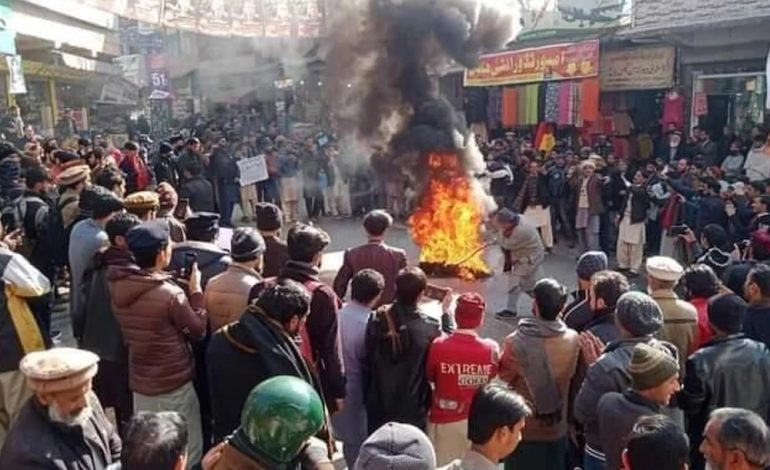
People in Gilgit-Baltistan protesting against the Pakistani government for inflation and neglect, in January 2023. (Photo courtesy: X/@MukherjeeVeer)

New Delhi: India on Friday lodged a strong diplomatic protest against Pakistan’s decision to hold elections to the so-called Gilgit-Baltistan assembly on June 7. New Delhi reiterated that the region remains an integral part of India and warning Islamabad against attempts to alter the status of territories under its occupation.
In a sharply worded statement, the Ministry of External Affairs (MEA) rejected Pakistan’s move to conduct what it described as “general election” in Gilgit-Baltistan, a region that India regards as part of the Union territory of Ladakh. New Delhi maintained that the entire Union territories of Jammu & Kashmir and Ladakh, including Gilgit-Baltistan, legally acceded to India in 1947 and remain its “integral and inalienable” territory.
The protest comes days before voters in Gilgit-Baltistan are scheduled to elect members of the local assembly, a process that India has consistently opposed over the years on the grounds that Pakistan has no legal authority to undertake political or administrative measures in territories it occupies.
Without directly commenting on Pakistan’s internal electoral arrangements, the MEA said any such exercise carried out in territories under Pakistan’s control would have no legal validity from India’s standpoint. The ministry also reiterated New Delhi’s longstanding position that Pakistan continues to occupy parts of the former princely state of Jammu & Kashmir illegally.
“The entire Union territories of Jammu & Kashmir and Ladakh, including the so-called Gilgit-Baltistan, are integral and inalienable parts of India,” the ministry said, underlining that the accession of Jammu & Kashmir to India was “complete, legal and irrevocable”.
Human rights concerns
Apart from objecting to the planned polls, India also sought to draw attention to what it described as deeper issues affecting residents of Gilgit-Baltistan and other Pakistan-occupied territories.
According to the MEA, Pakistan’s efforts to organize elections cannot obscure concerns relating to human rights, political freedoms and economic conditions in the region. The ministry alleged that people living in areas under Pakistan’s control continue to face political repression, restrictions on freedoms and economic exploitation.
The reference reflects a broader Indian diplomatic approach in recent years, which has increasingly highlighted governance and human rights concerns in Pakistan-occupied territories while rejecting Islamabad’s criticism of developments in Jammu & Kashmir.
The latest statement is also consistent with New Delhi’s position articulated in several recent diplomatic exchanges, including its rejection earlier this week of references to Jammu & Kashmir in a joint communiqué issued by Pakistan and the European Union. On that occasion, India asserted that Jammu & Kashmir and Ladakh were integral parts of the country and said external parties had no locus standi to comment on the matter.
Longstanding dispute
Gilgit-Baltistan, located in the northernmost part of the erstwhile princely state of Jammu & Kashmir, has remained under Pakistan’s control since the first India-Pakistan conflict of 1947-48. The strategically important region borders China, Afghanistan and India and forms a key part of the China-Pakistan Economic Corridor (CPEC).
India has repeatedly objected to infrastructure projects, administrative changes and electoral exercises undertaken by Pakistan in the region, arguing that such measures are intended to create an impression of legitimacy over territory that remains disputed.
Successive Indian governments have maintained that any unilateral attempt by Pakistan to alter the character or status of these territories is legally untenable. New Delhi has also insisted that Pakistan must vacate areas under its occupation.
Reiterating that position on Friday, the MEA said India categorically rejects any effort to bring about material changes in territories under Pakistan’s control and stressed that such actions cannot alter the ground reality regarding sovereignty over the region.
The latest protest is expected to add to diplomatic friction between the two neighbours, whose relations remain strained over issues related to Jammu & Kashmir, cross-border terrorism and territorial claims.