

India backs UN call to end Cuba embargo, maintains decades-old diplomatic stand
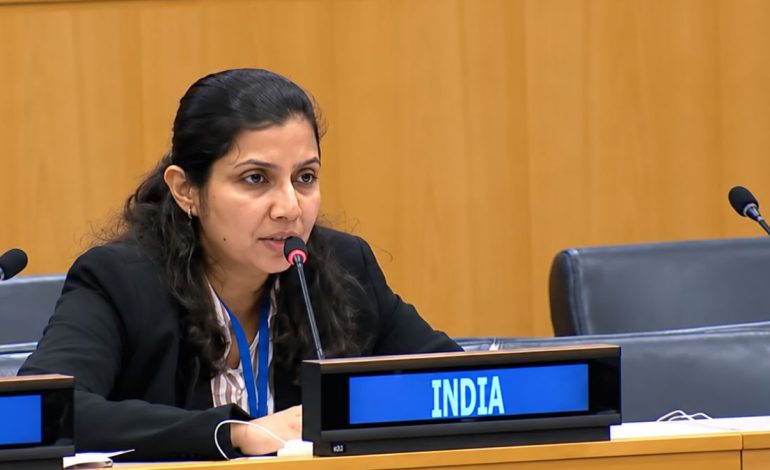
Soumya Nair, counsellor at India's permanent mission to the UN. (Image courtesy: Digitaly enhanced screenshot from a video shared via X/ @IndiaUNNewYork)

New Delhi: India voted in favour of a United Nations general assembly resolution on Wednesday calling for an end to the United States embargo on Cuba, reaffirming its longstanding opposition to unilateral economic restrictions. The decision came as international support for the measure declined sharply, even as New Delhi continued expanding its strategic partnership with Washington.
The 193-member assembly adopted the resolution by 130 votes to 17, with 25 abstentions. The US and Israel were among those opposing the measure, formally titled “Necessity of ending the economic, commercial and financial embargo imposed by the United States of America against Cuba”. The resolution is non-binding and cannot compel Washington to remove the restrictions.
India’s support predates the current diplomatic tensions. It voted for the first such resolution on November 24, 1992, when the measure passed with 59 votes in favour, three against and 71 abstentions. In a report submitted the following year, India explicitly confirmed its favourable vote and endorsed the resolution’s position on laws affecting other countries.
The pattern continued in recent years. India supported the resolution in 2023 and 2024, when it secured 187 votes in favour, two against and one abstention each year. It voted for the measure again in 2025, when support dropped to 165 countries, with seven opposing and 12 abstaining.
Addressing the latest debate, Soumya Nair, a counsellor at India’s permanent mission to the UN, criticized laws with extraterritorial effects that undermine other countries’ sovereignty and prosperity. She reiterated New Delhi’s preference for dialogue and diplomacy and expressed hope that lifting the embargo would allow Cubans greater participation in international cooperation.
The position echoes India’s October 2024 statement, delivered by first secretary, Sneha Dubey, opposing coercive economic measures and domestic laws whose effects extend beyond national borders. New Delhi’s objection concerns restrictions that impose consequences on businesses and individuals operating in other sovereign countries.
Citing a UN secretary-general’s report, Nair said Cuba faced shortages of more than 60 per cent of essential medicines, while food production had declined by over 50 per cent in five years. She also highlighted worsening fuel shortages affecting healthcare, education, water supplies and transport.
The vote came a day after a heated confrontation between US ambassador to the United Nations Mike Waltz and Cuban foreign minister, Bruno Rodríguez Parrilla disrupted general assembly proceedings on Tuesday. The confrontation erupted when Rodríguez and other Cuban diplomats challenged Waltz’s remarks criticizing Havana’s leadership and approached the podium, prompting an angry exchange between the two sides.
As the Cuban foreign minister moved towards the podium, Waltz demanded that he step back, declaring that he would not be intimidated. Rodríguez accused the American envoy of lying, while UN general assembly prepsident, Khalilur Rahman, repeatedly appealed for order before suspending the session. The meeting subsequently resumed, allowing both sides to present their positions.
During his address, Waltz accused Cuba’s political leadership of enjoying luxury watches, yachts, mansions and private islands while ordinary Cubans struggled with food shortages and widespread power outages. He also criticized the Cuban government’s human rights record and urged member states to reject the resolution calling for an end to the US embargo.
The confrontation escalated further after Waltz alleged that a member of the Cuban delegation had physically assaulted an American diplomat. He described the alleged incident as unacceptable, claimed it violated the host-country agreement and warned that the diplomat concerned would be sent back to Havana. The allegation and any subsequent action against the Cuban diplomat have not been independently confirmed.
Cuba embargo and changing international support
The embargo developed after the 1959 Cuban revolution, with Washington imposing sweeping trade restrictions in 1962 and subsequently tightening financial measures. The 1996 Helms-Burton Act expanded provisions affecting foreign companies, adding to objections over the reach of US domestic legislation.
International support has shifted considerably, with the resolution securing 57 fewer affirmative votes in 2026 than in 2023 or 2024. Germany and Italy, which previously backed it, abstained this year.
Italy acknowledged the embargo’s humanitarian consequences but cited concerns about Cuba’s economic reforms and political restrictions. US envoy, Mike Waltz, welcomed the changing voting pattern, while Washington maintained that Cuba’s domestic policies also contribute to its economic difficulties.
Cuba argues that the embargo restricts trade, investment and access to essential supplies. The US defends its policy as pressure on Havana’s government.
On the same day as the UN vote, the defence minister, Rajnath Singh, met US secretary of war, Pete Hegseth in Cebu, Philippines, to review their 10-year defence framework. Their discussions covered technology sharing, military cooperation, co-production and Indo-Pacific security.
The parallel developments underline New Delhi’s established diplomatic approach: strengthening strategic cooperation with Washington while maintaining its longstanding position against unilateral economic measures affecting Cuba.