

Netanyahu faces backlash over election claims as Arab parties gain leverage
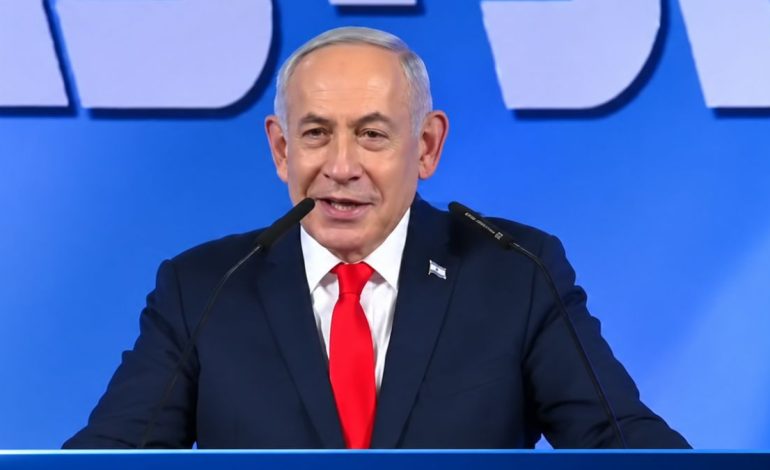
Benjamin Netanyahu.(Image courtesy: Screenshot of a video shared on X/@netanyahu)

New Delhi: The Israeli prime minister, Benjamin Netanyahu, faced mounting criticism after his Likud party alleged foreign interference and voter bribery following an election that cost his governing bloc its parliamentary majority. Arab-led parties secured a record 19 seats, putting their support at the centre of efforts to form Israel’s next government.
Results published by Israel’s central elections committee (CEC) on Friday gave Netanyahu’s alliance 53 seats and opposition leader Gadi Eisenkot’s bloc 48 in the 120-member Knesset, short of the 61 needed for a majority. The Joint List won 11 seats and Ra’am eight, with turnout reaching 77.9 per cent and more than 5.7 million ballots cast.
Likud accused Arab-led parties of benefiting from voter bribery and alleged interference involving Qatar and Turkey, without publicly presenting supporting evidence. Central Elections Committee chairman Justice Noam Sohlberg asked domestic security agency Shin Bet to examine suspicions of foreign involvement. The request concerned specific intelligence, not a finding that either country had intervened.
As RNA Media reported on Thursday, Israeli police said they had no investigative or intelligence evidence supporting Likud’s broader allegation that Arab-led parties had stolen the election.
Shin Bet said its inquiry was based on independently gathered intelligence and must not cast suspicion on an entire community that had voted lawfully. Acting committee director general, Dean Livne separately said there was no basis for claims of systematic violations of election integrity. Police arrested at least seven suspects over alleged voter fraud, but no connection to foreign funding has been established.
Eisenkot said it was “too early to determine what happened, or if anything happened at all”, accusing Netanyahu of orchestrating a campaign to delegitimize the results. The Joint List dismissed the allegations, while Balad chairman Sami Abu Shehadeh accused Netanyahu’s camp of constructing a racist narrative against Arab voters. Ra’am leader, Mansour Abbas denied party involvement and welcomed an investigation.
Qatar’s foreign ministry categorically denied financing activities to influence the election. Spokesman, Majed Al Ansari, called the accusations “ridiculous and dangerous” and accused Israeli politicians of spreading disinformation. Turkey’s Communications Directorate also rejected allegations of interference as baseless.
During Tuesday’s vote, Netanyahu described high Arab turnout as an “emergency” and a “matter of life or death” for the Israeli right, while circulating AI-generated images of Arab voters at polling stations, the BBC reported. Arab citizens comprise about one-fifth of Israel’s population, although their political affiliations and views are diverse.
Some Arab citizens have historically boycotted Israeli elections, arguing that participation legitimizes a political system they consider discriminatory. The BBC reported that opposition to Netanyahu’s right-wing coalition helped drive increased Arab voter participation this time, contributing to the unprecedented parliamentary strength of the two Arab-led lists.
A Hebrew University Accord Center survey conducted on election night found 61 per cent of 467 respondents who voted for four opposition parties supported an Eisenkot government including Ra’am. Conducted between 9.15 pm and 10.27 pm and weighted by party size, the poll measured preferences, not coalition commitments.
As RNA Media reported on Thursday, the political deadlock has left three broad possibilities: a unity government involving Netanyahu and Eisenkot, a Netanyahu-led majority assembled through opposition defections, or an Eisenkot administration relying on Arab-party support.The last could command 67 seats on paper, but Eisenkot and several allies have opposed governing with Arab parties.
The results are due to be formally submitted to president, Isaac Herzog, on November 4, with the new Knesset scheduled to convene on November 10. Netanyahu remains caretaker prime minister as the investigation and coalition negotiations proceed.