




Bhutan lake outburst forces 10,000 to safety in north Bengal, puts Assam on alert; Sankosh river on red alert
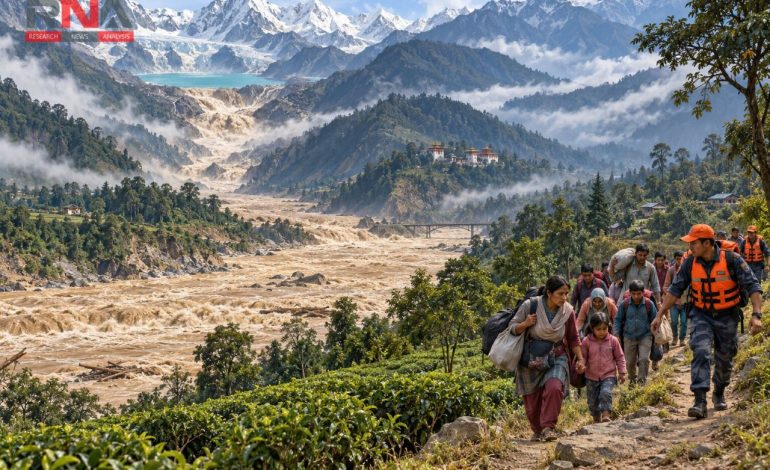
RNA Media illustration for representation.

New Delhi: More than 10,000 people have been moved to shelters and safer ground in West Bengal’s Alipurduar district after a reported glacial lake outburst in Bhutan sent floodwaters through a river system shared with India. The Sankosh river system remained on red alert, while neighbouring Assam stepped up surveillance in Dhubri district over a possible downstream surge.
The emergency followed a sudden release of water from Sintaphu lake, also spelt Shintaphu, in Bhutan’s northern Gasa district on Thursday evening. Floodwaters damaged roads and facilities at the Gasa Tshachu natural hot springs, although no deaths or injuries had been reported in Bhutan by the following morning.
The superintendent of police in Alipurduar, Amit Kumar Shaw, said approximately 4,000–5,000 people had been accommodated in relief shelters, including schools, while more than 6,000 others had moved to safer locations. The precautionary operation focused on communities exposed to a sudden rise in the Sankosh and its tributaries, according to local reports.
State disaster response personnel and civil defence teams were deployed, while National Disaster Response Force support was being mobilized. Shaw said the administration was coordinating with Bhutanese authorities and had arranged drinking water, dry food and toilet facilities for people staying in shelters.
Warnings covered vulnerable settlements in and around Kumargram, Chengmari, Pakriguri and Bholka, including riverbank communities and tea garden areas. Schools and community buildings were used as relief centres as officials urged residents to leave exposed locations before any surge arrived.
Shaw said information received from upstream indicated a slight reduction in the intensity of the flow, but the administration continued to maintain its alert. He also warned that the approaching water could carry timber and concrete debris, adding to the danger along the river.
Assam watches river levels
In Assam, an official of the state disaster management authority said the Sankosh’s water level was steady at 6.30am onFriday. Nevertheless, the Dhubri administration and response teams remained on standby, with the chief minister’s office saying the situation was being closely monitored.
A special advisory from the Union water ministry had warned of a possible sudden rise in the Sankosh in Alipurduar and Dhubri after the Indian embassy reported the Bhutan incident. The steady morning reading therefore provided a time-specific observation, while precautionary preparations continued downstream.
In Bhutan, floodwater reportedly reached Taktsemakhang at about 8.15pm on Thursday, damaging a road serving the remote highland community of Laya. Daily Bhutan reported that the affected section had become impassable and that people in exposed locations had been moved to safer ground.
Bhutan’s state broadcaster, Bhutan Broadcasting Service, reported damage to the Gasa Tshachu hot-spring facilities and said two Bailey bridges might also have been swept away. Darkness and strong currents initially prevented a full assessment, while Bhutan’s national newspaper, Kuensel, reported that the affected road towards Laya had been closed indefinitely.
A subsequent report on the infrastructure damage said a section of the Punakha-Gasa secondary national highway near the 31.85-kilometre point had been washed away. Travellers were advised to postpone non-essential journeys or check alternative arrangements as authorities assessed the damage.
The flood also partially damaged a solar-powered irrigation lifting system serving communities in Guma Gewog in Punakha, according to a local damage report. The installation had stopped functioning, while debris disrupted another stretch of the Punakha-Gasa highway in the Dzomlingthang area.
Sintaphu lies near Wakila Mountain in Lungo, Laya Gewog, at the headwaters of the Mo Chhu. The Mo Chhu flows south through Gasa and Punakha, where it meets the Pho Chhu to form the Punatsangchhu, which subsequently enters India as the Sankosh.
That connected river course allows an upstream flood in Bhutan to become a concern for settlements much farther downstream in India. The Central Water Commission was reported to be monitoring stations including Barobisha, Sankosh LRP, Golakganj and Baladoba, while Bhutanese hydrological authorities watched river levels at Tashithang and Yebesa.
Warning sirens were activated along the Mo Chhu and downstream sections of the Punatsangchhu. The Punatsangchhu II hydropower plant also reportedly suspended generation and opened its spillway gates to pass floodwater and debris through the installation.
What remains unclear
Sintaphu is among Bhutan’s 17 glacial lakes classified as potentially dangerous, a designation requiring sustained monitoring of lake conditions and the consequences of a possible sudden release. Bhutanese specialists surveyed the lake in 2023, examining its water bodies, surrounding terrain, natural barriers and the glacier feeding it.
A glacial lake outburst flood occurs when stored water escapes suddenly, often after the failure or weakening of a natural barrier made of rock, sediment and ice. The resulting surge can move rapidly through mountain valleys, gathering mud, boulders and other debris that increase its destructive force.
Although some early reports put the volume released at approximately 7.4 million cubic metres, the amount had not been independently confirmed in the Bhutanese account reviewed for this report. The precise trigger, the condition of the lake’s retaining barrier and whether the release involved overtopping or a breach also remained under assessment.
Gasa Tshachu had previously suffered flooding in 2021, when the Mo Chhu changed course through the hot-spring area. For the current incident, the immediate priorities remained assessing damaged infrastructure in Bhutan and monitoring the downstream threat to communities along the Sankosh in India.