
Army, RAF patrol Shillong as Khasi students’ rally violence spills into Assam-Meghalaya standoff
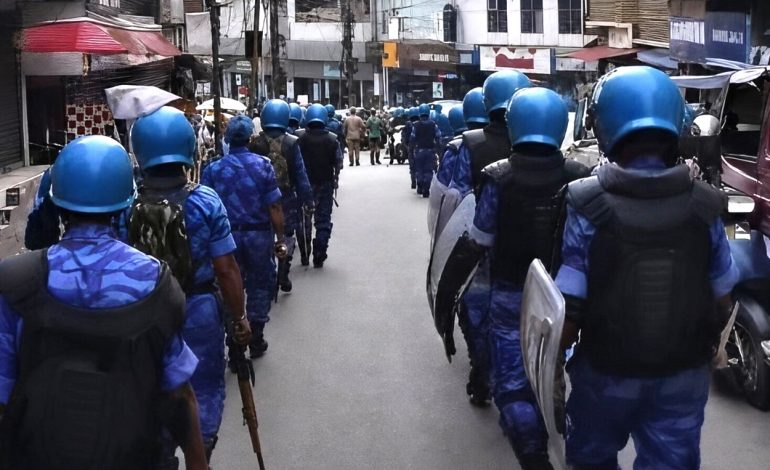
This screenshot from a widely circulated video on social media shows RAF personnel marching through a street in Shillong.

New Delhi: The Indian Army and the Rapid Action Force (RAF) conducted a flag march across Shillong on Saturday after violence during a Khasi Students’ Union (KSU) protest triggered retaliatory demonstrations and disrupted travel between Meghalaya and Assam. Although the immediate confrontation has begun to ease following talks between the two state governments, security remains tight in the Meghalaya capital and along the interstate transit corridor.
The Centre has authorized the deployment of five companies of central forces – four from the Central Reserve Police Force and one from the RAF – to support Meghalaya Police until August 25. The visible presence of security personnel is intended to deter further attacks, restore public confidence and prevent the unrest from acquiring a wider ethnic or interstate character.
The trouble began on August 19, when a black-flag motorcycle rally organized by the KSU descended into violence at several locations in Shillong. According to police, 16 people were injured, two vehicles were set ablaze and about 31 others were damaged, including Assam-registered vehicles and government property.
Statues of Swami Vivekananda and Netaji Subhas Chandra Bose were also allegedly vandalized as groups of masked men moved through parts of the city. The violence was reported in areas including Polo, Barik, Mawlai, Dhankheti and Nongrim Hills, where motorists and passengers were allegedly assaulted.
Meghalaya Police have registered 15 first information reports and constituted a special investigation team to identify and prosecute those responsible. Five masked suspects have been identified, while the KSU president, Raymond Kharjana, its vice-president, Pynkmenlang Sanmiet, and general secretary, Reuben Najiar, were arrested after the rally and sent to judicial custody.
The KSU expressed regret over the violence but denied that its members were responsible for the attacks, claiming that people with vested interests had infiltrated the procession to discredit its agitation. Police, however, are examining responsibility for both the violence and alleged breaches of the conditions under which the district administration had permitted the rally.
The attacks on Assam-registered vehicles transformed what had begun as a confrontation between the KSU and the Meghalaya government into an interstate crisis. Taxi drivers and transport organizations in Assam blocked Meghalaya-bound traffic at Jorabat and Khanapara, demanded compensation for damaged vehicles and threatened to restrict the movement of Meghalaya-registered vehicles.
Passenger vehicles and tourist taxis remained disrupted for three days, leaving travellers stranded and forcing the two governments to organize escorted movement. More than 3,770 Assam-registered vehicles were subsequently escorted out of Meghalaya, while the control rooms established by the two states received hundreds of requests for assistance.
The Meghalaya deputy chief minister, Sniawbhalang Dhar, and the Assam border protection and development minister, Atul Bora, led a three-hour meeting in Guwahati on August 22 to contain the fallout. Meghalaya expressed regret over the attacks, promised compensation to those injured and assured Assam that strong legal action would be taken against the perpetrators.
The two governments agreed to establish a permanent coordination channel between senior police officers, create joint district-level committees and form a separate panel involving transport officials and tourist taxi associations. They also committed themselves to ensuring safe transit for Assam vehicles travelling through Meghalaya and for Meghalaya residents who must pass through Assam to reach other parts of their state.
The blockade at Jorabat was subsequently withdrawn, and transport associations from both states agreed to exchange information about rallies and sensitive routes to prevent similar disruptions. Normal taxi services between Shillong and Guwahati were expected to resume gradually, although disagreement remained over who should compensate the owners of Assam vehicles damaged during the rally.
What caused the Shillong violence?
Despite being widely described as an Assam-Meghalaya border confrontation, the latest crisis did not begin over disputed territory between the two states. Its immediate cause was the KSU’s escalating agitation against the Meghalaya government over a five-point charter dealing with indigenous rights, migrant workers, public recruitment, environmental regulation and employment opportunities.
The KSU launched the rally after a 15-day deadline given to the government expired without what the organization considered an adequate response. It had held public meetings across Shillong on August 17 and 18 before taking out the black-flag procession the following day.
Its first demand is the cancellation of a July 31 public hearing on Shree Cement’s proposed limestone-mining project in East Jaintia Hills, which the union alleges was stage-managed and conducted without allowing opponents a fair hearing. It has also demanded action against district, police and pollution-control officials whom it accuses of preventing local participation.
The second demand concerns full implementation of the Meghalaya Residents’ Safety and Security Act, 2016, pending the Centre’s acceptance of the state’s longstanding demand for the Inner Line Permit system. The KSU wants facilitation centres at all 18 entry and exit points in the Khasi-Jaintia Hills, functioning district task forces and local verification through traditional Dorbar Shnongs.
Its remaining demands include enforcement of the amended law regulating migrant workers, changes in recruitment at the North-Eastern Indira Gandhi Regional Institute of Health and Medical Sciences, and wider reform of government recruitment. The union wants personal interviews abolished for certain Grade B, C and D posts and seeks changes in the functioning of the Meghalaya Public Service Commission and district selection committees.
At the root of the agitation is a longstanding fear among sections of Meghalaya’s indigenous population that migration, competition for jobs and large industrial projects could weaken their control over land, employment and local institutions. These anxieties have repeatedly fuelled demands for stronger entry controls and legal safeguards, but they do not justify attacks on travellers or vehicles from another state.
Assam and Meghalaya also have a separate, decades-old boundary dispute, arising from differences over the demarcation adopted when Meghalaya was carved out of Assam. The two states signed an agreement in March 2022 resolving six of 12 areas of difference, but the remaining sectors continue to provide a sensitive political backdrop to any confrontation involving residents of the two states.
The latest episode illustrates how quickly a domestic protest can become an interstate confrontation when people and vehicles are targeted by their place of origin. Restoring lasting normality will therefore require prosecution of those responsible, credible engagement with the KSU’s lawful demands and safeguards against retaliatory action on either side of the border.