Ajit Doval heads to Beijing for crucial India-China border talks. What is on his agenda?
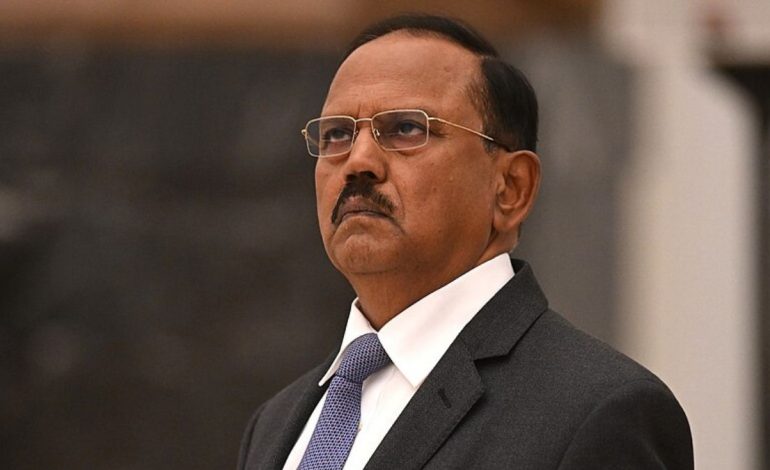
Ajit Doval. (File photo)

New Delhi: The national security advisor, Ajit Doval, will travel to Beijing on August 24 for the 25th round of Special Representatives’ talks with the foreign minister of China, Wang Yi, as the neighbours seek to move from military disengagement towards the more difficult tasks of de-escalation and boundary negotiations. The meeting, scheduled for August 25, will take place against a sensitive border backdrop and less than three weeks before the BRICS summit in New Delhi, which the president of China, Xi Jinping, is expected – but not yet officially confirmed – to attend.
Doval and Wang are their countries’ designated Special Representatives (SR) for negotiations over the boundary question, covering a disputed frontier that India measures at approximately 3,488 kilometres. Their latest engagement will be the 25th round under the mechanism created in 2003 to seek a political settlement while preventing unresolved territorial claims from triggering another military crisis.
The visit is part of an agreed diplomatic sequence rather than a hastily arranged intervention, as the two sides had decided during the previous round that China would host the next meeting in 2026. Its timing is nevertheless important because the cautiously improving relationship remains vulnerable to developments along the line of actual control (LAC).
India has consistently maintained that peace on the border is the essential foundation for progress elsewhere in the relationship, while Beijing has often argued that the boundary dispute should not define the entirety of bilateral ties. The external affairs minister, S Jaishankar, reiterated on August 22 that the condition of the border would, to a considerable extent, determine the condition of India-China relations.
From disengagement to de-escalation
Doval’s immediate objective is likely to be a review of the understandings reached during the 24th round, which he and Wang held in New Delhi on August 19, 2025. That meeting produced several potentially significant decisions, including the creation of an expert group to explore an “early harvest” in boundary delimitation and a separate working group to strengthen day-to-day border management.
An early-harvest approach would attempt to identify sectors where claims or perceptions of the boundary are less difficult to reconcile, without waiting for a comprehensive settlement covering the entire frontier. Delimitation refers to the political and legal process of defining a boundary, whereas demarcation involves physically marking an already agreed line on the ground.
The two countries also decided last year to establish general-level military mechanisms for the eastern and middle sectors, supplementing the arrangement already operating in the western sector. These channels are intended to improve communication between senior commanders and prevent routine patrol encounters or differences over the LAC from escalating into prolonged confrontations.
The principal challenge now is to progress beyond disengagement at the friction points that emerged in eastern Ladakh in 2020. Disengagement separates troops in specific areas, but de-escalation would require a broader reduction or relocation of forward-deployed forces, weapons and supporting infrastructure – a more complicated undertaking because it demands considerably greater confidence between the two militaries.
India and China had agreed in October 2024 on patrolling arrangements in Depsang and Demchok, enabling disengagement from the remaining friction points associated with the 2020 confrontation. The arrangement helped reopen political engagement, but it did not erase the military build-up, extensive border infrastructure or the fundamental disagreement over where the LAC runs.
The principles and practical modalities of de-escalation are therefore likely to be central to Doval’s discussions with Wang. New Delhi will want any reduction in military pressure to be reciprocal, verifiable and structured in a manner that does not place Indian troops at a tactical disadvantage.
Recent border concerns add urgency
The talks follow the 36th meeting of the Working Mechanism for Consultation and Coordination on India-China Border Affairs in New Delhi on August 6, when officials discussed boundary delimitation, border management, institution-building and transborder cooperation. Both governments subsequently said they would continue using diplomatic and military channels to resolve outstanding issues and prevent misunderstandings along the LAC.
The atmosphere has also been affected by reports of a face-off between Indian and Chinese patrols near Taksing in Arunachal Pradesh’s Upper Subansiri district in late July. Indian defence authorities dismissed the reports as unsubstantiated, while Beijing described the overall border situation as stable and said the two sides remained in communication.
Even an unverified report can acquire diplomatic significance when perceptions of the LAC differ and patrols operate in remote areas with limited communication. Doval is consequently likely to emphasize stronger local contacts, clearer protocols and quicker intervention by commanders whenever troops encounter one another.
China’s continuing claims over Arunachal Pradesh and its objections to India’s naming of places and geographical features in the state will remain part of the political background. New Delhi has repeatedly rejected such claims, asserting that Arunachal Pradesh is an integral and inalienable part of India and that invented Chinese names cannot alter that position.
Rivers, border trade and broader ties
Transborder rivers could also feature in the discussions because the previous SR meeting called for continued engagement on hydrological information, emergency management and the renewal of related agreements. Cooperation in this area has direct humanitarian and strategic importance for India, as several major rivers originate in Chinese-controlled Tibet before entering Indian territory.
The two sides may additionally review the restoration of traditional border trade and other practical measures intended to rebuild limited confidence. Direct passenger flights resumed in October 2025, the Kailash Mansarovar Yatra has continued through the Lipulekh and Nathu-la routes, and several official dialogue mechanisms suspended during the post-2020 freeze have been revived.
These steps indicate normalization, but they do not yet amount to a strategic reset between the two Asian powers. India’s approach remains one of controlled stabilization – maintaining diplomatic engagement and restoring useful exchanges without treating the unresolved boundary and the accompanying military risks as secondary issues.
Preparing ground for possible Modi-Xi meeting
Doval’s visit is also likely to help prepare the political ground for the BRICS summit in New Delhi on September 12 and 13, particularly if Xi confirms his attendance. A relatively calm border and measurable progress in the SR dialogue would improve the atmosphere for a possible meeting between the prime minister, Narendra Modi, and the Chinese leader.
Modi and Xi last held bilateral talks on August 31, 2025, on the sidelines of the Shanghai Cooperation Organisation summit in Tianjin, where they characterized India and China as development partners rather than rivals. Their engagement followed an earlier meeting in Kazan in October 2024 that provided the political push for ending the eastern Ladakh stand-off and cautiously reopening bilateral channels.
Doval and Wang may therefore exchange views not only on the boundary but also on the wider direction of relations, regional security and prospective outcomes from another leader-level meeting. The SR mechanism has traditionally allowed them to consider the boundary question from a broader political and strategic perspective rather than confining discussions to the technical management of individual patrol points.
A final boundary settlement is unlikely to emerge from the Beijing meeting, given the scale and complexity of the competing claims. A credible roadmap for de-escalation, activation of the expert and working groups, stronger military communication and progress on transborder cooperation would, however, constitute a substantive result.
The diplomatic thaw since 2024 has demonstrated that India and China can restore engagement when their leaders provide clear political direction. The Beijing talks will test whether that engagement can now produce durable arrangements on the ground – the measure by which New Delhi will ultimately judge the improvement in relations.