


US confirms on-orbit space weapons as Washington signals new phase in space warfare
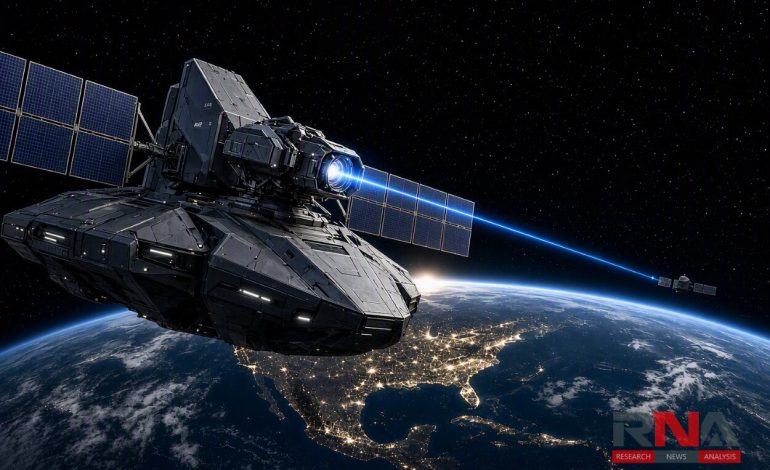

New Delhi: The United States has publicly acknowledged for the first time that it has deployed “on-orbit space control weapons”, marking a significant shift in Washington’s willingness to discuss military capabilities beyond Earth. The US Air Force secretary, Troy Meink, made the disclosure on Monday, while stopping short of revealing the nature, number, location or operational history of the systems.
Speaking at the US Air & Space Forces Association’s Air, Space & Cyber Conference in National Harbor, Maryland, Meink said the United States now possesses space-based weapons intended to defend the joint force against hostile actions by adversaries. He provided no details about when the systems were deployed or whether they are designed to physically destroy other spacecraft, interfere with them electronically or perform another form of space-control mission.
The carefully worded announcement appears to have been designed as much as a strategic signal as a disclosure of capability. Meink indicated that the language had been deliberately considered, while also making clear that revealing technical details would not serve US deterrence objectives.
That distinction matters because “space control” is a broad military term. US doctrine encompasses capabilities intended to protect friendly space systems and to disrupt, degrade or otherwise counter an adversary’s ability to use space, meaning that the phrase does not by itself establish that Washington has placed conventional interceptors or other physically destructive weapons in orbit.
Specialists quoted by US defence publications have therefore cautioned against assuming that the newly acknowledged systems are orbital missiles or other kinetic weapons. Possible categories of counterspace capability include electronic warfare systems and other non-kinetic technologies, although the US government has not confirmed publicly which, if any, of these are involved.
The announcement nevertheless represents a notable change in the public discussion of American space warfare. For years, Washington and other major military powers have acknowledged the growing vulnerability of satellites, while being considerably more guarded about the offensive capabilities that could be used to counter an adversary’s spacecraft.
The disclosure comes as the United States is rapidly expanding its ability to detect, track and respond to activity in orbit. The Space Force has been developing increasingly resilient missile-warning and tracking architectures, including a Medium Earth Orbit constellation, while the Space Development Agency has awarded contracts for additional missile-warning, missile-tracking and missile-defence satellites.
These programmes are part of a wider effort to make American military space infrastructure harder to disrupt in a conflict. US Space Force systems already provide missile warning, space surveillance and tracking, while newer architectures are intended to improve resilience and coverage against increasingly sophisticated threats.
The broader strategic backdrop is the rapid transformation of space from a predominantly supporting domain into a potential theatre of military competition. China and Russia have both developed capabilities that can threaten satellites, while the United States has increasingly emphasized that freedom to operate in space is essential to its military effectiveness and wider economic security.
The development is particularly significant because modern armed forces depend heavily on satellites for communications, navigation, intelligence, missile warning and other functions. A conflict capable of disrupting those systems could therefore affect military operations far beyond the orbital environment itself.
The legal position is more nuanced than the phrase “weapons in space” might suggest. The 1967 Outer Space Treaty prohibits states from placing nuclear weapons or other weapons of mass destruction in orbit or stationing them in outer space, but it does not impose a blanket prohibition on every form of conventional military technology in orbit.
That legal distinction has allowed military space capabilities to expand over decades even as governments have formally supported the principle of peaceful uses of outer space. The greater concern now is whether increasingly explicit counter-space capabilities will contribute to an arms race in which major powers seek to make their satellites more survivable while simultaneously acquiring ways to threaten those of their rivals.
For Washington, the disclosure also fits into a broader effort to establish what officials describe as credible deterrence in space. The underlying message is that an attack on American or allied space infrastructure would not necessarily go unanswered, even though the United States is deliberately keeping the precise nature of its response capabilities secret.
The immediate significance, therefore, lies less in the firepower of any particular unidentified system than in the change in strategic signalling. By acknowledging that operational weapons are already in orbit, Washington has moved the discussion of space warfare from future plans and experimental programmes towards an openly acknowledged military capability.