


Spent SpaceX rocket set to crash into Moon on August 5, Indians can watch it live from noon
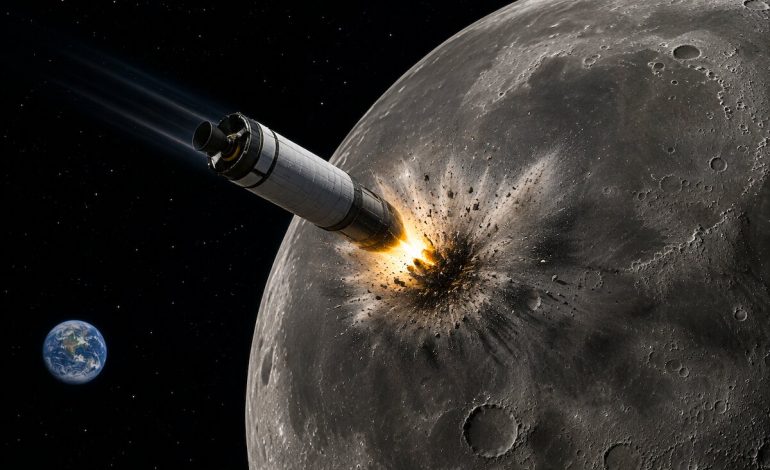
RNA Media illustration for representation.

New Delhi: A discarded upper stage of a SpaceX Falcon 9 rocket is expected to slam into Moon on Wednesday, marking only the second confirmed instance of an artificial object accidentally colliding with the lunar surface. The impact, predicted for around 12.05pm IST, will occur on the side of Moon facing Earth, near the Einstein and Bell craters, and poses no threat to our planet.
The spent rocket body, catalogued as 2025-010D and weighing close to 4,000 kilograms, is travelling at roughly 8,700 kilometres an hour – about seven times the speed of sound. Nasa has confirmed the impact will strike sunlit terrain on Moon’s western limb, gouging out a fresh crater between 20 and 30 metres wide and around five metres deep, and hurling a plume of dust and debris that could rise 75 to 100 kilometres above the surface.
The collision itself will not be visible to the naked eye, and even large telescopes are unlikely to catch the moment of impact. Sensitive instruments, however, may briefly detect the bright ejecta plume against the darkness of space, though scientists caution that visibility will depend heavily on Moon’s position and the geometry of the strike.
The stage originally lifted off from launch complex 39A at the Kennedy Space Centre on January 15, 2025, as part of a Nasa-backed commercial lunar delivery under the agency’s Commercial Lunar Payload Services initiative. It carried two landers: Firefly Aerospace’s Blue Ghost Mission 1, which touched down successfully, and ispace’s Hakuto-R Mission 2, named Resilience, which crash-landed on the surface.
After releasing its payloads, the upper stage was expected to fall back towards Earth and burn up in the atmosphere, as is standard practice. Nasa has said that solar activity and gravitational perturbations instead nudged the stage into an unstable orbit that steadily drew it towards Moon, a trajectory first flagged by the astronomer Bill Gray, who runs the orbit-tracking Project Pluto website, on April 29.
Where and when to watch it live
For readers in India, the window of interest falls close to noon. Multiple tracking sources place the impact between 12.05pm and 12.14pm IST today, corresponding to about 2.35am on the US east coast. Several platforms are running live coverage of the approach and impact.
SpaceTV.net has scheduled dedicated live tracking of the event from around 11am IST, while independent astronomy channels on YouTube are streaming real-time positional data and simulated visuals of the rocket stage closing in on Moon. The crowd-sourced telescope network SkyMapper is also offering free public access to live feeds from observatories worldwide through its SkyViewer platform, allowing viewers without their own equipment to watch alongside professional and amateur astronomers.
It is worth noting that Nasa itself has not organized a dedicated public broadcast, since the event is an unplanned occurrence rather than a scheduled mission milestone. The agency and SpaceX are nonetheless coordinating closely to track the stage and gather data from the collision.
Because the mass, velocity and approximate impact site of the rocket stage are known with unusual precision, researchers see the event as a rare opportunity to calibrate models of lunar cratering and ejecta behaviour. Nasa’s Lunar Reconnaissance Orbiter is expected to photograph the impact site before and after the collision to measure the resulting crater.
South Korea’s Danuri orbiter, also known as the Korea Pathfinder Lunar Orbiter, is expected to pass within a few kilometres of the rocket stage roughly two minutes before impact, offering a rare close-range vantage point. Findings from the collision could inform how space agencies plan the disposal of future rocket stages as lunar traffic increases.
Rare but not unprecedented
This will be only the second confirmed case of rocket debris accidentally striking Moon. The first, in March 2022, was initially attributed to a Falcon 9 booster before Gray himself corrected the record, identifying the object as a Chinese Chang’e 5-T1 rocket body instead.
Unlike that earlier episode, there is no ambiguity this time over the object’s identity. The current stage was tracked from the moment of launch, carries a formal catalogue number, and its orbit has been refined using dozens of independent observations, leaving little doubt about what is about to hit Moon, even as the precise minute of impact remains difficult to pin down.
Julianna Scheiman, the director of SpaceX’s Nasa science and Dragon programmes, told reporters at a briefing on Monday that the company had followed the appropriate rules and regulations for disposing of the Falcon 9 second stage after its mission concluded. The unplanned lunar impact comes at a sensitive moment for the company, which is due to report its first quarterly earnings as a newly public firm following its stock market listing in June, with shares having traded unevenly since.
Humanity has been depositing hardware on Moon since the Soviet Union’s Luna 2 probe made a deliberate crash landing on September 13, 1959, and nearly 70 spacecraft and spent boosters have since soft-landed or crashed there. Nasa itself intentionally crashed a rocket stage into a permanently shadowed crater near the lunar south pole in 2009, a mission that confirmed the presence of water ice – a discovery that continues to shape plans for permanent lunar bases.
Today’s accidental impact adds fresh urgency to a debate that extends well beyond astronomy. As more nations and private companies send hardware towards Moon, including India’s own lunar programme following Chandrayaan-3’s landing near the south pole in 2023, the case for clearer international norms on disposing of spent rocket stages beyond Earth orbit is likely to grow only stronger.