



‘Naughty Boy’: Isro to launch EOS-05, India’s first geosynchronous imaging satellite, on September 4
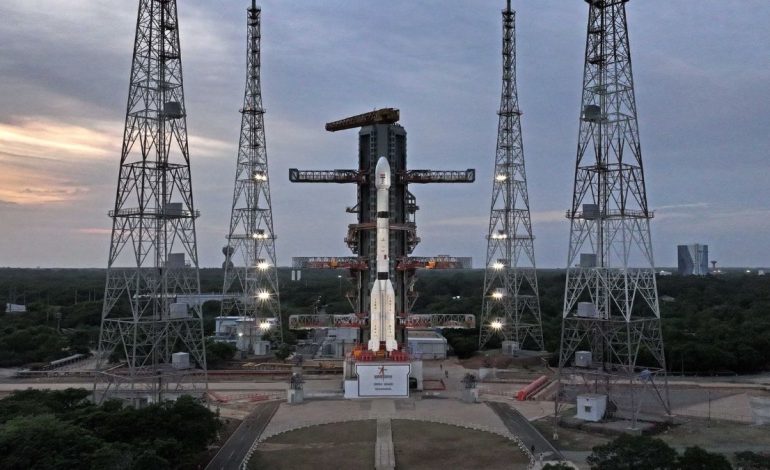
GSLV-F17 set to carry EOS-05 on India’s 19th GSLV flight. Image credit: X/@isro

New Delhi: The Indian Space Research Organization (Isro) is set to launch EOS-05, also known as GISAT-1A, aboard the GSLV-F17 rocket from Sriharikota at 2.55am on Friday. It marks India’s first attempt to place an imaging satellite in geosynchronous orbit – one that stays fixed over the same stretch of the planet rather than circling it.
The rocket will first drop the roughly 2,367kg satellite into a sub-geosynchronous transfer orbit. From there, EOS-05 will use its own thrusters to climb towards its final slot nearly 36,000km up, close to the altitude at which a spacecraft’s orbit matches Earth’s rotation.
Most of India’s Earth-observation satellites – the Cartosat and RISAT series among them – orbit much closer to Earth and pass over any given spot only at intervals.
EOS-05 is built to complement that fleet by staying trained on one broad region continuously. Isro says it will be able to image the entire Indian landmass roughly every 30 minutes, and priority areas as often as every five minutes – frequent enough to track a cyclone, flood or forest fire as it develops, rather than waiting for the next satellite pass.
EOS-05 carries two multispectral imagers and two hyperspectral imagers, built around a 700mm Ritchey-Chretien telescope. One of the multispectral cameras has a resolution of 42 metres per pixel – the sharpest image ever captured from geostationary orbit, according to Isro Spaceflight, which put the improvement at 567 times the pixel density of India’s existing geostationary imaging.
The satellite’s hyperspectral instruments will be the first of their kind flown that far from Earth. Unlike ordinary cameras, which capture light in a handful of broad colour bands, they split it into hundreds of narrow bands – fine enough to flag early signs of crop stress, track soil moisture, or spot changes in vegetation health well before they’re visible to the naked eye, according to GIS Resources.
Isro has pitched EOS-05 mainly as a tool for disaster management and agriculture. That same ability to keep watch over one place has an obvious security use too, several reports have pointed out – a persistent eye on remote or sensitive border regions. Isro has not called EOS-05 a military satellite, though, and continues to describe it as a civilian mission first.
Satellite built to replace failure
EOS-05 exists because of a loss five years ago. Its predecessor, GISAT-1 (officially EOS-03), was meant to give India this same capability back in 2021.
The rocket carrying it lifted off normally on August 12 that year, but its cryogenic upper stage – the final push that sends a satellite towards geostationary orbit – failed to ignite. The satellite never reached orbit, and with it went India’s first shot at a geostationary imaging satellite.
That cryogenic stage carries an older story of its own. According to reports, India tried to buy the technology from Russia in the early 1990s, but the US pushed back hard, citing missile-proliferation rules, and the deal collapsed under sanctions.
Isro built the engine indigenously instead – a years-long effort to master fuel that stays liquid only below −250°C. It’s this same homegrown cryogenic stage, on the rocket’s third and final tier, that failed in 2021 and will fire again on Friday, September 4.
The rocket itself has a chequered reputation to match. GSLV has long carried the nickname “Naughty Boy” inside Isro, earned over a run of early failures before engineers got a handle on the cryogenic stage. GSLV-F17 will be its 19th flight a three-stage rocket standing 51.7 metres tall and weighing about 420.5 tonnes at liftoff. Its first stage pairs a solid-fuel core with four liquid-fuelled strap-on boosters, the second stage runs on liquid propulsion, and the third is that indigenous cryogenic stage.
Launch riding on shaky year
This flight also lands at an anxious moment for Isro. It comes after a gap of more than seven months since the organizations last launch attempt – PSLV-C62, which failed during its third stage on January 12, 2026, destroying the EOS-N1 satellite and 15 others it was carrying. It was the second straight failure for the PSLV, after an earlier one in May 2025 destroyed the EOS-09 satellite.
GSLV, at least, runs on different engines and propulsion systems entirely, so the PSLV’s troubles don’t directly implicate this launch.
GSLV’s own recent record is mixed rather than reassuring. GSLV-F15 lifted off successfully with NVS-02 in January 2025, but the satellite was then stranded in transfer orbit after an oxidiser valve failed to open.
GSLV-F16 fared better. It placed the Isro-Nasa satellite Nisar into orbit successfully in July 2025 – the rocket’s first flight to a sun-synchronous orbit. At roughly $1.5 billion, Nisar is one of the most expensive Earth observation satellites ever built.
According to reports, Isro chairman, V Narayanan, visited the Tirumala temple on Wednesday and placed models of the GSLV-F17 rocket and EOS-05 satellite before the deity, seeking blessings for the mission – a ritual he has performed before several recent launches, including the ones that failed.