



Nasa’s Perseverance rover breaks Mars driving record, can eventually cover 100 kilometres
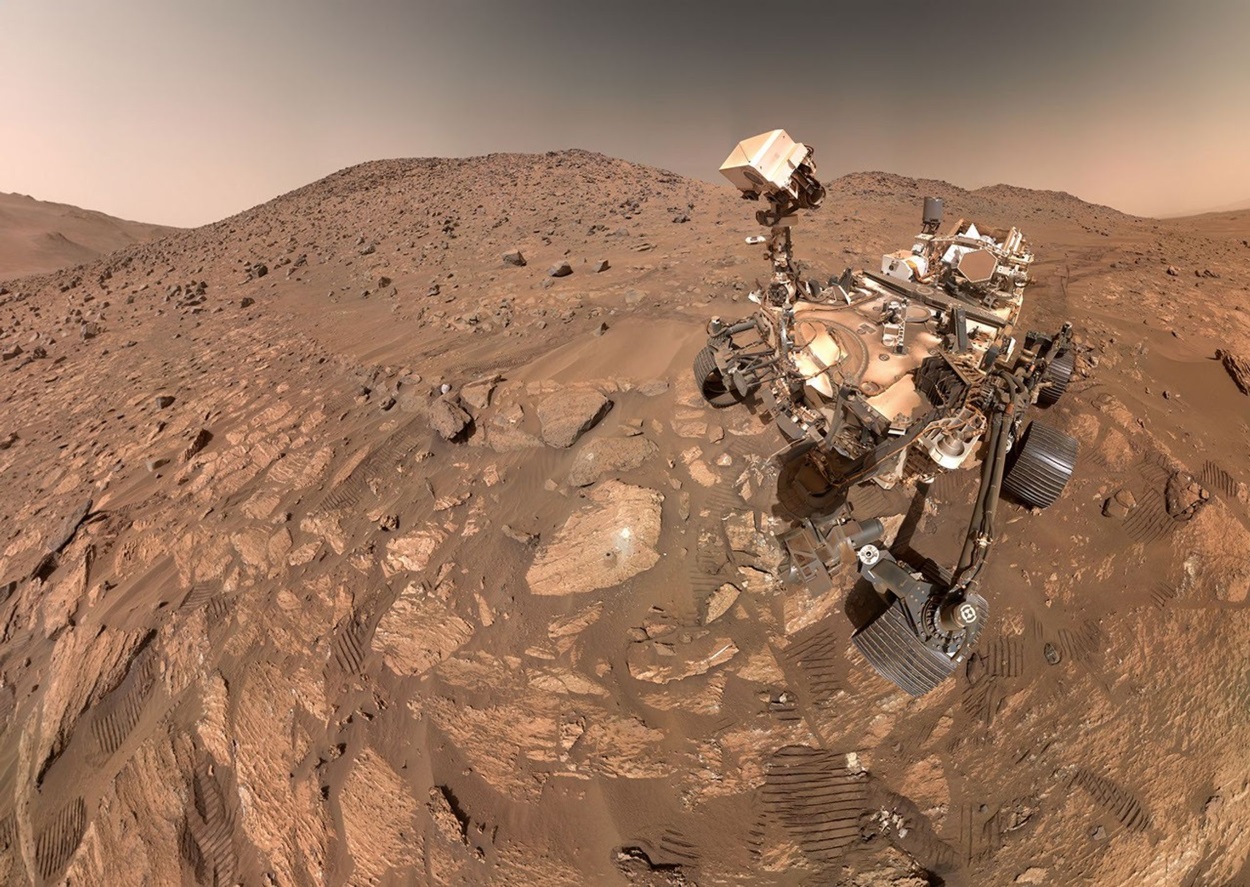
The Perseverance rover on Mars. (Photo: Nasa)

New Delhi: Nasa’s Perseverance rover has become the farthest-travelled vehicle on the surface of any world beyond Earth, overtaking the record held by its predecessor, Opportunity. The milestone comes as the six-wheeled explorer begins an extended mission to investigate ancient Martian rocks, with engineers optimistic that it could eventually cover a total of 100 kilometres.
Perseverance’s odometer reached 45.22 kilometres on Tuesday, exceeding Opportunity’s lifetime distance of 45.16 kilometres. It achieved the feat in about five-and-a-half years, compared with the nearly 15 years during which Opportunity explored Mars between 2004 and 2018.
The record-breaking journey included a 91.31-metre drive while Perseverance was travelling towards a scientific target called Idubi, near Jezero Crater’s western rim. Nasa announced the achievement on October 12, following the rover’s 2,006th Martian day, or sol, on the planet.
The new distance is already more than twice the roughly 20 kilometres envisaged in the rover’s original driving requirements. Its mobility systems remain fully operational, and Nasa has approved a mission extension that began this month and is expected to continue through roughly the end of 2028.
In interviews with Space.com, the rover-navigation specialist, Mark Maimone, said the team believed Perseverance was in sufficiently good condition to reach 100 kilometres overall. That remains an engineering expectation rather than a guaranteed outcome, but it would mean travelling more than twice its current distance.
The mission’s deputy project scientist, Vivian Sun, also told the publication that the rover retained broadly all its original capabilities, particularly its scientific instruments. She attributed its performance to both technological improvements developed across successive Mars missions and close coordination between scientists, engineers and rover operators.
Much of Perseverance’s progress rests on its ability to navigate independently once ground controllers have planned its activities. Rather than requiring Earth-based operators to specify every movement, its software assesses nearby terrain and selects a safe route within the limits they establish.
Nasa’s enhanced autonomous navigation system can examine potential hazards up to about 15 metres ahead, comparing alternative routes and checking how individual wheels would encounter the ground. More than 90 per cent of the rover’s journey has relied on autonomous driving, helping it move efficiently between locations selected for scientific investigation.
That capability has already enabled a single-day drive of approximately 412 metres, completed on June 19, 2025. Separately, extensive tests of corresponding hardware on Earth have given engineers confidence that many of the rover’s systems could support operations until at least 2031, although such assessments cannot eliminate the uncertainties of working on Mars.
Perseverance landed in Jezero Crater on February 18, 2021, to investigate whether ancient Mars possessed environments capable of supporting microbial life. It also collects and seals samples of rock and loose surface material for possible retrieval and detailed examination on Earth by a future mission.
Its current exploration of the Lac de Charmes region, west of the crater rim, takes it into terrain that predates the river and lake deposits inside Jezero. These rocks formed during the young planet’s turbulent history of asteroid bombardment and could help scientists reconstruct how Mars and other rocky planets evolved.
Investigations there have identified rocks associated with cooled lava or magma, others produced by impacts, and some showing evidence of both processes. The terrain also presents practical difficulties: a recent attempt to collect a sample from a light-toned boulder failed because the rock was too hard, prompting the team to search for comparable material elsewhere.
The rover’s earlier discoveries illustrate why access to varied geological settings matters. A sample called Sapphire Canyon, collected from the rock Cheyava Falls in July 2024, contains chemical and mineral features that scientists described as potential biosignatures in a peer-reviewed study published on September 10, 2025.
Those findings do not establish that life existed on Mars, because the relevant minerals can also form through non-biological processes. Researchers need further evidence to distinguish between possible explanations, making the collection of samples from different environments an essential part of the investigation.
Looking ahead, the team plans to continue south along the crater rim towards an area called Rainbow Falls. Sun told Space.com that scientists believe it may contain kaolinite, a clay mineral formed through interactions between water and rock, which could offer further clues to ancient environmental conditions and habitability.