

Isro validates indigenous sea-based tracking system to support Gaganyaan, future space missions
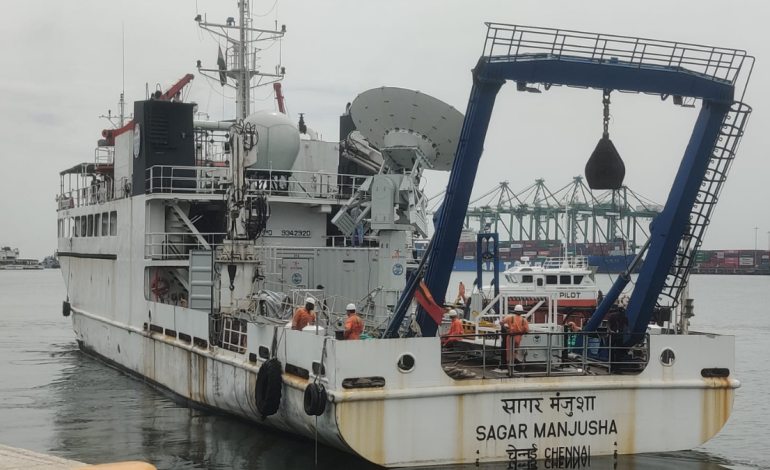
ISRO validates indigenous sea-based tracking system. (Image courtesy: X/@MoesNiot)

New Delhi: The Indian Space Research Organisation (Isro) has expanded its mission support infrastructure by successfully validating an indigenous ship-borne terminal (SBT), a mobile tracking system developed by its telemetry, tracking and command network (Istrac) for launch vehicle, satellite and human spaceflight missions. The validation was carried out aboard the National Institute of Ocean Technology’s (Niot) research vessel Sagar Manjusha off the Chennai coast on Sunday.
The sea trial confirmed the performance of the indigenous terminal under operational maritime conditions, paving the way for its deployment during future space missions that require tracking beyond the reach of India’s ground stations.
Unlike the fixed tracking stations, the ship-borne terminal could be deployed at sea to keep track of the launch vehicle beyond the coverage range of terrestrial stations. The ability to provide uninterrupted tracking of the flight trajectory during the most crucial mission phases in the ocean region where no ground station infrastructure can be established.
The system has also been developed to support satellite tracking whenever spacecraft pass through regions without land-based coverage. By serving as a mobile extension of Isro’s tracking network, the terminal will improve mission support across remote oceanic stretches and other inaccessible areas.
MoES Niot said the indigenous capability will also support the Gaganyaan programme by providing tracking during different phases of India’s first human spaceflight mission. Continuous monitoring of the launch vehicle and crew module is considered essential for mission operations, and the sea-based terminal will complement the agency’s existing ground tracking assets.
The successful validation was carried out using NIOT’s research vessel Sagar Manjusha, demonstrating the terminal’s ability to operate effectively from a moving maritime platform. The exercise highlighted the collaboration between Istrac and Niot in strengthening India’s space mission support capabilities.
According to Isro, the addition of the ship-borne terminal enhances the country’s operational flexibility for launch campaigns, satellite missions and future deep-space and human spaceflight programmes while reinforcing India’s growing indigenous capabilities in critical space infrastructure.