


Growing satellite fleets threaten scientific viewing of Universe, study warns
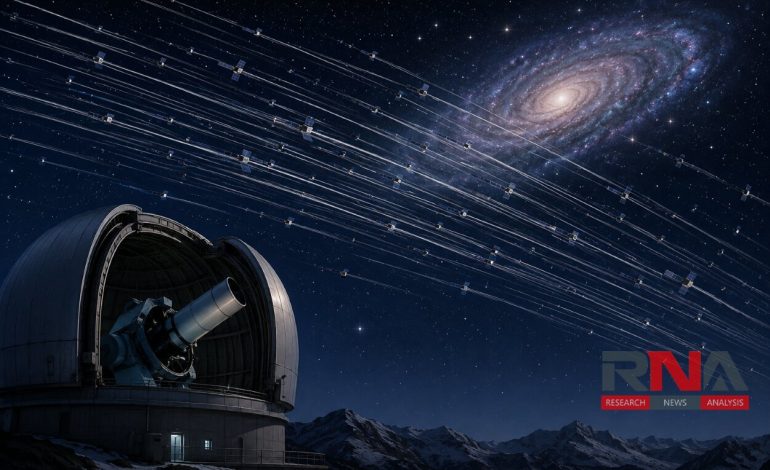
RNA Media illustration for representation.

New Delhi: The rapid expansion of satellite constellations could seriously impair astronomers’ ability to study distant galaxies, potentially hazardous asteroids and planets beyond the solar system, according to new research. The warning comes as companies and state-backed operators pursue proposals that, if fully implemented, would place more than 1.7 million additional satellites in Earth’s orbit.
Around 15,000 satellites are presently in orbit, compared with only a few thousand before the commercial satellite industry began expanding sharply in 2019. The figure rises to approximately 32,000 when defunct spacecraft and catalogued debris are included, according to the European Southern Observatory.
Much of the increase has been driven by low-Earth-orbit communications networks such as SpaceX’s Starlink and Amazon Leo, which are designed to deliver high-speed internet services across large geographical areas. More ambitious filings include SpaceX’s proposal for up to one million orbital data-centre satellites, alongside substantial constellations planned by E-Space and Chinese operators.
The study by the ESO astronomer, Olivier Hainaut, examined how satellites of different sizes, brightness levels and orbital configurations would affect ground-based optical observations. Its computer simulations reproduced their movement and visibility above the Paranal Observatory in Chile’s Atacama Desert, which houses ESO’s Very Large Telescope.
An individual satellite crossing a telescope’s field of view creates a luminous streak that can conceal or distort the faint celestial object being observed. Although one such trail may destroy only a small section of an image, hundreds or thousands of crossings can erase substantial quantities of scientific data and complicate the processing of whatever remains.
The problem is not restricted to visible lines across astronomical photographs. Light reflected from large numbers of satellites can scatter through the atmosphere or combine into a diffuse artificial glow, raising the brightness of the entire night sky and reducing the contrast needed to detect extremely faint objects.
Hainaut’s simulations indicated that a proposed constellation of one million relatively faint satellites could produce dozens of trails in each image taken by the Very Large Telescope during the early hours of the night. For some of its instruments, the resulting loss of usable field of view could reach 28 per cent even if the satellites remained below naked-eye visibility.
Wide-field survey telescopes would be particularly exposed because they photograph much larger sections of the sky in each observation. A satellite trail bright enough to saturate a sensitive detector can also create electronic artefacts and secondary trails, potentially contaminating far more of an image than the satellite’s apparent path alone.
The most disruptive proposals involve exceptionally bright spacecraft designed to reflect sunlight towards Earth. The US company Reflect Orbital has proposed deploying as many as 50,000 mirror satellites by 2035, a fleet that the study estimated could make the overall night sky three to four times brighter when fully illuminated.
Under the modelling assumptions, a mirror satellite directing its beam towards an observer could appear several times brighter than the full Moon. Even when its principal beam was pointed elsewhere, its reflected light could resemble the brightness of Venus and interfere with observations from some of the world’s darkest locations.
The research suggested that astronomy could continue operating with tolerable losses if the total satellite population remained below approximately 100,000 and every spacecraft was fainter than visual magnitude seven. That figure is not presented as an absolute safety boundary, but as a practical ceiling below which observational losses would remain broadly comparable with downtime caused by equipment failures and other technical problems.
Previous research has indicated that shifting astronomy into orbit would not necessarily solve the difficulty. A Nature study on space-based observatories estimated that, if about 560,000 proposed satellites were deployed, nearly 40 per cent of Hubble Space Telescope images and more than 92 per cent of exposures from some lower-orbit observatories could contain at least one satellite trail.
Implications for India
The implications extend to India because satellites pass over observatories worldwide, irrespective of domestic restrictions on ground-level light pollution. Researchers examining 10 nights of commissioning observations from the four-metre International Liquid Mirror Telescope at Devasthal detected 83 orbital-object streaks, while the Indian Astronomical Observatory at Hanle depends on the exceptionally dark skies of Ladakh for sensitive observations.
Astronomers acknowledge that satellite networks can expand internet access, support communications and strengthen disaster-response capabilities. They argue, however, that satellite operators should reduce spacecraft brightness, share accurate orbital data and design constellations in consultation with observatories so that technological expansion does not permanently diminish access to the night sky.
SpaceX has previously experimented with coatings, sunshades and changes in spacecraft orientation to reduce the apparent brightness of Starlink satellites, but researchers say engineering modifications alone cannot compensate for fleets numbering in the hundreds of thousands. The central regulatory question is therefore no longer confined to how individual satellites should be designed, but how many spacecraft Earth’s orbital environment and astronomical science can reasonably accommodate.