



Euclid telescope maps 900 million galaxies in historic survey. Can it finally unravel the dark universe?
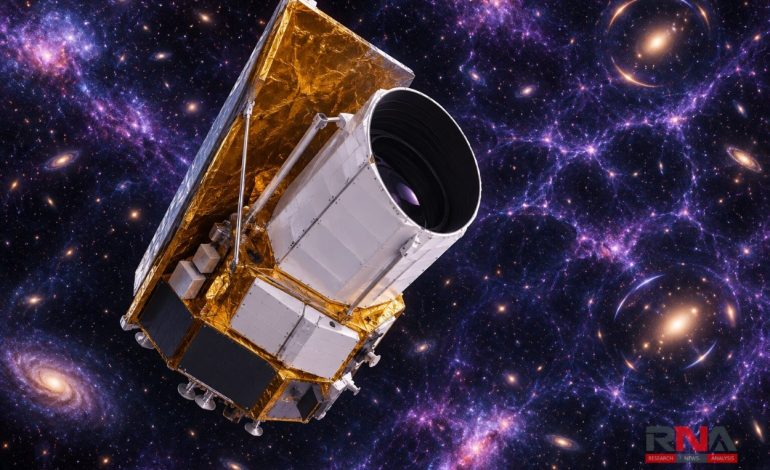
RNA Media illustration featuring the Euclid telescope surveying the cosmic web for representation.

New Delhi: The European Space Agency has unveiled an extraordinary cosmic survey containing more than 900 million galaxies, marking a major advance in humanity’s effort to understand the invisible forces governing the universe. The findings, released on November 12, 2026, by the agency’s Euclid space telescope mission, could help scientists investigate the nature of dark matter and dark energy – two mysterious components believed to account for approximately 95 per cent of the universe.
The first major public data release, designated DR1-Foundation, contains approximately 1.7 petabytes of astronomical information collected over more than a year of observations. Covering nearly 1,900 square degrees of sky, the dataset represents about 14 per cent of Euclid’s planned survey and includes detailed images, measurements and spectra of distant celestial objects.
Perhaps its most striking discovery is the identification of approximately 15,000 potential instances of strong gravitational lensing, a phenomenon in which the gravity of massive foreground objects bends light travelling from galaxies farther away. Before Euclid’s observations, astronomers had identified only about 1,000 such systems, making the new collection an important resource for investigating the distribution of matter throughout the cosmos.
The survey has also identified more than 60 million potential quasars – exceptionally luminous galactic cores powered by supermassive black holes consuming surrounding material. Together with spectra from more than 160 million sources, these observations provide scientists with an enormous database for reconstructing the universe’s development across billions of years.
Why the discovery matters
Although astronomers can observe countless galaxies, stars and other celestial objects, everything made of ordinary matter accounts for only about five per cent of the universe’s total mass-energy content. According to the prevailing cosmological model, dark matter contributes approximately 25 per cent, while dark energy accounts for nearly 70 per cent, although neither has been directly identified in the laboratory.
Dark matter is believed to provide much of the gravitational framework around which galaxies and galaxy clusters form, preventing their observed motions from being explained by visible matter alone. Dark energy, meanwhile, is the name given to the unknown component associated with the accelerating expansion of the universe, first established through observations of distant supernovae in the late 1990s.
Euclid seeks to investigate both mysteries by examining how galaxies are distributed, how their shapes are distorted by gravity and how cosmic structures have evolved over approximately 10 billion years. Its observations could help determine whether existing theories adequately explain the universe or whether scientists need to reconsider fundamental assumptions about gravity and cosmic expansion.
Gravitational lensing is particularly valuable because it allows astronomers to estimate the presence and distribution of matter that cannot be observed directly. When a massive galaxy or galaxy cluster lies between Earth and a more distant object, its gravitational field distorts spacetime, bending the background light into arcs, rings or multiple images.
Scientists can measure these distortions to reconstruct the gravitational influence of foreground structures, including their invisible dark matter. Different theoretical models predict different patterns of dark matter clustering, meaning Euclid’s discoveries could help researchers distinguish between competing explanations.
The mission combines an unusually wide field of view with high-resolution imaging, allowing it to examine vast regions of space without sacrificing the detail needed for precision measurements. According to the ESA’s mission overview, its images are at least four times sharper than those obtained through conventional ground-based sky surveys.
What comes next?
Launched aboard a SpaceX Falcon 9 rocket on July 1, 2023, Euclid operates near the Sun-Earth Lagrange point L2, approximately 1.5 million kilometres from Earth. The European-led mission, which includes significant NASA participation, is designed to survey more than one-third of the sky and construct an exceptionally detailed three-dimensional representation of the universe.
Its two principal instruments observe visible and near-infrared light, enabling astronomers to study galaxy shapes, estimate distances and investigate the formation of large-scale cosmic structures. The resulting map will trace the vast network of galaxies, clusters, filaments and relatively empty regions commonly described as the cosmic web.
However, the November release does not establish what dark matter or dark energy actually are, and its gravitational-lensing candidates require further scientific assessment. The next major release, scheduled for mid-2027, is expected to include more advanced measurements of galaxy clustering and weak gravitational lensing – the subtle distortions that can reveal the distribution of dark matter across enormous cosmic distances.
Euclid’s eventual findings could also be compared with results from other major cosmological investigations, including the Dark Energy Spectroscopic Instrument, which independently studies the expansion history of the universe. Such comparisons will be important in testing whether dark energy behaves as a constant property of space or changes over cosmic time.
For now, Euclid’s achievement is principally one of unprecedented observational scale rather than a definitive scientific breakthrough about the universe’s invisible components. Nevertheless, by making enormous quantities of detailed cosmic information available to researchers worldwide, the mission has substantially expanded the evidence through which some of modern physics’ most fundamental questions can be investigated.